
Key takeaway: This AP calculus differential equations lesson shows how an equation about a derivative describes an unknown function. You will verify a proposed solution by substitution, read a slope field to sketch a curve, and solve separable equations with an initial value. Exponential growth and decay follow from \(\frac{dy}{dx}=ky\), whose solution is \(y=y_0e^{kx}\). The notes cover the AB differential equations unit from the first check to the final model.
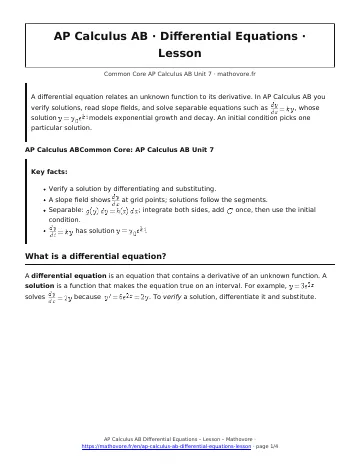
A differential equation relates an unknown function to its derivative. In AP Calculus AB you verify solutions, read slope fields, and solve separable equations such as \(\frac{dy}{dx}=ky\), whose solution \(y=y_{0}e^{kt}\) models exponential growth and decay. An initial condition picks one particular solution.
AP Calculus Differential Equations Lesson: key facts
- Verify a solution by differentiating and substituting.
- A slope field shows \(\frac{dy}{dx}\) at grid points; solutions follow the segments.
- Separable: \(g(y)\,dy=h(x)\,dx\); integrate both sides, add \(C\) once, then use the initial condition.
- \(\frac{dy}{dt}=ky\) has solution \(y=y_{0}e^{kt}\).
What is a differential equation?
A differential equation is an equation that contains a derivative of an unknown function. A solution is a function that makes the equation true on an interval. For example, \(y=3e^{2x}\) solves \(\frac{dy}{dx}=2y\) because \(y^{\prime}=6e^{2x}=2y\). To verify a solution, differentiate it and substitute.
General solution: a family of functions with an arbitrary constant \(C\).
Initial condition: a point \((a,b)\) on the graph, written \(y(a)=b\). It picks one particular solution.
Slope field: short segments drawn at grid points \((x,y)\) with slope \(\frac{dy}{dx}\) from the equation.
How do slope fields help?
At every grid point, substitute \(x\) and \(y\) into \(\frac{dy}{dx}\) and draw a short segment with that slope. A solution curve follows the segments. In the field above, \(\frac{dy}{dx}=x-y\) is zero on the line \(y=x\), so segments there are horizontal. If the slope depends only on \(x\), the segments in each vertical column are parallel. If it depends only on \(y\), the segments in each horizontal row are parallel.
How does separation of variables work?
An equation is separable when it can be written as \(g(y)\,dy=h(x)\,dx\).
Worked example. Solve \(\frac{dy}{dx}=2xy\) with \(y(0)=3\).
- Separate: \(\frac{1}{y}\,dy=2x\,dx\).
- Integrate: \(\ln|y|=x^{2}+C\).
- Solve: \(y=Ae^{x^{2}}\), where \(A=\pm e^{C}\).
- Use \(y(0)=3\): \(3=Ae^{0}\), so \(A=3\) and \(y=3e^{x^{2}}\).
Always include the constant on one side before you use the initial condition. Forgetting it is a classic way to lose points on the AP exam.
What are exponential growth and decay?
When a quantity changes at a rate proportional to its size, \(\frac{dy}{dt}=ky\), the solution is \(y=y_{0}e^{kt}\). Growth means \(k>0\); decay means \(k<0\).
| Model | Equation | Solution |
|---|---|---|
| Exponential change | \(\frac{dy}{dt}=ky\) | \(y=y_{0}e^{kt}\) |
| Doubling time \(T\) | \(k=\frac{\ln 2}{T}\) | \(y=y_{0}\cdot 2^{t/T}\) |
| Newton cooling | \(\frac{dT}{dt}=k(T-T_{s})\) | \(T=T_{s}+(T_{0}-T_{s})e^{kt}\) |
A cooling object follows the third row: its temperature moves toward the surrounding temperature \(T_{s}\), never past it.
Differential Equations: frequently asked questions
What is a differential equation in AP Calculus AB?
It is an equation relating a function to one or more of its derivatives, such as \(\frac{dy}{dx}=x-y\). A solution is a function that satisfies the equation, and an initial condition selects one particular solution.
How do you verify that a function is a solution?
Differentiate the function, then substitute both the function and its derivative into the equation. If both sides simplify to the same expression, the function is a solution. Also check any initial condition.
What does a slope field show?
A slope field shows the slope \(\frac{dy}{dx}\) at many points. Solution curves follow the segments, so you can sketch a solution through a given point without solving the equation.
When can you use separation of variables?
You can use it when all the \(y\) factors can be moved to one side with \(dy\) and all the \(x\) factors to the other side with \(dx\). Then you integrate both sides and add one constant \(C\).
Why is the solution of dy/dt = ky exponential?
Separating gives \(\frac{1}{y}\,dy=k\,dt\), so \(\ln|y|=kt+C\) and \(y=y_{0}e^{kt}\). The rate of change is proportional to the amount, so the amount grows or decays by a constant factor in equal time intervals.
How do you verify that a function solves an equation?
Differentiate the candidate and substitute both into the equation. For \(y=3e^{2x}\), the derivative is \(6e^{2x}\), which equals \(2y\). Therefore the equation \(\frac{dy}{dx}=2y\) holds for every \(x\). Always test the initial condition separately.
What does a slope field show?
Each small segment gives the slope \(\frac{dy}{dx}\) at its grid point. For \(\frac{dy}{dx}=xy-1\) at \((2,3)\), the slope is 5, so the segment is steep. A solution curve follows the segments and never crosses one at a different angle.
How does separation of variables work in an AP calculus differential equations lesson?
Move all \(y\) terms to one side and all \(x\) terms to the other. From \(\frac{dy}{dx}=\frac{x}{y^2}\), the first step is \(y^2\,dy=x\,dx\). Then integrate both sides and add one constant. Finally, use the starting point to find that constant before you solve for \(y\).
Why does exponential decay need a negative constant?
The rate must point downward. With \(\frac{dy}{dt}=ky\) and a half-life of 10 years, \(k=-\frac{\ln2}{10}\). In contrast, a doubling time gives a positive constant. As a result, the sign of \(k\) tells growth from decay at a glance.
Which routine builds confidence with these equations?
Write the five-step plan on an index card: separate, integrate, add the constant, apply the starting value, solve for \(y\). Next, solve one growth model and one separable equation each day. Finally, sketch a slope field by hand for a simple equation, so the picture connects to the algebra.

See every chapter on the AP Calculus AB math page.