


This ap calculus differential equations worksheet gives 24 problems on differential equations, ordered from easy to hard, with a separate answer key.
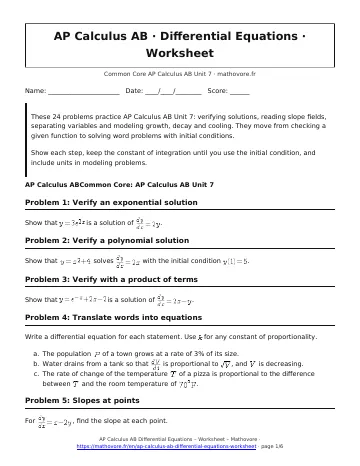
These 24 problems practice AP Calculus AB Unit 7: verifying solutions, reading slope fields, separating variables and modeling growth, decay and cooling. They move from checking a given function to solving word problems with initial conditions.
Show each step, keep the constant of integration until you use the initial condition, and include units in modeling problems.
AP Calculus Differential Equations Worksheet: problems 1–5
Problem 1: Verify an exponential solution
Show that \(y=3e^{2x}\) is a solution of \(\frac{dy}{dx}=2y\).
Problem 2: Verify a polynomial solution
Show that \(y=x^{2}+4\) solves \(\frac{dy}{dx}=2x\) with the initial condition \(y(1)=5\).
Problem 3: Verify with a product of terms
Show that \(y=e^{-x}+2x-2\) is a solution of \(\frac{dy}{dx}=2x-y\).
Problem 4: Translate words into equations
Write a differential equation for each statement. Use \(k\) for any constant of proportionality.
- The population \(P\) of a town grows at a rate of 3% of its size.
- Water drains from a tank so that \(\frac{dV}{dt}\) is proportional to \(\sqrt{V}\), and \(V\) is decreasing.
- The rate of change of the temperature \(T\) of a pizza is proportional to the difference between \(T\) and the room temperature of \(70^{\circ}\text{F}\).
Problem 5: Slopes at points
For \(\frac{dy}{dx}=x-2y\), find the slope at each point.
- \((0,0)\)
- \((1,0)\)
- \((2,1)\)
- \((1,-1)\)
- \((-2,3)\)
AP Calculus Differential Equations Worksheet: problems 6–10
Problem 6: Match a slope field
The slope field shows one of three equations: \(\frac{dy}{dx}=x\), \(\frac{dy}{dx}=y\) or \(\frac{dy}{dx}=x+y\). Identify the equation and explain how you know.
Problem 7: Sketch and solve from a slope field
The slope field is for \(\frac{dy}{dx}=\frac{y}{2}\).
- Sketch the solution curve through \((0,1)\).
- Find the particular solution with \(y(0)=1\).
Problem 8: Separable with a power
Solve \(\frac{dy}{dx}=4x^{3}\) with \(y(1)=3\).
Problem 9: Exponential initial value problem
Solve \(\frac{dy}{dx}=3y\) with \(y(0)=5\).
Problem 10: Separable with a quotient
Solve \(\frac{dy}{dx}=\frac{3x^{2}}{y}\) with \(y(0)=2\).
AP Calculus Differential Equations Worksheet: problems 11–15
Problem 11: Separable with a product
Solve \(\frac{dy}{dx}=xy\) with \(y(0)=3\).
Problem 12: Solution with a restricted domain
Solve \(\frac{dy}{dx}=2xy^{2}\) with \(y(0)=1\). State the largest open interval containing \(0\) on which the solution is defined.
Problem 13: Separable with an exponential
Solve \(\frac{dy}{dx}=\frac{e^{x}}{y^{2}}\) with \(y(0)=1\).
Problem 14: Exponential growth
A bacteria culture has \(P(0)=500\) cells and satisfies \(\frac{dP}{dt}=0.2P\), where \(t\) is in hours. Find \(P(t)\), then find \(P(5)\) to the nearest whole cell.
Problem 15: Exponential decay and time
A sample of mass \(m\) grams satisfies \(\frac{dm}{dt}=-0.05m\), where \(t\) is in years, and \(m(0)=80\). When will the mass be 40 grams? Round to the nearest hundredth.
AP Calculus Differential Equations Worksheet: problems 16–20
Problem 16: Half-life
A radioactive isotope has a half-life of 12 years. A sample starts with 200 mg.
- Find the constant \(k\) in \(\frac{dm}{dt}=km\). Round to four decimal places.
- Find the mass remaining after 30 years, to the nearest hundredth of a milligram.
Problem 17: Doubling time
A population of insects starts at 1,000 and doubles every 8 hours. Assuming \(\frac{dP}{dt}=kP\), find the population after 20 hours, to the nearest whole insect.
Problem 18: Continuous compounding
An account holds \$2,000 and grows by \(\frac{dA}{dt}=0.05A\), where \(t\) is in years. Find the balance after 10 years, to the nearest cent.
Problem 19: Newton cooling
A cup of coffee at \(190^{\circ}\text{F}\) sits in a \(70^{\circ}\text{F}\) room and satisfies \(\frac{dT}{dt}=-0.1(T-70)\), where \(t\) is in minutes. Find \(T(t)\) and the temperature after 10 minutes, to the nearest tenth of a degree.
Problem 20: Tangent line and concavity
Let \(y=f(x)\) satisfy \(\frac{dy}{dx}=x+y\) with \(f(0)=1\).
- Write the tangent line at \(x=0\) and use it to estimate \(f(0.2)\).
- Find \(\frac{d^{2}y}{dx^{2}}\) at \((0,1)\). Is the estimate too large or too small?
AP Calculus Differential Equations Worksheet: problems 21–24
Problem 21: Homogeneous-style separation
Solve \(\frac{dy}{dx}=\frac{y}{x}\) for \(x>0\) with \(y(2)=6\).
Problem 22: Draining tank
A tank holds 100 gallons and drains so that \(\frac{dV}{dt}=-\frac{1}{2}\sqrt{V}\), where \(t\) is in minutes. Find \(V(t)\) and the time when the tank is empty.
Problem 23: Population of a town
A town has 20,000 residents. Its population satisfies \(\frac{dP}{dt}=kP\), and it grows to 24,000 residents after 4 years. Find the population after 10 years, to the nearest 10 residents.
Problem 24: Medicine in the bloodstream
The concentration \(C\) of a drug in the blood satisfies \(\frac{dC}{dt}=-0.2C\), where \(t\) is in hours. The initial dose gives \(C(0)=50\) mg. How long until \(C=10\) mg? Round to the nearest hundredth of an hour.

How to use this ap calculus differential equations worksheet
Print this ap calculus differential equations worksheet as a PDF, solve every problem on paper, then compare with the answer key.

See every chapter on the AP Calculus AB math page.