

Key takeaway: This AP calculus analyzing functions lesson shows how the first and second derivatives reveal the shape of a graph. The sign of \(f’\) tells you where a function rises or falls, while the sign of \(f”\) gives concavity. Critical numbers, inflection points and the Mean Value Theorem then organize the full picture. The notes match AP Calculus AB Unit 5 and finish with the Candidates Test for absolute extrema.
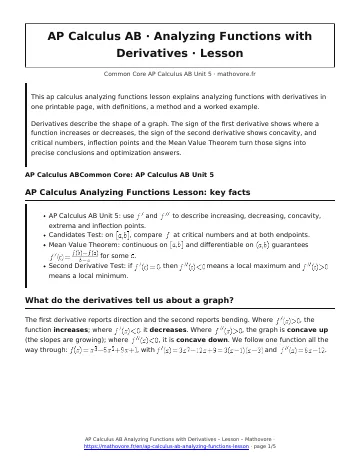
Derivatives describe the shape of a graph. The sign of the first derivative shows where a function increases or decreases, the sign of the second derivative shows concavity, and critical numbers, inflection points and the Mean Value Theorem turn those signs into precise conclusions and optimization answers.
AP Calculus Analyzing Functions Lesson: key facts
- AP Calculus AB Unit 5: use \(f^{\prime}\) and \(f^{\prime\prime}\) to describe increasing, decreasing, concavity, extrema and inflection points.
- Candidates Test: on \([a,b]\), compare \(f\) at critical numbers and at both endpoints.
- Mean Value Theorem: continuous on \([a,b]\) and differentiable on \((a,b)\) guarantees \(f^{\prime}(c)=\frac{f(b)-f(a)}{b-a}\) for some \(c\).
- Second Derivative Test: if \(f^{\prime}(c)=0\), then \(f^{\prime\prime}(c) < 0\) means a local maximum and \(f^{\prime\prime}(c) > 0\) means a local minimum.
What do the derivatives tell us about a graph?
The first derivative reports direction and the second reports bending. Where \(f^{\prime}(x) > 0\), the function increases; where \(f^{\prime}(x) < 0\), it decreases. Where \(f^{\prime\prime}(x) > 0\), the graph is concave up (the slopes are growing); where \(f^{\prime\prime}(x) < 0\), it is concave down. We follow one function all the way through: \(f(x)=x^{3}-6x^{2}+9x+1\), with \(f^{\prime}(x)=3x^{2}-12x+9=3(x-1)(x-3)\) and \(f^{\prime\prime}(x)=6x-12\).
How do the first and second derivative tests work?
The First Derivative Test looks at the sign of \(f^{\prime}\) on both sides of a critical number \(c\): a change from \(+\) to \(-\) gives a local maximum, a change from \(-\) to \(+\) gives a local minimum, and no change gives neither. The Second Derivative Test needs only \(f^{\prime}(c)=0\): if \(f^{\prime\prime}(c) < 0\) there is a local maximum, if \(f^{\prime\prime}(c) > 0\) a local minimum, and if \(f^{\prime\prime}(c)=0\) the test fails. A point of inflection is where the concavity changes. For our function, \(f^{\prime\prime}(1)=-6\) and \(f^{\prime\prime}(3)=6\), and \(f^{\prime\prime}\) changes sign at \(x=2\).
What do the Extreme Value and Mean Value Theorems guarantee?
Mean Value Theorem: if \(f\) is continuous on \([a,b]\) and differentiable on \((a,b)\), some \(c\) in \((a,b)\) has \(f^{\prime}(c)=\dfrac{f(b)-f(a)}{b-a}\).
On \([0,4]\) our function has \(f(0)=1\) and \(f(4)=5\), so the average rate of change is \(\frac{5-1}{4}=1\). Solving \(3x^{2}-12x+9=1\) gives \(c=2\pm\frac{2\sqrt{3}}{3}\), and both values lie in \((0,4)\).
How do you find absolute extrema and solve optimization problems?
Use the Candidates Test on a closed interval:
- Find every critical number inside the interval.
- Evaluate \(f\) at those numbers and at both endpoints.
- The largest value is the absolute maximum and the smallest is the absolute minimum.
On \([-1,4]\) the candidates are \(x=-1,1,3,4\):
| \(x\) | \(-1\) | \(1\) | \(3\) | \(4\) |
|---|---|---|---|---|
| \(f(x)\) | \(-15\) | \(5\) | \(1\) | \(5\) |
The absolute minimum is \(-15\) at \(x=-1\); the absolute maximum is \(5\), reached at both \(x=1\) and \(x=4\). Optimization works the same way: write the quantity as a function of one variable, state its domain, differentiate, and justify with the Candidates Test or a derivative test. Finally, the graph of \(f^{\prime}\) tells the whole story of \(f\), because its zeros are critical numbers and its lowest point marks the inflection.
Analyzing Functions with Derivatives: frequently asked questions
What is the difference between a critical number and a point of inflection?
A critical number is where \(f^{\prime}\) is zero or undefined and is a candidate for a local extremum. A point of inflection is where the concavity changes, which happens where \(f^{\prime\prime}\) changes sign.
If f prime of c equals 0, must f have a maximum or minimum at c?
No. For \(f(x)=x^{3}\) we have \(f^{\prime}(0)=0\), yet \(f^{\prime}\) is positive on both sides, so there is no extremum. You need a sign change in \(f^{\prime}\) or the sign of \(f^{\prime\prime}\).
When can I use the Mean Value Theorem?
Only when the function is continuous on the closed interval and differentiable on the open interval. On the exam, state both conditions before you claim that a value \(c\) exists.
Why must the Candidates Test include the endpoints?
An absolute extremum on a closed interval can occur at an endpoint where the derivative is not zero. Skipping the endpoints can miss the true maximum or minimum.
How should I justify an answer on the free-response section?
Name the test and cite the evidence: for example, “\(f^{\prime}\) changes from positive to negative at \(x=1\), so \(f\) has a local maximum there.” A bare number without a reason earns no justification point.
How do you find critical numbers and intervals of increase?
Take \(f(x)=x^3+3x^2-9x\). Its derivative is \(3(x+3)(x-1)\), so the critical numbers are \(-3\) and \(1\). Then test one point in each interval. The derivative is positive left of \(-3\), negative between the two numbers, and positive after 1. Therefore \(f\) has a local maximum at \(-3\).
What do concavity and inflection points show in an AP calculus analyzing functions lesson?
For \(f(x)=x^3-6x^2+2x\), the second derivative is \(6x-12\). It changes sign at \(x=2\), so that point is an inflection point. However, a zero second derivative alone is not enough. The function \(x^4\) has \(f”(0)=0\), yet the concavity never changes.
When does the Mean Value Theorem apply?
You need continuity on \([a,b]\) and differentiability on \((a,b)\). For \(f(x)=x^3\) on \([0,2]\), the average slope is 4. Setting \(3c^2=4\) gives \(c=\frac{2\sqrt{3}}{3}\). In contrast, \(|x-2|\) fails at the corner, so no guarantee exists there.
How does the Candidates Test find absolute extrema?
Compare the function at every critical number and at both endpoints. On \([0,5]\), the function \(x^2-6x+4\) has values 4, \(-5\) and \(-1\) at the key inputs 0, 3 and 5. As a result, the absolute maximum is 4.
Which analysis habits pay off on the AP exam?
Write the sign chart for \(f’\) and for \(f”\) on one number line, and label each interval with a reason. Next, always state the theorem by name when you justify an answer. Finally, practice one optimization problem each day until setup feels automatic.

See every chapter on the AP Calculus AB math page.