Key takeaway: This AP calculus derivative rules quiz poses ten items on the limit definition, the power rule, product and quotient rules, trig derivatives, tangent lines and graphs. Exactly one option is right each time, and the explanation names a common error. Three items include a figure. Allow a short quarter hour, and read your total as a checkpoint before test day.
This 10-question multiple choice quiz checks the limit definition, differentiability, the power, product and quotient rules, and trig, exponential and logarithmic derivatives. Pick the one correct answer for each question, then read the explanation to learn from any miss.
Question 1
Question 2
Question 3
Question 4
Question 5
Question 6
Question 7
Question 8
Question 9
Question 10
🎉 Quiz complete!
Remember:
- AP Calculus AB Unit 2: \(f^{\prime}(a)=\lim_{h\to 0}\frac{f(a+h)-f(a)}{h}\) is the slope of the tangent line at \(x=a\).
- Average rate of change on \([a,b]\) is \(\frac{f(b)-f(a)}{b-a}\), the slope of a secant line.
- Power rule: \(\frac{d}{dx}x^{n}=nx^{n-1}\). Product rule: \((fg)^{\prime}=f^{\prime}g+fg^{\prime}\). Quotient rule: \((\frac{f}{g})^{\prime}=\frac{f^{\prime}g-fg^{\prime}}{g^{2}}\).
- A function is not differentiable at a corner, cusp, vertical tangent or discontinuity; differentiable implies continuous.
- \(\frac{d}{dx}\sin x=\cos x\), \(\frac{d}{dx}\cos x=-\sin x\), \(\frac{d}{dx}e^{x}=e^{x}\), \(\frac{d}{dx}\ln x=\frac{1}{x}\).
What do the first three items review?
Item 1 reads the slope of a tangent line at \((2,2)\), which is 2. Item 2 picks the limit definition, so the correct option has \(f(x+h)-f(x)\) over \(h\). Next, item 3 rewrites \(4\sqrt{x}\) as \(4x^{1/2}\), which gives \(\frac{2}{\sqrt{x}}\).
How do you solve the product and quotient items in the AP calculus derivative rules quiz?
For item 4, \(f'(x)=e^x(x^2+2x)\), so \(f'(1)=3e\). Item 5 gives \(\frac{2}{(x+2)^2}\) because the numerator simplifies to \((x+2)-x=2\). Wrong options often keep a minus sign or skip squaring the denominator.
How do items 6 to 9 test trig and graphs?
The derivative of \(3\cos x\) is \(-3\sin x\), so item 6 gives \(-\frac{3}{2}\) at \(\frac{\pi}{6}\). Item 7 asks for the corner in a graph, at \(x=1\). In item 8, \(\csc x\) becomes \(-\csc x\cot x\). Item 9 estimates a slope from points around \(x=3\), and the result is 2.25.
What is the trick in item 10?
The tangent to \(e^{2x}\) at 0 passes through \((0,1)\) with slope 2. Therefore its equation is \(y=2x+1\), not \(y=2x\).
Which topic should you review after the quiz?
If items 4 and 5 failed, practice three product problems and three quotient problems with a written template. If graph items failed, sketch a corner, a cusp and a smooth curve. Afterward, retry the quiz and compare scores.

Printable PDF · Quiz
AP Calculus AB Definition of the Derivative and Basic Rules quiz
Download the PDF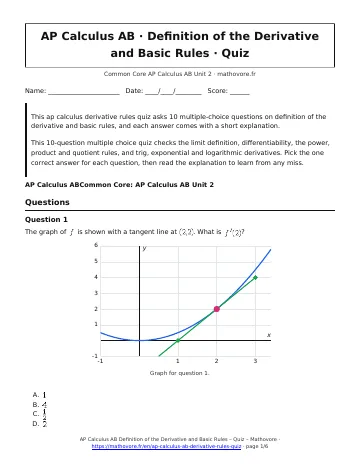
See every chapter on the AP Calculus AB math page.