



This ap calculus derivative rules worksheet gives 20 problems on definition of the derivative and basic rules, ordered from easy to hard, with a separate answer key.
These 20 problems cover AP Calculus AB Unit 2: average and instantaneous rates of change, the limit definition, differentiability, the power, sum, product and quotient rules, and derivatives of trig, exponential and logarithmic functions.
They run from easy to hard and finish with applications such as projectile height, marginal cost and drug concentration. Show every step, and simplify only when asked.
AP Calculus Derivative Rules Worksheet: problems 1–5
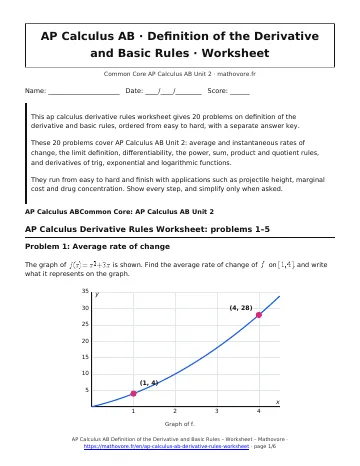
Problem 1: Average rate of change
The graph of \(f(x)=x^{2}+3x\) is shown. Find the average rate of change of \(f\) on \([1,4]\), and write what it represents on the graph.
Problem 2: Derivative at a point by definition
Use the limit definition to find each derivative.
- \(f^{\prime}(3)\) for \(f(x)=x^{2}\)
- \(f^{\prime}(2)\) for \(f(x)=x^{2}+4x\)
Problem 3: Limit definition for a function
Let \(f(x)=2x^{2}-5x\). Use the limit definition to find \(f^{\prime}(x)\), then evaluate \(f^{\prime}(1)\).
Problem 4: Definition with a reciprocal
Apply the definition of the derivative as a limit to differentiate \(g(x)=\frac{2}{x-1}\).
Problem 5: Power rule
Differentiate each function.
- \(f(x)=x^{8}\)
- \(f(x)=6x^{5}\)
- \(f(x)=\frac{3}{x^{2}}\)
- \(f(x)=\sqrt[3]{x}\)
AP Calculus Derivative Rules Worksheet: problems 6–10
Problem 6: Sum and constant multiple rules
Let \(f(x)=4x^{3}-7x^{2}+5x-9\). Find \(f^{\prime}(x)\), evaluate \(f^{\prime}(2)\), and find every \(x\) where \(f^{\prime}(x)=5\).
Problem 7: Derivatives of sin, cos, e^x and ln x
Find the derivative.
- \(f(x)=3\sin x-2\cos x\)
- \(f(x)=5e^{x}+2\ln x\)
- \(g(x)=e^{x}+\sin x\); then find \(g^{\prime}(0)\)
- \(h(x)=4\ln x-x^{3}\); then find \(h^{\prime}(1)\)
Problem 8: Tangent line
The graph of \(f(x)=x^{3}-2x\) is shown. Write an equation of the tangent line at \(x=2\).
Problem 9: Horizontal tangent lines
At which points does the graph of \(f(x)=2x^{3}-3x^{2}-12x+1\) have a horizontal tangent line? Give both coordinates of each point.
Problem 10: Product rule
Find the derivative. Do not simplify part (a) before checking it.
- \(f(x)=(x^{2}+1)(x^{3}-4x)\)
- \(f(x)=x^{2}\sin x\)
- \(f(x)=e^{x}\ln x\)
AP Calculus Derivative Rules Worksheet: problems 11–15
Problem 11: Quotient rule
Find the derivative.
- \(f(x)=\frac{x^{2}}{x+1}\)
- \(f(x)=\frac{\sin x}{x}\)
- \(f(x)=\frac{e^{x}}{x^{2}}\)
Problem 12: Derivatives of tan, sec, csc and cot
Find the derivative.
- \(f(x)=\tan x\); then evaluate \(f^{\prime}(\frac{\pi}{4})\)
- \(f(x)=3\,\text{sec}\,x\)
- \(f(x)=2\,\text{cot}\,x+\text{csc}\,x\)
Problem 13: Estimate derivatives from a table
Selected values of a differentiable function \(f\) are shown.
| x | 1 | 1.5 | 2 | 2.5 | 3 |
|---|---|---|---|---|---|
| f(x) | 2.0 | 3.1 | 5.0 | 7.7 | 11.0 |
- Find the average rate of change of \(f\) on \([1,2]\).
- Estimate \(f^{\prime}(2)\) using the values at \(x=1.5\) and \(x=2.5\).
- Use your estimate to write an equation of the tangent line at \(x=2\).
Problem 14: Is it differentiable?
Two graphs are shown: \(f(x)=|x-2|\) and \(p(x)=x^{2}\) for \(x\le 1\), \(p(x)=2x-1\) for \(x > 1\).
- Is \(f\) differentiable at \(x=2\)? Use one-sided slopes.
- Show that \(p\) is differentiable at \(x=1\) and find \(p^{\prime}(1)\).
Problem 15: Height of a ball
A ball is thrown upward and its height in feet after \(t\) seconds is \(h(t)=-16t^{2}+48t+5\).
- Find the average velocity on \([1,2]\).
- Find the velocity at \(t=1\).
- Find the time and height at the top of the flight.
AP Calculus Derivative Rules Worksheet: problems 16–20
Problem 16: Marginal cost of bicycles
A shop pays \(C(x)=0.02x^{2}+3x+500\) dollars to build \(x\) bicycle helmets. Find \(C^{\prime}(100)\) and interpret it. Then compare it with \(C(101)-C(100)\).
Problem 17: Learning curve
After \(t\) hours of practice (\(t\ge 1\)), a typing student scores \(S(t)=40+15\ln t\) words per minute. Find \(S^{\prime}(t)\), then \(S^{\prime}(5)\) and \(S^{\prime}(10)\), and explain what the change says about practice.
Problem 18: Revenue growth
A store sells \(q(t)=300-4t\) scarves per day at a price of \(p(t)=20+0.5t\) dollars, where \(t\) is days since a promotion began. Revenue is \(R(t)=p(t)\,q(t)\). Find \(R^{\prime}(10)\) and interpret it.
Problem 19: Concentration of a medicine
The concentration of a medicine in the blood is \(C(t)=\frac{t}{t^{2}+4}\) mg/L, \(t\) hours after a dose.
- Find \(C^{\prime}(t)\).
- Find \(C^{\prime}(1)\) and interpret it.
- At what time is the concentration greatest, and what is the maximum?
Problem 20: Derivatives from a table of values
Values of two differentiable functions are shown.
| x | f(x) | f'(x) | g(x) | g'(x) |
|---|---|---|---|---|
| 2 | 3 | -1 | 5 | 4 |
Find the derivative at \(x=2\) of each function.
- \(h(x)=f(x)\,g(x)\)
- \(k(x)=\frac{f(x)}{g(x)}\)
- \(m(x)=2f(x)-3g(x)\)

How to use this ap calculus derivative rules worksheet
Print this ap calculus derivative rules worksheet as a PDF, solve every problem on paper, then compare with the answer key.

See every chapter on the AP Calculus AB math page.