



Worked solutions and a scoring guide for the 20-point test. Award the points listed in each scoring note, and give partial credit when a student shows correct steps but makes one arithmetic slip. Figures are shown where they help check the reading of a graph.
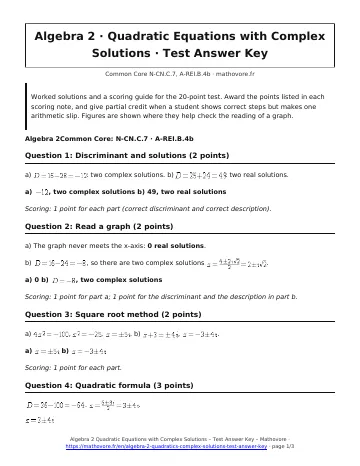
Question 1: Discriminant and solutions (2 points)
a) \(D=16-28=-12\): two complex solutions. b) \(D=25+24=49\): two real solutions.
a) \(-12\), two complex solutions b) 49, two real solutions
Scoring: 1 point for each part (correct discriminant and correct description).
Question 2: Read a graph (2 points)
a) The graph never meets the x-axis: 0 real solutions.
b) \(D=16-24=-8\), so there are two complex solutions \(x=\frac{4\pm 2i\sqrt{2}}{2}=2\pm i\sqrt{2}\).
a) 0 b) \(D=-8\), two complex solutions
Scoring: 1 point for part a; 1 point for the discriminant and the description in part b.
Question 3: Square root method (2 points)
a) \(4x^{2}=-100\), \(x^{2}=-25\), \(x=\pm 5i\). b) \(x+3=\pm 4i\), \(x=-3\pm 4i\).
a) \(x=\pm 5i\) b) \(x=-3\pm 4i\)
Scoring: 1 point for each part.
Question 4: Quadratic formula (3 points)
\(D=36-100=-64\). \(x=\frac{6\pm 8i}{2}=3\pm 4i\).
\(x=3\pm 4i\)
Scoring: 1 point for the discriminant; 1 point for substituting correctly into the formula; 1 point for the simplified solutions.
Question 5: Complete the square (3 points)
\(x^{2}+10x=-34\). Add \(25\): \((x+5)^{2}=-9\). Then \(x+5=\pm 3i\).
\(x=-5\pm 3i\)
Scoring: 1 point for moving the constant and adding 25 to both sides; 1 point for \((x+5)^{2}=-9\); 1 point for the solutions.
Question 6: A quadratic with fractions (2 points)
\(D=1-4=-3\). \(x=\frac{-1\pm i\sqrt{3}}{2}\).
\(x=\frac{-1\pm i\sqrt{3}}{2}\)
Scoring: 1 point for the discriminant; 1 point for the solutions.
Question 7: Solutions in the plane (3 points)
a) \(p=-2+3i\) and \(q=-2-3i\).
b) The sum is \(-4\), and the sum equals \(-b\), so \(b=4\).
c) The product is \(4-9i^{2}=13\), so \(c=13\).
a) \(-2\pm 3i\) b) \(b=4\) c) \(c=13\)
Scoring: 1 point for each part.
Question 8: Will the balloon reach 20 feet? (3 points)
Set \(-16t^{2}+32t=20\), so \(16t^{2}-32t+20=0\) and \(4t^{2}-8t+5=0\).
\(D=64-80=-16\), so \(t=\frac{8\pm 4i}{8}=1\pm 0.5i\).
The solutions are not real, so the balloon never reaches 20 ft. Its maximum height is 16 ft at \(t=1\).
Scoring: 1 point for writing the equation correctly; 1 point for the discriminant or solutions; 1 point for the conclusion.
20 points
See every chapter on the Algebra 2 math page.