Key takeaway: Each worked solution in this algebra 1 graphs test answer key is followed by a scoring guide, for a total of 20 points. Credit goes to a sound method even if a later slip occurs, while answers with no work earn nothing.
The graphs in the answers mark the intersection points, so graders can match a student’s sketch to the true picture quickly. Equivalent forms of an equation also earn full marks.
Each worked solution is followed by a scoring guide. Give credit for a correct method even when a later slip occurs, but give no credit for answers without work. The test totals 20 points, and the graphs in the answers mark the intersection points.
Algebra 1 Graphs Test Answer Key: questions 1–5
1. Points on a graph (2 points)
- \((-3)^{2}-5=9-5=4\), so yes, \((-3,4)\) is on the graph.
- \(2^{2}-5=-1\neq 1\), so no, \((2,1)\) is not on the graph.
Scoring: 1 point for each correct decision supported by substitution.
2. Solutions on a line (2 points)
- P and R lie on the line: \(-2(1)+3=1\) and \(-2(-1)+3=5\). P and R
- For Q: \(-2(2)+3=-1\), not 0, so Q is not a solution. (For S: \(-2(0)+3=3\neq 2\).)
Scoring: 1 point for naming exactly P and R; 1 point for a correct substitution showing a mismatch.
3. Line and parabola system (3 points)
\(x^{2}-6x+8=2x-7\) gives \(x^{2}-8x+15=0\), so \((x-3)(x-5)=0\) and \(x=3\) or \(x=5\). Then \(y=2(3)-7=-1\) and \(y=2(5)-7=3\).
Solutions: \((3,-1)\) and \((5,3)\). Check: \(9-18+8=-1\) and \(25-30+8=3\).
Scoring: 1 point for setting the expressions equal and reaching a correct equation equal to 0; 1 point for the x-values; 1 point for both y-values written as ordered pairs.
4. Reading a system graph (3 points)
- The graphs meet at \((-1,-3)\) and \((2,0)\).
- \(x^{2}-4=x-2\) gives \(x^{2}-x-2=0\), so \((x-2)(x+1)=0\) and \(x=2\) or \(x=-1\). Then \(y=0\) and \(y=-3\), which matches the graph.
Scoring: 1 point for both points read from the graph; 1 point for the correct quadratic and factoring; 1 point for the y-values and agreement with the graph.
5. How many solutions? (2 points)
- \(x^{2}+1=1\) gives \(x=0\): one solution, \((0,1)\).
- \(x^{2}+1=0\) gives \(x^{2}=-1\), which has no real solution: none.
Scoring: 1 point for each correct count with supporting algebra.
Algebra 1 Graphs Test Answer Key: questions 6–8
6. Features of an exponential (3 points)
- \(f(0)=4\cdot 1=4\), so \((0,4)\).
- \(2^{x}\) is always positive, so \(4\cdot 2^{x}\) is never 0.
- As \(x\) gets very large, \(f(x)\) gets very large; as \(x\) gets very small, \(f(x)\) approaches 0.
Scoring: 1 point per part; part (c) needs both directions.
7. Rewrite exponentials (3 points)
(a) \(16^{x}=(2^{4})^{x}=2^{4x}\).
(b) \(1.07^{t}=(1.07^{1/12})^{12t}\approx(1.0057)^{12t}\), a monthly rate of about 0.57%.
Scoring: 1 point for (a); in (b), 1 point for the exponent rewrite and 1 point for the rate 0.57%.
8. Find the exponential (2 points)
- The y-intercept gives \(a=2\), and each step right multiplies \(y\) by 3, so \(y=2\cdot 3^{x}\).
- As \(x\) gets very small, \(y\) approaches 0 (the x-axis is a horizontal asymptote).
Scoring: 1 point for the equation with both a and b correct; 1 point for the end behavior.
Scoring summary
20 points: add the points of every question of this algebra 1 graphs test answer key.
What answers does the algebra 1 graphs test answer key expect?
Question 1 expects yes for \((-3,4)\), since \(9-5=4\), and no for \((2,1)\), since \(4-5=-1\). Question 3 expects \((3,-1)\) and \((5,3)\), because \(x^{2}-8x+15=0\). In question 7, \(16^{x}=2^{4x}\), and the monthly factor for 1.07 is about 1.00565.
How should graders award partial credit?
In question 3, give one point for setting the expressions equal, one for factoring, and one for both ordered pairs. However, a student who finds x-values only earns two points. In question 6, award one point for the intercept 4 and one for the reason that powers of 2 are never zero.
Question 4 asks for estimates, so accept answers close to the true points. Verifying them algebraically earns the last point.
What patterns appear in low scores?
Errors on questions 1 and 2 suggest weak substitution. Meanwhile, errors on 7 suggest confusion about exponent rules. Consequently, target the weaker skill with two short drills.
How should you use the scores?
Hand papers back with the first wrong line marked, then let students fix one answer on their own. Next, pair learners who missed the same question. Finally, schedule the quiz as a quick follow-up to see if the repairs hold.

Printable PDF · Test Answer Key
Algebra 1 Graphs as Solution Sets, Linear-Quadratic Systems and Exponential Expressions test answer key
Download the PDF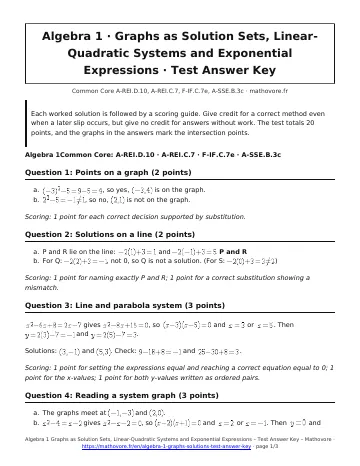
See every chapter on the Algebra 1 math page.