Key takeaway: This algebra 1 functions notation quiz presents ten multiple-choice questions on recognizing functions, evaluating notation, reading graphs and describing domain and range. Mark one option per item, and afterward study the rationale for each miss.
A few items include figures, such as a mapping diagram or a graph with closed endpoints. Look at the figure before the options, because the picture often settles the question. Scratch paper helps with the arithmetic items.
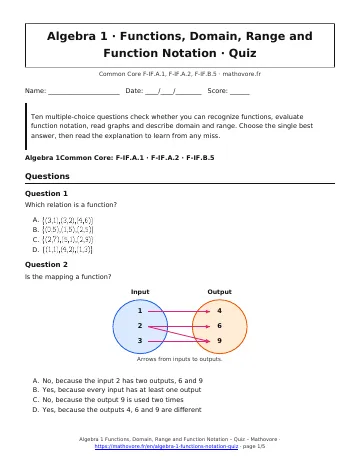
Ten multiple-choice questions check whether you can recognize functions, evaluate function notation, read graphs and describe domain and range. Choose the single best answer, then read the explanation to learn from any miss.
Question 1
Question 2
Question 3
Question 4
Question 5
Question 6
Question 7
Question 8
Question 9
Question 10
🎉 Quiz complete!
Remember:
- Every input of a function has exactly one output; two inputs may share an output.
- A graph is a function if no vertical line crosses it twice.
- f(a) = b means the output is b when the input is a.
- Domain is the set of inputs; range is the set of outputs.
- Discrete data has separate values; continuous data fills an interval.
What does the algebra 1 functions notation quiz check?
Question 1 asks which relation is a function, and the constant output list \(\{(0,5),(1,5),(2,5)\}\) is correct. Next, question 2 shows a mapping where input 2 has outputs 6 and 9, so it is not a function. Then question 3 evaluates \(f(x)=4x-7\) at -3 and gets -19.
After that, question 4 evaluates \(g(x)=x^{2}-5x\) at -2 and gets 14.
Which items catch common mistakes?
Next, question 6 reverses the job: if \(f(x)=2x+1\) and \(f(a)=15\), then \(a=7\). Then question 7 asks what \(H(10)=18\) means, and the answer is that the plant is 18 inches tall ten days after planting. Question 8 reads a segment with domain \(-3\le x\le 5\) and range \(-2\le y\le 4\).
Question 9 lists the eight pencil costs from $0.25 to $2.00. Finally, question 10 shows a vertical line hitting two points, so the graph is not a function.
What is the best way to study the rationales?
Begin with the option you picked and find the exact step that misled you. Then restate the correct rule in one sentence. Later, write a fresh item that tests the same idea. Over time, the pattern of your misses shows what to study.
What belongs on your study list now?
Revisit every missed item and explain it aloud. After that, take the written test, where units and complete sentences count. Once both feel comfortable, draw a mapping diagram of your own and ask a friend whether it shows a function.

See every chapter on the Algebra 1 math page.