


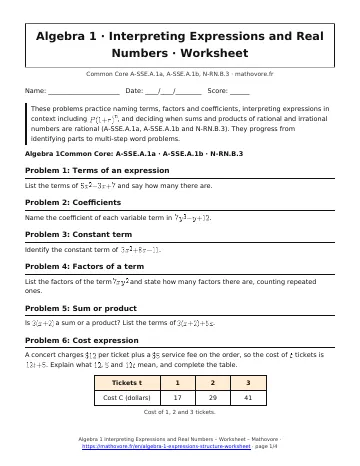
Problem 1: Terms of an expression
List the terms of \(5x^{2}-3x+7\) and say how many there are.
Problem 2: Coefficients
Name the coefficient of each variable term in \(7y^{3}-y+12\).
Problem 3: Constant term
Identify the constant term of \(3x^{2}+8x-11\).
Problem 4: Factors of a term
List the factors of the term \(7xy^{2}\) and state how many factors there are, counting repeated ones.
Problem 5: Sum or product
Is \(3(x+2)\) a sum or a product? List the terms of \(3(x+2)+5x\).
Problem 6: Cost expression
A concert charges \(\$12\) per ticket plus a \(\$5\) service fee on the order, so the cost of \(t\) tickets is \(12t+5\). Explain what \(12\), \(5\) and \(12t\) mean, and complete the table.
Problem 7: Evaluating P(1 + r)^n
Evaluate \(P(1+r)^{n}\) for \(P=500\), \(r=0.04\) and \(n=3\). Round to the nearest cent.
Problem 8: Growth factor
A balance grows by \(4\%\) each year, so the growth factor is \(1.04\). Explain what multiplying by \(1.04\) does, and find the balance after one year on \(\$900\).
Problem 9: Reading a growth model
The value of an account after \(t\) years is \(A=1200(1.05)^{t}\). Identify the starting amount and the yearly growth rate, then find \(A\) when \(t=2\).
Problem 10: Growth or decay
A machine’s value is \(V=800(0.92)^{n}\) dollars after \(n\) years. Decide whether this is growth or decay, find the yearly percent change, and find \(V\) when \(n=2\).
Problem 11: Factors of an expression
Identify the two factors of \((x+4)(x-1)\) and the terms of each factor.
Problem 12: Rational or irrational
Classify each number as rational or irrational: \(\sqrt{49}\), \(\sqrt{20}\), \(\frac{22}{7}\), \(0.\overline{3}\), \(\frac{\pi}{2}\), \(\sqrt{\frac{9}{4}}\).
Problem 13: Sum of rationals
Find \(\frac{3}{4}+\frac{3}{5}\) and tell whether the sum is rational or irrational.
Problem 14: Rational plus irrational
Is \(5+\sqrt{2}\) rational or irrational? Give a decimal approximation to the nearest thousandth.
Problem 15: A nonzero rational times an irrational
Is \(3\sqrt{5}\) rational or irrational? Is \(0\cdot\sqrt{5}\)? Explain the difference.
Problem 16: Product of irrationals
Decide whether \(\sqrt{2}\cdot\sqrt{8}\) and \(\sqrt{3}\cdot\sqrt{5}\) are rational or irrational.
Problem 17: Sum of irrationals
Decide whether \((3+\sqrt{5})+(3-\sqrt{5})\) and \(\sqrt{2}+\sqrt{2}\) are rational or irrational.
Problem 18: Why the sum is irrational
Explain why the sum of a rational number \(q\) and an irrational number \(s\) must be irrational. Use the number line to see \(\sqrt{2}\) and \(3+\sqrt{2}\).
Problem 19: A square's perimeter
A square has an area of \(50\text{ in}^{2}\). Find the side length in simplest radical form, then the perimeter, and tell whether each is rational or irrational.
Problem 20: A circle's circumference
A circle has radius \(\frac{3}{2}\text{ ft}\). Find its circumference in terms of \(\pi\). Is it rational? What radius \(r\) would make \(2\pi r=8\) a rational number?
Problem 21: A sale price
A jacket’s regular price is \(p\) dollars. The sale price is \(0.75p-5\) after a \(\$5\) coupon. Explain what \(0.75\), \(0.75p\) and \(5\) mean, then find the price when \(p=64\).
Problem 22: Investment growth
Mei invests \(\$2,000\) at \(3.5\%\) interest compounded yearly. Write the expression for the balance after \(n\) years, then find the balance and the interest earned after \(4\) years.
Problem 23: Sums that are rational
Which sums are rational? (a) \(\sqrt{9}+\sqrt{16}\) (b) \(\sqrt{3}+\sqrt{12}\) (c) \(\sqrt{2}+(-\sqrt{2})\) (d) \(\frac{1}{3}+\sqrt{7}\)
Problem 24: Two accounts
Account A is \(A=1000(1.03)^{n}\) and account B is \(B=1000+40n\), where \(n\) is years. Explain how each grows each year, then compare them when \(n=10\) and \(n=20\).

See every chapter on the Algebra 1 math page.