



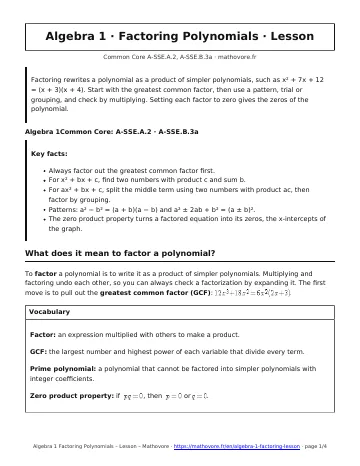
Factoring rewrites a polynomial as a product of simpler polynomials, such as x² + 7x + 12 = (x + 3)(x + 4). Start with the greatest common factor, then use a pattern, trial or grouping, and check by multiplying. Setting each factor to zero gives the zeros of the polynomial.
Key facts:
- Always factor out the greatest common factor first.
- For x² + bx + c, find two numbers with product c and sum b.
- For ax² + bx + c, split the middle term using two numbers with product ac, then factor by grouping.
- Patterns: a² − b² = (a + b)(a − b) and a² ± 2ab + b² = (a ± b)².
- The zero product property turns a factored equation into its zeros, the x-intercepts of the graph.
What does it mean to factor a polynomial?
To factor a polynomial is to write it as a product of simpler polynomials. Multiplying and factoring undo each other, so you can always check a factorization by expanding it. The first move is to pull out the greatest common factor (GCF): \(12x^{3}+18x^{2}=6x^{2}(2x+3)\).
Factor: an expression multiplied with others to make a product.
GCF: the largest number and highest power of each variable that divide every term.
Prime polynomial: a polynomial that cannot be factored into simpler polynomials with integer coefficients.
Zero product property: if \(pq=0\), then \(p=0\) or \(q=0\).
How do you factor x² + bx + c?
- Find two integers whose product is \(c\) and whose sum is \(b\).
- Write the binomials \((x+m)(x+n)\).
- Multiply to check.
Worked example. For \(x^{2}+7x+12\) the numbers are 3 and 4, so it factors as \((x+3)(x+4)\). If \(c\) is negative, the two numbers have opposite signs: \(x^{2}-2x-3=(x-3)(x+1)\).
How do you factor ax² + bx + c?
Multiply \(a\cdot c\), find two numbers with that product and sum \(b\), split the middle term, then factor by grouping. For \(2x^{2}+7x+3\), \(ac=6\) and the numbers are 1 and 6: \(2x^{2}+x+6x+3=x(2x+1)+3(2x+1)=(2x+1)(x+3)\).
What are the factoring patterns?
| Pattern | Factored form |
|---|---|
| \(a^{2}-b^{2}\) | \((a+b)(a-b)\) |
| \(a^{2}+2ab+b^{2}\) | \((a+b)^{2}\) |
| \(a^{2}-2ab+b^{2}\) | \((a-b)^{2}\) |
A sum of squares such as \(x^{2}+9\) is prime. With four terms, try grouping: \(x^{3}+4x^{2}+3x+12=x^{2}(x+4)+3(x+4)=(x^{2}+3)(x+4)\).
How does factoring help find zeros?
Set the factored expression equal to zero and apply the zero product property. For \(x^{2}-2x-3=0\), factor to get \((x-3)(x+1)=0\), so \(x=3\) or \(x=-1\). These zeros are the x-intercepts of the parabola.
Factoring Polynomials: frequently asked questions
How do you know a polynomial is factored completely?
Every factor is prime and no common factor remains. For example, \(4x^{2}-36=(2x-6)(2x+6)\) is not complete because each binomial still has a factor of 2. The complete form is \(4(x-3)(x+3)\).
What is the zero product property?
If a product equals zero, at least one factor equals zero. So \((x-5)(x+2)=0\) means \(x=5\) or \(x=-2\). It works only when the other side is exactly zero.
Why should you check a factorization by multiplying?
Expanding the factors must give back the original polynomial. This catches sign errors, such as writing \((x+4)(x-3)\) when the middle term needs \((x-4)(x+3)\).
Can every quadratic be factored?
Not with integer coefficients. The trinomial \(x^{2}+x+1\) has no integer pair with product 1 and sum 1, so it is prime. Some quadratics still have zeros that are not integers.
Why can’t x² + 9 be factored?
The difference of squares pattern needs a minus sign. A sum of squares has no real factors with integer coefficients, and its graph never touches the x-axis.
See every chapter on the Algebra 1 math page.