

Key takeaway: This algebra 1 exponential functions lesson explains how a starting value multiplies by the same factor again and again. It covers growth, decay, percent rates and compound interest for standards F-LE.A.1 to F-LE.A.3.
You will meet the growth factor b, the starting value a, and a quick table test that separates a curve from a line. Each idea comes with a small example, so you can check your own work step by step. Read the short rules first. Then test them on the sample tables, because practice with real numbers makes the pattern stick.
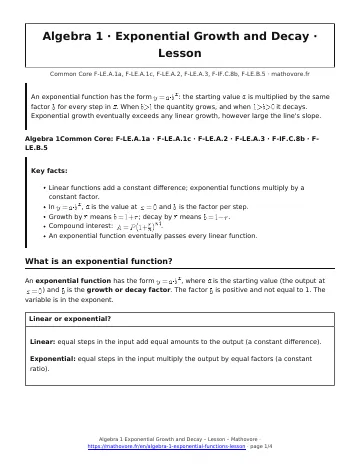
An exponential function has the form \(y=a\cdot b^{x}\): the starting value \(a\) is multiplied by the same factor \(b\) for every step in \(x\). When \(b>1\) the quantity grows, and when \(1>b>0\) it decays. Exponential growth eventually exceeds any linear growth, however large the line’s slope.
Algebra 1 Exponential Functions Lesson: key facts
- Linear functions add a constant difference; exponential functions multiply by a constant factor.
- In \(y=a\cdot b^{x}\), \(a\) is the value at \(x=0\) and \(b\) is the factor per step.
- Growth by \(r\) means \(b=1+r\); decay by \(r\) means \(b=1-r\).
- Compound interest: \(A=P(1+\frac{r}{n})^{nt}\).
- An exponential function eventually passes every linear function.
What is an exponential function?
An exponential function has the form \(y=a\cdot b^{x}\), where \(a\) is the starting value (the output at \(x=0\)) and \(b\) is the growth or decay factor. The factor \(b\) is positive and not equal to 1. The variable is in the exponent.
Linear: equal steps in the input add equal amounts to the output (a constant difference).
Exponential: equal steps in the input multiply the output by equal factors (a constant ratio).
How do percent rates become the factor b?
A quantity that grows by \(r\) each period has \(b=1+r\). A quantity that decays by \(r\) each period has \(b=1-r\). A 5% increase gives \(b=1.05\). A 12% decrease gives \(b=0.88\). If \(b>1\) the graph rises; if \(1>b>0\) it falls toward the \(x\)-axis.
How does compound interest work?
Interest that is added to the balance also earns interest, so the balance is exponential: \(A=P(1+\frac{r}{n})^{nt}\). Here \(P\) is the principal, \(r\) the yearly rate, \(n\) the compounds per year and \(t\) the years.
Example. $500 at 4% compounded yearly for 3 years: \(A=500(1.04)^{3}\approx\$562.43\).
How do you write an exponential function from a description?
- Find the starting value \(a\).
- Convert the percent rate to the factor \(b\).
- Write \(y=a\cdot b^{x}\) and check one known value.
Worked example. A town has 2,400 people and grows 3% per year. Then \(a=2400\), \(b=1.03\) and \(P(t)=2400(1.03)^{t}\). After 5 years, \(P(5)\approx 2,782\) people.
Does an exponential function always beat a linear one?
Yes, eventually. A line adds the same amount each step, but an exponential adds more each step. In the graph, \(y=2^{x}\) starts below \(y=10x+2\), yet it passes the line before \(x=6\) because \(2^{6}=64\) and \(10(6)+2=62\).
Exponential Growth and Decay: frequently asked questions
How can you tell whether a table is linear or exponential?
Check equal steps in \(x\). If the differences between outputs are equal, it is linear. If the ratios of consecutive outputs are equal, it is exponential. The outputs 3, 6, 12, 24 have a ratio of 2 each time.
What is the difference between a growth factor and a growth rate?
The rate is the percent change, such as 8%, written 0.08. The factor is what you multiply by, \(1+0.08=1.08\). Decay works the same way: a 20% loss has a factor of 0.80.
Why can b not be 1 or negative in an exponential function?
If \(b=1\), every output equals \(a\), so the function is constant. A negative \(b\) would make the outputs flip between positive and negative, which does not model steady growth or decay.
What does the number a mean in y = a · b^x?
It is the initial value, the output when \(x=0\), because \(b^{0}=1\). In \(y=250(0.9)^{x}\), the quantity starts at 250 and loses 10% each step.
Will an exponential function always exceed a linear function?
Eventually, yes. A line may stay ahead for a while, but each exponential step is larger than the last. For \(y=2^{x}\) and \(y=10x+2\), the exponential passes the line at \(x=6\).
How do you spot an exponential function in a table?
First, look at equal steps in x. Next, divide each output by the one before it. If every quotient matches, the table is exponential. For example, the outputs 5, 15, 45 and 135 give a factor of 3 each time.
In contrast, subtract when you suspect a line. The outputs 5, 9, 13 and 17 rise by 4, so that table is linear. Therefore, always test the quotient and the difference before you write a rule.
How does a percent rate become the factor b in an algebra 1 exponential functions lesson?
Start with the rate as a decimal. Then add it for growth or subtract it for decay. A 12% yearly gain gives \(b=1.12\), because 1 plus 0.12 is 1.12. Likewise, a 7% loss gives \(b=0.93\).
However, many students write 0.12 as the factor. As a result, their model shrinks the original amount instead of growing it. Instead, remember that the factor keeps 100% of the value and then adds or removes a part.
How does compound interest use the same idea?
Compound interest is exponential growth in a bank account. For instance, $2,000 at 3% compounded yearly becomes \(2000(1.03)^{4}\) after four years, which is about $2,251.02. Meanwhile, simple interest only adds the same dollars each year, so it stays linear.
Also, more frequent compounding helps a little. Because interest earns interest sooner, $1,000 at 6% for two years grows to $1,123.60 with yearly compounding but $1,125.51 with twice-yearly compounding.
Does an exponential function always beat a linear one?
Not at the start, but eventually yes. Compare \(2^{x}\) with \(5x+3\). At \(x=3\) the line is still ahead, 18 to 8. By \(x=5\), however, the curve reaches 32 while the line reaches 28. Thus a larger factor always wins in the long run.
What should you try after this lesson?
Write your own rule from two points, such as \((0,5)\) and \((2,45)\). Then check it with a table of three more values. After that, move to the worksheet and compare each factor with its percent rate. Finally, explain aloud why decay factors sit between 0 and 1.

See every chapter on the Algebra 1 math page.