

Key takeaway: An algebra 1 linear functions lesson starts with one big idea: a line changes at a constant rate, called its slope. This page shows how to find slope from two points, write the equation in slope-intercept, point-slope or standard form, and graph the line from any of them.
You will also write parallel and perpendicular lines and build models from tables and stories. The F-IF, F-LE and A-CED standards frame the examples. Work each one with a pencil, and compare your answer with the check line that follows.
A linear function has a constant rate of change called its slope. It can be written as y = mx + b (slope-intercept), y – y1 = m(x – x1) (point-slope) or Ax + By = C (standard). Find the slope from two points, graph the line from any form, and write models from tables, graphs or words.
Algebra 1 Linear Functions Lesson: key facts
- Standards F-IF.C.7a, F-LE.A.1a, F-LE.A.2 and A-CED.A.2: graph linear functions, recognize constant rates of change, and write linear models.
- Slope from two points: \(m=\frac{y_{2}-y_{1}}{x_{2}-x_{1}}\).
- Slope-intercept \(y=mx+b\), point-slope \(y-y_{1}=m(x-x_{1})\), standard \(Ax+By=C\).
- Parallel lines have equal slopes; perpendicular lines have slopes whose product is \(-1\).
- In a model, the slope is the rate of change and the y-intercept is the starting value.
What is slope and how do you find it?
A linear function changes by the same amount every time \(x\) goes up by 1. That constant rate of change is the slope. Given two points \((x_{1},y_{1})\) and \((x_{2},y_{2})\), subtract the coordinates in the same order:
\[m=\frac{y_{2}-y_{1}}{x_{2}-x_{1}}\]
For \((-2,1)\) and \((4,5)\), \(m=\frac{5-1}{4-(-2)}=\frac{4}{6}=\frac{2}{3}\). A positive slope rises from left to right, a negative slope falls, a horizontal line has slope 0, and a vertical line has undefined slope.
What are the three forms of a linear equation?
Slope-intercept form: \(y=mx+b\), where \(m\) is the slope and \(b\) is the y-intercept.
Point-slope form: \(y-y_{1}=m(x-x_{1})\), for a line with slope \(m\) through \((x_{1},y_{1})\).
Standard form: \(Ax+By=C\), usually with integer coefficients and \(A\ge 0\).
To convert, solve for \(y\) or clear fractions. For example, \(2x+3y=12\) becomes \(3y=-2x+12\), so \(y=-\frac{2}{3}x+4\).
How do you graph a line from its equation?
- Write the equation in a form that shows a point and the slope.
- Plot that point, such as the y-intercept \((0,b)\).
- Use rise over run to plot at least one more point, then draw the line through them.
- Check a third point in the equation.
Worked example. Graph \(y=-\frac{2}{3}x+4\). Plot \((0,4)\). The slope \(-\frac{2}{3}\) means down 2 and right 3, which gives \((3,2)\) and \((6,0)\). Check: \(-\frac{2}{3}(6)+4=0\).
How are parallel and perpendicular lines related?
Parallel lines have equal slopes and different y-intercepts. Perpendicular lines have slopes that are negative reciprocals, so their product is \(-1\). If \(m=2\), a perpendicular line has slope \(-\frac{1}{2}\).
How do you write a linear model from a situation?
Find the constant rate of change (the slope) and the starting value (the y-intercept). A gym that charges a \(\$25\) sign-up fee plus \(\$18\) per month has cost \(C=18m+25\). Two points from a table also work: find \(m\) first, then use point-slope form.
Linear Functions: Slope-Intercept, Point-Slope and Standard Form: frequently asked questions
How do you find the slope of a line from two points?
Divide the change in y by the change in x, keeping the same point first in both differences. For \((1,3)\) and \((5,11)\), \(m=\frac{11-3}{5-1}=2\).
Which form of a linear equation should I use?
Use slope-intercept form to graph quickly from the y-intercept and slope. Use point-slope form when you know a point and the slope. Use standard form to find intercepts or to write equations with integer coefficients.
How do you convert standard form to slope-intercept form?
Solve the equation for \(y\). For \(3x+4y=12\), subtract \(3x\) to get \(4y=-3x+12\), then divide by 4 to get \(y=-\frac{3}{4}x+3\).
How do you write a line parallel or perpendicular to a given line?
A parallel line keeps the same slope. A perpendicular line uses the negative reciprocal of the slope. Then plug the given point into point-slope form.
What do slope and y-intercept mean in a word problem?
The slope is the amount the output changes per one unit of input, such as dollars per month. The y-intercept is the starting amount when the input is 0, such as a sign-up fee.
What is slope, and how do you find it from two points?
Slope compares vertical change with horizontal change, written \(m=\frac{y_{2}-y_{1}}{x_{2}-x_{1}}\). For the points \((-4,9)\) and \((6,-6)\), the slope is \(\frac{-15}{10}=-\frac{3}{2}\). A negative slope means the line falls from left to right.
Special lines need care. Flat lines have slope 0. Straight up-and-down lines have no defined slope, since their run is zero.
What are the three forms of a linear equation?
Slope-intercept form is \(y=mx+b\), where b is the y-intercept. Point-slope form is \(y-y_{1}=m(x-x_{1})\), which is handy when you know a point. Standard form is \(Ax+By=C\), which makes intercepts easy.
To convert, solve for y. For example, \(3x+4y=12\) becomes \(y=-\frac{3}{4}x+3\). Conversely, \(y=-\frac{2}{5}x+4\) becomes \(2x+5y=20\) after you multiply by 5.
How are parallel and perpendicular lines related?
Parallel lines never meet, so they keep one slope. Perpendicular lines meet at right angles, so their slopes are negative reciprocals. A line through \((3,-2)\) parallel to \(y=4x+1\) is \(y=4x-14\). In contrast, a line through \((4,1)\) perpendicular to \(y=2x-5\) has slope \(-\frac{1}{2}\), so it is \(y=-\frac{1}{2}x+3\).
How do you write a linear model in an algebra 1 linear functions lesson?
Find the constant rate, then find the starting value. A gym with a $25 sign-up fee and $18 per month gives \(C=18m+25\). Similarly, a car that is 55 miles from home after 1 hour and 145 miles after 3 hours travels at 45 miles per hour, so \(d=45t+10\).
Before you finish, test the model. First, plug in a known time. Then compare the output with the story. If the two disagree, recheck the rate. Also, decide what the intercept means, because a good model explains it in words.
Where can you go from here?
Draw three lines through the same point with different slopes and write each equation in all three forms. Then pick a story with a fee and a rate, and model it. Afterward, try the worksheet and name the meaning of m and b in every word problem.

Printable PDF · Lesson
Algebra 1 Linear Functions: Slope-Intercept, Point-Slope and Standard Form lesson
Download the PDF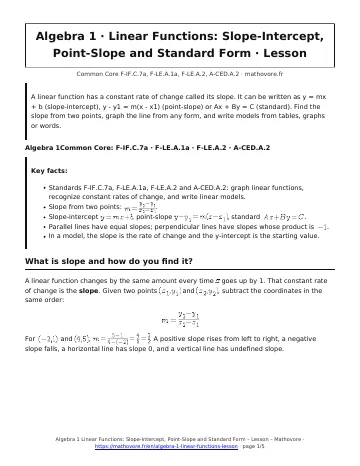
- Linear Functions: Slope-Intercept, Point-Slope and Standard Form worksheet (22 problems)
- Linear Functions: Slope-Intercept, Point-Slope and Standard Form quiz (10 questions)
- Linear Functions: Slope-Intercept, Point-Slope and Standard Form test (45 minutes)
- Previous lesson: Key Features of Graphs and Rate of Change
- Next lesson: Arithmetic and Geometric Sequences
See every chapter on the Algebra 1 math page.