Key takeaway: This algebra 1 quadratic functions worksheet offers 24 printable problems about parabolas. You will name coefficients, find the axis of symmetry and vertex, read vertex and factored form, complete the square and solve thrown-ball, fence and sale problems.
The set follows the F-IF and A-SSE standards. The first items are brief and pictorial; the final four apply the ideas. Keep graph paper beside you, and write the formula before you substitute. A matching key sits on a different page.
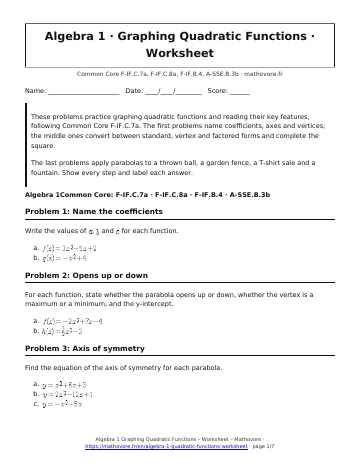
These problems practice graphing quadratic functions and reading their key features, following Common Core F-IF.C.7a. The first problems name coefficients, axes and vertices; the middle ones convert between standard, vertex and factored forms and complete the square.
The last problems apply parabolas to a thrown ball, a garden fence, a T-shirt sale and a fountain. Show every step and label each answer.
Algebra 1 Quadratic Functions Worksheet: problems 1–5
1. Name the coefficients
Write the values of \(a\), \(b\) and \(c\) for each function.
- \(f(x)=3x^{2}-5x+2\)
- \(g(x)=-x^{2}+4\)
2. Opens up or down
For each function, state whether the parabola opens up or down, whether the vertex is a maximum or a minimum, and the y-intercept.
- \(f(x)=-2x^{2}+7x-4\)
- \(h(x)=\frac{1}{2}x^{2}-3\)
3. Axis of symmetry
Find the equation of the axis of symmetry for each parabola.
- \(y=x^{2}+8x+3\)
- \(y=2x^{2}-12x+1\)
- \(y=-x^{2}+5x\)
4. Vertex from standard form
Find the vertex of each parabola.
- \(y=x^{2}-6x+5\)
- \(y=-2x^{2}+8x-3\)
5. Read vertex form
Give the vertex, the axis of symmetry, and the maximum or minimum value of each function.
- \(y=2(x-3)^{2}+1\)
- \(y=-(x+2)^{2}+5\)
Algebra 1 Quadratic Functions Worksheet: problems 6–10
6. Zeros from factored form
The function \(y=(x+2)(x-6)\) is in factored form. Find its x-intercepts, its axis of symmetry and its vertex.
7. Complete a table
Complete the table for \(y=x^{2}-4x+1\). Then name the vertex and the axis of symmetry.
| x | -1 | 0 | 1 | 2 | 3 | 4 | 5 |
|---|---|---|---|---|---|---|---|
| y | ? | ? | ? | ? | ? | ? | ? |
8. Read a graph
Use the graph to name the vertex, the axis of symmetry, the x-intercepts, the y-intercept, and the range of the function.
9. Effect of a
The equations \(y=x^{2}\), \(y=2x^{2}\) and \(y=\frac{1}{2}x^{2}\) are graphed below. Match each equation to its curve. Then describe how the graph of \(y=-2x^{2}\) differs from curve B.
10. Intercepts from standard form
Find the x-intercepts and the y-intercept of \(y=x^{2}-5x+6\).
Algebra 1 Quadratic Functions Worksheet: problems 11–15
11. Maximum or minimum value
Does \(f(x)=-x^{2}+6x-5\) have a maximum or a minimum? Find the value and where it occurs. Then find the zeros.
12. Factored to standard form
Write \(y=(x-3)(x+5)\) in standard form. Then find its vertex.
13. Complete the square
Rewrite \(y=x^{2}+8x+7\) in vertex form by completing the square. State the vertex.
14. No x-intercepts
Complete the square for \(y=x^{2}-10x+30\). Find the minimum value and explain why the graph has no x-intercepts.
15. Leading coefficient 2
Write \(y=2x^{2}-12x+10\) in vertex form. Then find the zeros.
Algebra 1 Quadratic Functions Worksheet: problems 16–20
16. Increasing and decreasing
The graph of \(f(x)=-x^{2}+4x\) is shown. State the interval where \(f\) is increasing, the interval where it is decreasing, and the interval where \(f(x) > 0\).
17. Equation from a graph
The graph shows a parabola with vertex \((1, 4)\) that passes through \((3, 0)\). Write its equation in vertex form, then in standard form.
18. Compare two functions
Function \(f\) is \(f(x)=x^{2}-6x+11\). Function \(g\) is given by the table. Which function has the lower minimum value?
| x | 0 | 1 | 2 | 3 | 4 |
|---|---|---|---|---|---|
| g(x) | 5 | 2 | 1 | 2 | 5 |
19. Three forms, one parabola
Show that \(y=(x-3)^{2}-4\) and \(y=(x-1)(x-5)\) are both equal to \(y=x^{2}-6x+5\). Then tell which form shows the vertex, which shows the zeros, and which shows the y-intercept.
20. Equation from zeros and a point
A parabola has x-intercepts at 2 and 8 and passes through \((5, -9)\). Write its equation in factored form and in standard form. Find the vertex.
Algebra 1 Quadratic Functions Worksheet: problems 21–24
21. Thrown ball
Maya throws a ball upward from a balcony. Its height in feet after \(t\) seconds is \(h(t)=-16t^{2}+32t+6\).
- How high is the ball at \(t=0\)?
- When does it reach its highest point, and how high is that?
- At what other time is the ball again at the height from part (a)?
22. Garden fence
Diego has 40 feet of fence for a rectangular garden. One side is a wall, so only three sides need fence. Let \(x\) be the length of each of the two sides that touch the wall.
- Write a function \(A(x)\) for the area.
- Find the value of \(x\) that gives the largest area.
- Find that area and the dimensions of the garden.
23. T-shirt sale
The school store sells 100 T-shirts at \(\$12\) each. For every \(\$1\) the price goes up, the store sells 5 fewer shirts. With \(x\) dollars of increase, the revenue is \(R(x)=(12+x)(100-5x)\).
- Write \(R(x)\) in standard form.
- What price gives the greatest revenue?
- Find the greatest revenue and the number of shirts sold.
24. Fountain arc
A stream of water from a fountain follows \(y=-\frac{1}{4}x^{2}+2x\), where \(x\) is the horizontal distance and \(y\) is the height, both in feet.
- Find the greatest height of the water.
- How far from the nozzle does the water land?
- Find the height at \(x=2\), and another distance at which the water has that same height.

What does this algebra 1 quadratic functions worksheet contain?
Problems 1 and 2 name coefficients and the direction of opening. Next, problems 3 to 8 find axes, vertices and zeros from standard, vertex and factored form, and from a table or graph. Then problems 9 to 12 study the effect of a, intercepts and maximum values.
After that, problems 13 to 15 complete the square, and problems 16 to 20 interpret graphs and write equations. Finally, problems 21 to 24 model a ball, a fence, a sale and a fountain.
Which problems deserve extra care?
Next, problem 14, \(y=x^{2}-10x+30\), has no x-intercepts, so the explanation matters as much as the numbers. Problem 15 has a leading coefficient of 2, so factor it out before completing the square. Problem 20 gives zeros 2 and 8 and a point, so you must solve for a. Meanwhile, problem 5 hides signs inside the parentheses: \((x-3)\) means \(h=3\).
Also, problem 19 asks why two forms describe one parabola, which is a good chance to expand both.
How do the application problems use the vertex?
In problem 21, Maya’s ball starts at 6 feet on a balcony and follows \(h(t)=-16t^{2}+32t+6\). Then, in problem 22, Diego’s 40 feet of fence leave an area of \(w(40-2w)\). Meanwhile, in problem 23, the store raises the price by x dollars and sells 5 fewer shirts for each dollar. The fountain in problem 24 follows \(y=-\frac{1}{4}x^{2}+2x\).
Therefore, each story asks for the vertex or the zeros. Decide which one before you calculate.
Which routine helps with vertex questions?
First, find the axis from \(-\frac{b}{2a}\). Next, substitute that x into the function. Then write the vertex as an ordered pair. After that, state whether it is a maximum or a minimum. Also, test one more point to confirm the shape. Finally, add units if the problem is a story.
How do you decide which form to use?
Choose the form that answers the question fastest. If a question asks for the maximum, vertex form is best, because the vertex is visible. Should it ask for zeros, factored form wins, since each factor gives one zero. When it asks for the y-intercept, standard form shows c immediately. For example, \(y=(x-3)(x+4)\) has zeros 3 and -4, and expanding gives a y-intercept of -12. Meanwhile, completing the square turns a hard standard form into vertex form. In other words, the forms are tools, not rules. As a result, switch freely, and check each switch with a point. Finally, remember that all three forms describe the same curve, so they must give the same values at x equal to 0.
Similarly, when a question gives a graph, read the features first. Next, match them to a form. Then write the equation. Because the vertex and one other point determine a parabola, problem 17 needs only those two clues. For instance, vertex \((1,4)\) and point \((3,0)\) give \(y=-(x-1)^{2}+4\). Therefore, a quick substitution finds the value of a.
How do you read a table of values for a parabola?
First, look for the smallest or largest output. Next, find the input where it occurs, because that input is the axis. For instance, the table for \(y=x^{2}-4x+1\) gives -3 at \(x=2\), so the vertex is \((2,-3)\). Then check the symmetry. The outputs at \(x=1\) and \(x=3\) match, and so do those at \(x=0\) and \(x=4\). Therefore, equal outputs sit equally far from the axis. Also, differences between neighboring outputs change by a constant amount, so a quadratic never rises evenly. Besides, a table with unequal steps may still be quadratic, as long as the second differences agree.
Similarly, a graph answers many questions at a glance. First, mark the turning point. Next, read the y-intercept where the curve crosses the vertical axis. Then count the x-intercepts, which may be zero, one or two. After that, state the range in words, such as all values at or above -4. Consequently, you describe the parabola without an equation. Finally, compare your reading with the algebra, because both must agree.
How can you avoid sign mistakes in vertex form?
Vertex form hides a trap: the vertex’s x-coordinate carries the opposite sign of what you see in the parentheses. For example, \(y=2(x+4)^{2}-7\) has vertex \((-4,-7)\). First, rewrite the plus as a minus a negative. Next, read h and k. Then double-check by substituting x equal to h, which must give k. Also, remember that the sign outside the parentheses is the actual k. Thus, a quick substitution settles any doubt. Besides, when completing the square, add and subtract the same number, so the value stays equal. Finally, verify the result by expanding it back to standard form.
What is a good next step with this worksheet?
Check each vertex against the solutions, then redo any problem where the sign inside the parentheses fooled you. Next, invent your own fence problem with 60 feet. Finally, take the quiz and see whether the three forms now feel like one idea.

See every chapter on the Algebra 1 math page.