
Key takeaway: Eight questions and 20 points make up this algebra 1 graphs solutions test, which takes about 45 minutes. You will decide which points are solutions, solve one line-and-parabola system, and work with exponential graphs and exponent rules.
Show your work for every question, because answers without work earn no credit. A separate scoring guide exists for teachers, and graphs there mark each intersection. Calculators are optional, but exact answers are expected.
This test has 8 questions worth 20 points in total and takes about 45 minutes. Decide which points are solutions, solve a system with a line and a parabola, and work with exponential graphs and exponent rules. Show your work for every question.
- Grade: Algebra 1
- Chapter: Graphs as Solution Sets, Linear-Quadratic Systems and Exponential Expressions
- Common Core: A-REI.D.10, A-REI.C.7, F-IF.C.7e, A-SSE.B.3c
- Time: 45 minutes
- Total: 20 points (Question 1: 2 pts; Question 2: 2 pts; Question 3: 3 pts; Question 4: 3 pts; Question 5: 2 pts; Question 6: 3 pts; Question 7: 3 pts; Question 8: 2 pts)
Algebra 1 Graphs Solutions Test: questions 1–5
1. Points on a graph (2 points)
The graph of \(y=x^{2}-5\) is a parabola.
- Is \((-3,4)\) on the graph? Justify. (1 point)
- Is \((2,1)\) on the graph? Justify. (1 point)
2. Solutions on a line (2 points)
The line shown is the graph of \(y=-2x+3\).
- Which of the points P, Q, R and S are solutions of the equation? (1 point)
- Show by substitution that one of the other points is not a solution. (1 point)
3. Line and parabola system (3 points)
Solve the system \(y=x^{2}-6x+8\) and \(y=2x-7\). Show all work.
4. Reading a system graph (3 points)
The graph shows \(y=x^{2}-4\) (solid) and \(y=x-2\) (dashed).
- Estimate the coordinates of the intersection points from the graph. (1 point)
- Verify them by solving the system algebraically. (2 points)
5. How many solutions? (2 points)
Decide how many solutions each system has and justify with algebra.
- \(y=x^{2}+1\) and \(y=1\) (1 point)
- \(y=x^{2}+1\) and \(y=0\) (1 point)
Algebra 1 Graphs Solutions Test: questions 6–8
6. Features of an exponential (3 points)
Let \(f(x)=4\cdot 2^{x}\).
- Find the y-intercept. (1 point)
- Explain why the graph has no x-intercept. (1 point)
- Describe the end behavior as \(x\) gets very large and very small. (1 point)
7. Rewrite exponentials (3 points)
(a) Write \(16^{x}\) as a power of 2. (1 point)
(b) An investment grows by a factor of 1.07 each year, so its value is \(1.07^{t}\) times the deposit. Rewrite this with an exponent of \(12t\) and find the monthly growth rate to the nearest hundredth of a percent. (2 points)
8. Find the exponential (2 points)
The graph of an exponential function \(y=a\cdot b^{x}\) passes through the plotted points.
- Write the equation. (1 point)
- Describe what happens to \(y\) as \(x\) gets very small. (1 point)

What does the algebra 1 graphs solutions test ask?
Question 1 checks whether \((-3,4)\) and \((2,1)\) lie on \(y=x^{2}-5\). Next, question 2 picks the solutions of \(y=-2x+3\) from plotted points. Then question 3 solves \(y=x^{2}-6x+8\) with \(y=2x-7\) and shows all work.
Following that, question 4 reads a graph of \(y=x^{2}-4\) and \(y=x-2\), and question 5 counts solutions with algebra.
How do the exponential questions work?
Question 6 uses \(f(x)=4\cdot 2^{x}\), where the y-intercept is 4 and no x-intercept exists. Question 7 writes \(16^{x}\) as a power of 2 and turns a yearly factor of 1.07 into a monthly one. Finally, question 8 finds the equation through plotted points.
Therefore, review how to read two points and divide the y-values to get the base.
Which mistakes cost points?
First, students often solve for x and forget y. Next, some divide a yearly rate by 12 and call it monthly. Also, a few claim a double root means two separate solutions. Instead, count the distinct points.
How should you prepare?
Solve three line-parabola systems and check each pair in both equations. Then sketch two exponentials and label the asymptotes. After that, rewrite one rate in a new time unit. Finally, time a mixed set of five problems to rehearse the pace.

Printable PDF · Test
Algebra 1 Graphs as Solution Sets, Linear-Quadratic Systems and Exponential Expressions test
Download the PDF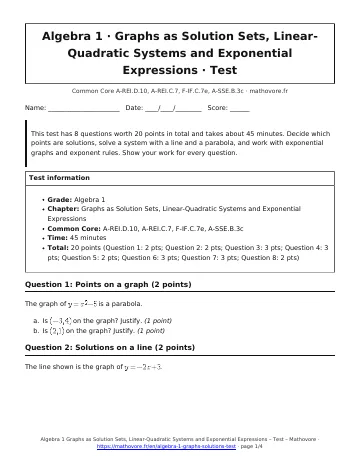
- Review the lesson: Graphs as Solution Sets, Linear-Quadratic Systems and Exponential Expressions
- Practice with the graphs as solution sets, linear-quadratic systems and exponential expressions worksheet
- Warm up with the graphs as solution sets, linear-quadratic systems and exponential expressions quiz
See every chapter on the Algebra 1 math page.