Key takeaway: This algebra 1 units quantities worksheet has 23 problems that move from single conversions to multi-step word problems. You will convert miles, hours, gallons and acres, interpret a slope with units, choose a graph scale, and round a product sensibly. The final problems use a gas tank, a pool, and a printing job.
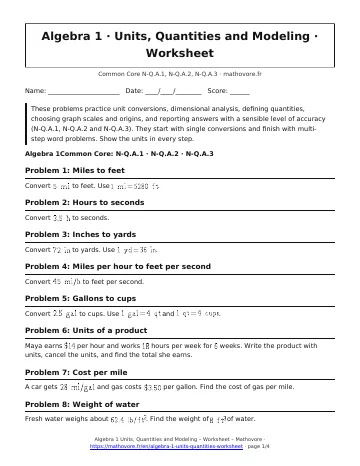
These problems practice unit conversions, dimensional analysis, defining quantities, choosing graph scales and origins, and reporting answers with a sensible level of accuracy (N-Q.A.1, N-Q.A.2 and N-Q.A.3). They start with single conversions and finish with multi-step word problems. Show the units in every step.
Algebra 1 Units Quantities Worksheet: problems 1–5
1. Miles to feet
Convert \(5\text{ mi}\) to feet. Use \(1\text{ mi}=5280\text{ ft}\).
2. Hours to seconds
Convert \(3.5\text{ h}\) to seconds.
3. Inches to yards
Convert \(72\text{ in}\) to yards. Use \(1\text{ yd}=36\text{ in}\).
4. Miles per hour to feet per second
Convert \(45\text{ mi/h}\) to feet per second.
5. Gallons to cups
Convert \(2.5\text{ gal}\) to cups. Use \(1\text{ gal}=4\text{ qt}\) and \(1\text{ qt}=4\text{ cups}\).
Algebra 1 Units Quantities Worksheet: problems 6–10
6. Units of a product
Maya earns \(\$14\) per hour and works \(18\) hours per week for \(6\) weeks. Write the product with units, cancel the units, and find the total she earns.
7. Cost per mile
A car gets \(28\text{ mi/gal}\) and gas costs \(\$3.50\) per gallon. Find the cost of gas per mile.
8. Weight of water
Fresh water weighs about \(62.4\text{ lb/ft}^{3}\). Find the weight of \(8\text{ ft}^{3}\) of water.
9. Acres of a field
A square field measures \(330\text{ ft}\) on each side. Find its area in acres. Use \(1\text{ acre}=43{,}560\text{ ft}^{2}\).
10. Square feet to square yards
Convert \(540\text{ ft}^{2}\) to square yards.
Algebra 1 Units Quantities Worksheet: problems 11–15
11. Reading a measurement
A ruler marked in tenths of an inch shows a pencil’s length as \(3.4\text{ in}\), as in the figure. Write an inequality for the actual length \(L\).
12. Choosing a vertical scale
Diego tracks weekly school-store sales in dollars: 310, 322, 318, 335 and 340. Graph A uses a vertical axis from 0 to 400, and Graph B uses a vertical axis from 300 to 350. For each graph, find what percent of the axis height the data range covers.
13. Choosing an origin
A town’s population \(P\) is measured in thousands, and \(x\) is the number of years since 2010. (a) Find \(x\) for the year 2026. (b) Explain what \(P=48.3\) means. (c) Find the year when \(x=22\).
14. Defining a quantity
A kayak rental charges an \(\$8\) fee plus \(\$12\) per hour. Define variables with units, write an equation for the total cost, and find the cost for \(3\) hours and the hours possible with \(\$80\).
15. Rounding a product
Aisha measures a rectangle as \(7.3\text{ in}\) by \(4.8\text{ in}\), each to the nearest tenth of an inch. Her calculator shows an area of \(35.04\text{ in}^{2}\). Report the area with an appropriate level of accuracy.
Algebra 1 Units Quantities Worksheet: problems 16–20
16. Units of a slope
The graph shows the distance \(d\) a delivery truck travels in \(t\) hours. (a) Find the slope. (b) State its units and meaning. (c) Find the distance traveled in \(3.5\) hours.
17. Gallons in a tank
A tank is \(4\text{ ft}\) long, \(3\text{ ft}\) wide and \(2\text{ ft}\) tall. One cubic foot holds about \(7.48\) gallons. Find the number of gallons the tank holds.
18. Percent error of a length
A board is measured as \(12.5\text{ ft}\) to the nearest tenth of a foot. Find the greatest possible error in the measurement and write it as a percent of \(12.5\text{ ft}\).
19. Speed of sound
Sound travels about \(1125\text{ ft/s}\) in air. Convert this speed to miles per hour and round to the nearest whole number.
20. Walking time
Liam walks at \(3.2\text{ mi/h}\). Find how long he needs to walk \(8\text{ mi}\), in hours and in hours and minutes.
Algebra 1 Units Quantities Worksheet: problems 21–23
21. Filling the gas tank
Priya’s car gets \(32\text{ mi/gal}\) and has a \(12\text{-gallon}\) tank. Gas costs \(\$3.80\) per gallon. Find (a) the cost to fill an empty tank, (b) the distance on a full tank, and (c) the gas cost per \(100\) miles, to the nearest cent.
22. Filling a pool
A hose delivers \(12\text{ gal/min}\) to a pool that needs \(6{,}000\) gallons. Water costs \(\$4.50\) per \(1{,}000\) gallons. Find the fill time in hours and minutes and the cost of the water.
23. Printing a packet
Noah must print \(2{,}700\) pages on a printer that prints \(18\) pages per minute, double-sided (two pages per sheet). A ream holds \(500\) sheets and costs \(\$6.25\). Find the printing time in hours, and the cost of the reams he must buy.

Which conversions appear on the algebra 1 units quantities worksheet?
Problem 1 turns 5 miles into feet, and problem 2 turns 3.5 hours into seconds. Next, problem 4 converts \(45\text{ mi/h}\) to feet per second. Problem 5 chains gallons to quarts to cups, so 2.5 gallons become 40 cups.
How do the rate and area problems work?
Problem 7 combines \(28\text{ mi/gal}\) with $3.50 per gallon, so gas costs $0.125 per mile. Problem 9 finds the area of a 330-foot square field in acres. Because \(330^{2}=108{,}900\) square feet, the field is 2.5 acres. In contrast, problem 10 divides by 9 to change square feet to square yards.
What do the modeling problems teach?
Problem 13 sets x as years since 2010, so a town’s population graph starts at \(x=0\). Problem 15 multiplies 7.3 by 4.8 and asks you to round to a fair number of digits. Meanwhile, problem 19 turns the speed of sound, 1125 ft/s, into about 767 miles per hour.
- Write every unit beside its number.
- Then cancel units before multiplying.
- Finally, round once.
How should you check before the key?
Send each answer through a quick size test. Is 66 ft/s faster than 45 mi/h? It should be about 1.5 times larger in numbers. Then redo problem 23 with a different order of conversions.

See every chapter on the Algebra 1 math page.