Key takeaway: Practice with 22 printable problems on this algebra 1 linear inequalities worksheet. You will solve multi-step inequalities, remember to reverse the sign when dividing by a negative, graph solutions, write interval notation and handle compound inequalities.
The last six problems are budget and limit stories, such as a school store, a weekend job and an elevator. The A-REI and A-CED standards shape the set. Draw each number line with a ruler, and label the endpoint. Solutions are kept elsewhere.
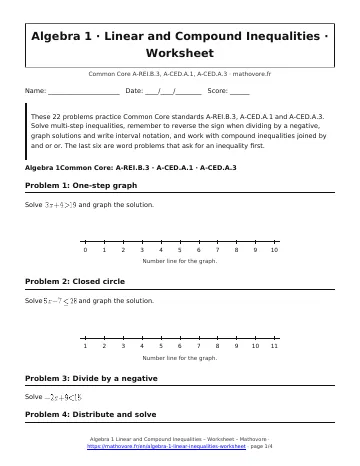
These 22 problems practice Common Core standards A-REI.B.3, A-CED.A.1 and A-CED.A.3. Solve multi-step inequalities, remember to reverse the sign when dividing by a negative, graph solutions and write interval notation, and work with compound inequalities joined by and or or. The last six are word problems that ask for an inequality first.
Algebra 1 Linear Inequalities Worksheet: problems 1–5
1. One-step graph
Solve \(3x+4>19\) and graph the solution.
2. Closed circle
Solve \(5x-7\le28\) and graph the solution.
3. Divide by a negative
Solve \(-2x+9< 15\).
4. Distribute and solve
Solve \(4(x-3)\ge2x+6\).
5. Variables on both sides
Solve \(7-3x>2x-8\).
Algebra 1 Linear Inequalities Worksheet: problems 6–10
6. Fraction coefficient
Solve \(\frac{x}{3}-2\le4\).
7. Negative fraction
Solve \(-\frac{2}{3}x\ge8\).
8. Negative outside parentheses
Solve \(-2(x+4)< 6\).
9. Fractions on both sides
Solve \(\frac{x+1}{2}\ge\frac{2x-1}{3}\).
10. Decimal inequality
Solve \(0.6x-1.5< 0.2x+2.5\).
Algebra 1 Linear Inequalities Worksheet: problems 11–15
11. All or none
Solve each inequality.
- \(3(x+2)>3x+1\)
- \(2x+5< 2x-1\)
12. Read the graph
Write an inequality and interval notation for each graph.
13. Compound with and
Solve \(-3< 2x+1\le9\) and graph the solution.
14. Compound with or
Solve \(2x-1<-5\text{ or }3x+2\ge11\) and graph the solution.
15. Three-part inequality
Solve \(4\le3x-2< 13\).
Algebra 1 Linear Inequalities Worksheet: problems 16–20
16. Overlap of two conditions
Solve \(x+3>1\text{ and }2x\le10\).
17. School store budget
Diego has \(\$50\). A backpack costs \(\$18.50\) and each T-shirt costs \(\$6.25\). Write and solve an inequality for the number of T-shirts \(t\) he can add. What is the greatest whole number?
18. Weekend job
Aisha earns \(\$12\) per hour and pays \(\$15\) for bus fare. She wants to take home at least \(\$150\). How many hours must she work?
19. Elevator limit
An elevator holds at most 1,200 pounds. Liam loads a cart that weighs 180 pounds and boxes that weigh 35 pounds each. How many boxes can he load?
20. Car rental
Rental company A charges \(\$30\) per day plus \(\$0.20\) per mile. Company B charges \(\$45\) per day with unlimited miles. For how many miles in one day is A cheaper?
Algebra 1 Linear Inequalities Worksheet: problems 21–22
21. Test average
Mei scored 88, 92 and 85 on three tests. She wants an average of at least 90 after the fourth test, and the highest possible score is 100. Write a compound inequality for her fourth score \(s\).
22. Saving up
Sofia has \(\$35\) and saves \(\$5\) each week. After how many weeks will she have between \(\$100\) and \(\$150\), inclusive?

What is covered by this algebra 1 linear inequalities worksheet?
Problems 1 and 2 solve and graph one-step-style cases, like \(3x+4>19\) and \(5x-7\le 28\). Next, problems 3 to 10 build skill with negatives, parentheses, fractions and decimals. Then problem 11 asks about inequalities that are always true or never true, such as \(3(x+2)>3x+1\).
After that, problems 12 to 16 read graphs and solve compound inequalities. Finally, problems 17 to 22 model real limits.
Which problems need extra care?
Problem 5, \(7-3x>2x-8\), has variables on both sides, so collect them before you divide. Next, problem 7 has a negative fraction, which reverses the sign. Problem 9 clears fractions on both sides, and a slip in the multipliers leads to the wrong direction. Problem 21 asks for a test score that brings Mei’s average to at least 90.
Also, problem 11 is tricky because the variable disappears. If the leftover statement is true, every real number works. Otherwise, no number does.
How do the limit problems turn into inequalities?
Look for the phrase that sets a boundary. At most means \(\le\), and at least means \(\ge\). Aisha earns $12 per hour and pays $15 for the bus, so \(12h-15\ge 150\) leads to \(h\ge 13.75\). Because she works whole hours, she needs 14. Similarly, the elevator holds at most 1,200 pounds, so \(180+35b\le 1200\) gives 29 boxes.
In other words, always interpret the algebra: round in the safe direction, and say what the number means.
What habits keep the sign under control?
Before dividing, glance at the sign of the divisor. If it is negative, write the reversed symbol right away. Then check a test number. For instance, if you found \(x<-4\), try -5 in the original. Because the statement holds, the direction is right. Meanwhile, a value like 0 should fail. As a result, a two-second check catches the most common slip.
How can you check graphs and intervals?
Compare the circle type with the symbol. An open circle goes with strict symbols, while a closed circle goes with symbols that include equality. Next, check the shading direction. For example, \(x>5\) shades right, so the interval is \((5,\infty)\). Likewise, \(x\le 7\) shades left, so the interval is \((-\infty,7]\). Also, always use a parenthesis at infinity, because infinity is not a number. In addition, read compound graphs from left to right, so the order of the endpoints stays correct. Therefore, a quick match of symbol, circle and shading finds almost every graphing slip.
How should you use the practice afterward?
Check each solution set against the key and redo any problem where the arrow pointed the wrong way. Next, write a limit story of your own and turn it into an inequality. To finish, take the quiz and see if the sign flip now happens without thought.

See every chapter on the Algebra 1 math page.