


This algebra 2 probability rules worksheet gives 24 problems on probability: sample spaces, independence and conditional probability, ordered from easy to hard, with a separate answer key.
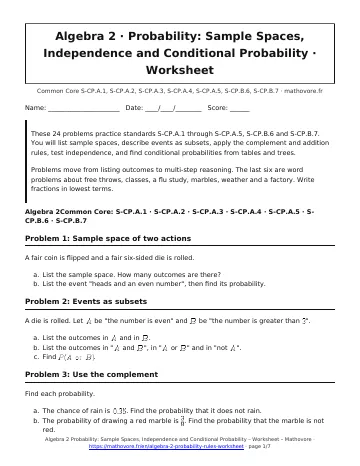
These 24 problems practice standards S-CP.A.1 through S-CP.A.5, S-CP.B.6 and S-CP.B.7. You will list sample spaces, describe events as subsets, apply the complement and addition rules, test independence, and find conditional probabilities from tables and trees.
Problems move from listing outcomes to multi-step reasoning. The last six are word problems about free throws, classes, a flu study, marbles, weather and a factory. Write fractions in lowest terms.
Algebra 2 Probability Rules Worksheet: problems 1–5
Problem 1: Sample space of two actions
A fair coin is flipped and a fair six-sided die is rolled.
- List the sample space. How many outcomes are there?
- List the event “heads and an even number”, then find its probability.
Problem 2: Events as subsets
A die is rolled. Let \(A\) be “the number is even” and \(B\) be “the number is greater than \(3\)”.
- List the outcomes in \(A\) and in \(B\).
- List the outcomes in “\(A\) and \(B\)”, in “\(A\) or \(B\)” and in “not \(A\)”.
- Find \(P(A\text{ or }B)\).
Problem 3: Use the complement
Find each probability.
- The chance of rain is \(0.35\). Find the probability that it does not rain.
- The probability of drawing a red marble is \(\frac{3}{8}\). Find the probability that the marble is not red.
- A fair coin is flipped three times . Find the probability of at least one head.
Problem 4: Cards from a deck
One card is drawn from a standard deck of \(52\) cards. Find each probability.
- The card is a heart.
- The card is a king.
- The card is a red face card (jack, queen or king).
- The card is not a spade.
Problem 5: Apply the addition rule
Find \(P(A\text{ or }B)\).
- \(P(A)=0.5\), \(P(B)=0.3\), \(P(A\text{ and }B)=0.1\)
- \(P(A)=\frac{3}{8}\), \(P(B)=\frac{1}{2}\), \(P(A\text{ and }B)=\frac{1}{8}\)
Algebra 2 Probability Rules Worksheet: problems 6–10
Problem 6: Find the overlap
Events \(A\) and \(B\) have \(P(A)=0.5\), \(P(B)=0.6\) and \(P(A\text{ or }B)=0.8\). Find \(P(A\text{ and }B)\).
Problem 7: Heart or king
One card is drawn from a standard deck. Find the probability that it is a heart or a king.
Problem 8: Read a Venn diagram
The Venn diagram shows how \(30\) students take part in soccer and art club. One student is chosen at random. Find each probability.
- The student plays soccer.
- The student is in art club.
- The student does both.
- The student does soccer or art.
- The student does neither.
Problem 9: Two dice
Two fair dice are rolled. The grid shows every sum. Find each probability.
- The sum is \(8\).
- The sum is at least \(10\).
- The dice show a double (the same number).
Problem 10: Mutually exclusive events
Events \(A\) and \(B\) are mutually exclusive, with \(P(A)=0.25\) and \(P(B)=0.4\).
- Find \(P(A\text{ and }B)\).
- Find \(P(A\text{ or }B)\).
- Can \(A\) and \(B\) be independent? Explain.
Algebra 2 Probability Rules Worksheet: problems 11–15
Problem 11: Test independence by the product
Decide whether \(A\) and \(B\) are independent.
- \(P(A)=0.4\), \(P(B)=0.5\), \(P(A\text{ and }B)=0.2\)
- \(P(A)=0.6\), \(P(B)=0.5\), \(P(A\text{ and }B)=0.35\)
Problem 12: Area model
The square represents independent events \(A\) and \(B\), with each region labeled by its area. Find each probability.
- \(P(A\text{ and }B)\)
- \(P(A\text{ or }B)\)
- \(P(\text{neither }A\text{ nor }B)\)
Problem 13: Coin and die
A fair coin is flipped and a fair die is rolled. The two results are independent. Find each probability.
- Heads and a \(5\).
- Tails and an even number.
- Heads and a number greater than \(4\).
Problem 14: Read a two-way table
The table shows \(100\) students by grade and pet ownership. One student is chosen at random. Find each probability.
- The student is in grade \(9\).
- The student has a pet.
- The student is in grade \(9\) and has a pet.
- The student is in grade \(9\) or has a pet.
Problem 15: Conditional from a table
Use the table in Exercise 14 to find each conditional probability.
- \(P(\text{pet}\,|\,\text{grade }9)\)
- \(P(\text{grade }9\,|\,\text{pet})\)
- \(P(\text{pet}\,|\,\text{grade }10)\)
Algebra 2 Probability Rules Worksheet: problems 16–20
Problem 16: Conditional probability formula
Solve each problem.
- If \(P(A\text{ and }B)=0.12\) and \(P(B)=0.4\), find \(P(A|B)\).
- If also \(P(A)=0.5\), find \(P(B|A)\).
- If \(P(A|B)=0.75\) and \(P(B)=0.2\), find \(P(A\text{ and }B)\).
Problem 17: Read a tree diagram
Two marbles are drawn without replacement from a bag of \(3\) green and \(2\) yellow marbles. The tree shows the probabilities.
- Find the probability of two green marbles.
- Find the probability that the two marbles have different colors.
- Find \(P(\text{second is yellow}\,|\,\text{first is green})\).
Problem 18: Independence in a table
The table shows \(100\) students by grade and whether they like soccer.
- Find \(P(\text{likes soccer})\).
- Find \(P(\text{likes soccer}\,|\,\text{grade }7)\).
- Are liking soccer and being in grade \(7\) independent? Explain.
Problem 19: Free throws
Ethan makes \(70\%\) of his free throws, and his shots are independent. He takes two shots. Find the probability that he
- makes both,
- misses both,
- makes exactly one.
Problem 20: Language and art classes
Of \(120\) students, \(70\) take Spanish, \(45\) take art, and \(20\) take both.
- Find the probability that a random student takes Spanish or art.
- Find the probability that a student takes neither.
- Find \(P(\text{art}\,|\,\text{Spanish})\) and \(P(\text{Spanish}\,|\,\text{art})\).
- Are taking Spanish and taking art independent? Show your work.
Algebra 2 Probability Rules Worksheet: problems 21–24
Problem 21: Flu shot study
A clinic recorded \(500\) patients. Of the \(200\) who got a flu shot, \(12\) caught the flu. Of the \(300\) who did not get a shot, \(45\) caught the flu.
- Find the probability of catching the flu given a flu shot.
- Find the probability of catching the flu given no shot.
- Find the probability that a patient who caught the flu had a shot.
- Are getting a shot and catching the flu independent? Explain.
Problem 22: Marbles without replacement
Sofia draws two marbles without replacement from a bag with \(6\) red and \(4\) blue marbles. Find the probability that
- both are red,
- the first is red and the second is blue,
- both are the same color.
Problem 23: Weekend weather
The chance of rain on Saturday is \(0.4\) and on Sunday is \(0.3\). Assume the days are independent.
- Find the probability of rain on both days.
- Find the probability of rain on at least one day.
- Find the probability of no rain on either day, and check it against part b.
Problem 24: Defective parts
A factory has two machines. Machine A makes \(60\%\) of the parts and \(2\%\) of its parts are defective. Machine B makes \(40\%\) of the parts and \(5\%\) of its parts are defective.
- Find the probability that a random part is defective.
- A part is found to be defective. Find the probability that it came from machine A.

How to use this algebra 2 probability rules worksheet
Print this algebra 2 probability rules worksheet as a PDF, solve every problem on paper, then compare with the answer key.

See every chapter on the Algebra 2 math page.