Key takeaway: This algebra 2 probability worksheet answer key lists the working and the result for every one of the 24 problems. Every answer states the rule it uses, which shows why that method applies. Confirm that your probabilities are between 0 and 1. Then compare your reasoning, because a right fraction from a wrong rule will fail on the next problem.
Each solution shows the rule used, the substitution and the result in bold. If your answer differs, check whether you used the right denominator for conditional probabilities and whether you subtracted the overlap in the addition rule.
Algebra 2 Probability Worksheet Answer Key: problems 1–5
1. Sample space of two actions
- Sample space: \(\{H1,H2,H3,H4,H5,H6,T1,T2,T3,T4,T5,T6\}\). There are 12 outcomes.
- The event is \(\{H2,H4,H6\}\), so \(P=\frac{3}{12}=\) \(\frac{1}{4}\).
2. Events as subsets
- \(A=\{2,4,6\}\) and \(B=\{4,5,6\}\).
- “\(A\) and \(B\)” \(=\{4,6\}\); “\(A\) or \(B\)” \(=\{2,4,5,6\}\); “not \(A\)” \(=\{1,3,5\}\).
- \(P(A\text{ or }B)=\frac{4}{6}=\) \(\frac{2}{3}\).
3. Use the complement
- \(1-0.35=\) \(0.65\)
- \(1-\frac{3}{8}=\) \(\frac{5}{8}\)
- The only outcome with no heads is TTT, with probability \(\frac{1}{8}\). So \(1-\frac{1}{8}=\) \(\frac{7}{8}\).
4. Cards from a deck
- \(\frac{13}{52}=\) \(\frac{1}{4}\)
- \(\frac{4}{52}=\) \(\frac{1}{13}\)
- There are \(3\) face cards in each of \(2\) red suits: \(\frac{6}{52}=\) \(\frac{3}{26}\)
- \(1-\frac{13}{52}=\frac{39}{52}=\) \(\frac{3}{4}\)
5. Apply the addition rule
- \(0.5+0.3-0.1=\) \(0.7\)
- \(\frac{3}{8}+\frac{4}{8}-\frac{1}{8}=\frac{6}{8}=\) \(\frac{3}{4}\)
Algebra 2 Probability Worksheet Answer Key: problems 6–10
6. Find the overlap
Rearrange the addition rule: \(P(A\text{ and }B)=P(A)+P(B)-P(A\text{ or }B)=0.5+0.6-0.8=\) \(0.3\).
7. Heart or king
\(P(\text{heart})=\frac{13}{52}\), \(P(\text{king})=\frac{4}{52}\), and the king of hearts is in both: \(\frac{1}{52}\).
\(\frac{13}{52}+\frac{4}{52}-\frac{1}{52}=\frac{16}{52}=\) \(\frac{4}{13}\)
8. Read a Venn diagram
Soccer total \(12+5=17\); art total \(8+5=13\).
- \(\frac{17}{30}\): \(\frac{17}{30}\)
- \(\frac{13}{30}\): \(\frac{13}{30}\)
- \(\frac{5}{30}=\) \(\frac{1}{6}\)
- \(\frac{17}{30}+\frac{13}{30}-\frac{5}{30}=\frac{25}{30}=\) \(\frac{5}{6}\)
- \(\frac{5}{30}=\) \(\frac{1}{6}\)
9. Two dice
- The sum is \(8\) for \((2,6),(3,5),(4,4),(5,3),(6,2)\): \(\frac{5}{36}\). \(\frac{5}{36}\)
- Sums \(10\), \(11\), \(12\) occur \(3+2+1=6\) ways: \(\frac{6}{36}=\) \(\frac{1}{6}\)
- Six doubles: \(\frac{6}{36}=\) \(\frac{1}{6}\)
10. Mutually exclusive events
- They cannot happen together: \(0\)
- \(0.25+0.4-0=\) \(0.65\)
- No. Independence needs \(P(A\text{ and }B)=0.25\cdot 0.4=0.1\), but the intersection is \(0\). Not independent
Algebra 2 Probability Worksheet Answer Key: problems 11–15
11. Test independence by the product
- \(0.4\cdot 0.5=0.2=P(A\text{ and }B)\): independent
- \(0.6\cdot 0.5=0.30\), but \(P(A\text{ and }B)=0.35\): not independent
12. Area model
The regions come from products: \(0.6\cdot0.5=0.30\), \(0.6\cdot0.5=0.30\), \(0.4\cdot0.5=0.20\), \(0.4\cdot0.5=0.20\).
- The violet region: \(0.30\)
- \(0.30+0.30+0.20=\) \(0.80\) (or \(0.6+0.5-0.3\))
- The gray region: \(0.20\)
13. Coin and die
- \(\frac{1}{2}\cdot\frac{1}{6}=\) \(\frac{1}{12}\)
- \(\frac{1}{2}\cdot\frac{3}{6}=\) \(\frac{1}{4}\)
- Numbers \(5\) and \(6\): \(\frac{1}{2}\cdot\frac{2}{6}=\) \(\frac{1}{6}\)
14. Read a two-way table
- \(\frac{50}{100}=\) \(\frac{1}{2}\)
- \(\frac{54}{100}=\) \(\frac{27}{50}\)
- \(\frac{30}{100}=\) \(\frac{3}{10}\)
- \(\frac{50+54-30}{100}=\frac{74}{100}=\) \(\frac{37}{50}\)
15. Conditional from a table
- Use the grade 9 column (\(50\) students): \(\frac{30}{50}=\) \(\frac{3}{5}\)
- Use the pet row (\(54\) students): \(\frac{30}{54}=\) \(\frac{5}{9}\)
- Grade 10 column: \(\frac{24}{50}=\) \(\frac{12}{25}\)
Algebra 2 Probability Worksheet Answer Key: problems 16–20
16. Conditional probability formula
- \(\frac{0.12}{0.4}=\) \(0.3\)
- \(\frac{0.12}{0.5}=\) \(0.24\)
- \(P(A\text{ and }B)=P(A|B)P(B)=0.75\cdot 0.2=\) \(0.15\)
17. Read a tree diagram
- \(\frac{3}{5}\cdot\frac{2}{4}=\frac{6}{20}=\) \(\frac{3}{10}\)
- Green then yellow \(\frac{3}{5}\cdot\frac{2}{4}=\frac{3}{10}\) plus yellow then green \(\frac{2}{5}\cdot\frac{3}{4}=\frac{3}{10}\): \(\frac{6}{10}=\) \(\frac{3}{5}\)
- Read the second branch after green: \(\frac{2}{4}=\frac{1}{2}\)
18. Independence in a table
- \(\frac{60}{100}=\) \(0.6\)
- \(\frac{24}{40}=\) \(0.6\)
- Yes. \(P(\text{soccer}\,|\,\text{grade }7)=P(\text{soccer})=0.6\). Also \(0.6\cdot 0.4=0.24=P(\text{soccer and grade }7)\). Independent
19. Free throws
- \(0.7\cdot 0.7=\) \(0.49\)
- \(0.3\cdot 0.3=\) \(0.09\)
- Make then miss, or miss then make: \(2(0.7)(0.3)=\) \(0.42\) (check: \(0.49+0.09+0.42=1\))
20. Language and art classes
- Both: \(20\); Spanish only \(50\); art only \(25\). \(\frac{70+45-20}{120}=\frac{95}{120}=\) \(\frac{19}{24}\)
- \(\frac{120-95}{120}=\frac{25}{120}=\) \(\frac{5}{24}\)
- \(\frac{20}{70}=\) \(\frac{2}{7}\) and \(\frac{20}{45}=\) \(\frac{4}{9}\)
- \(P(\text{Spanish})\cdot P(\text{art})=\frac{7}{12}\cdot\frac{3}{8}=\frac{7}{32}\approx 0.219\), but \(P(\text{both})=\frac{1}{6}\approx 0.167\). Not independent
Algebra 2 Probability Worksheet Answer Key: problems 21–24
21. Flu shot study
- \(\frac{12}{200}=\) \(0.06\)
- \(\frac{45}{300}=\) \(0.15\)
- Total who caught the flu: \(12+45=57\). \(\frac{12}{57}=\) \(\frac{4}{19}\)
- No. The flu rate is \(0.06\) with a shot and \(0.15\) without, so the shot changes the probability. Not independent
22. Marbles without replacement
- \(\frac{6}{10}\cdot\frac{5}{9}=\frac{30}{90}=\) \(\frac{1}{3}\)
- \(\frac{6}{10}\cdot\frac{4}{9}=\frac{24}{90}=\) \(\frac{4}{15}\)
- Both blue: \(\frac{4}{10}\cdot\frac{3}{9}=\frac{12}{90}\). Same color: \(\frac{30}{90}+\frac{12}{90}=\frac{42}{90}=\) \(\frac{7}{15}\)
23. Weekend weather
- \(0.4\cdot 0.3=\) \(0.12\)
- \(0.4+0.3-0.12=\) \(0.58\)
- \(0.6\cdot 0.7=\) \(0.42\). Check: \(1-0.58=0.42\).
24. Defective parts
- \(P(\text{defective})=0.6\cdot 0.02+0.4\cdot 0.05=0.012+0.020=\) \(0.032\)
- \(P(A|\text{defective})=\frac{0.6\cdot 0.02}{0.032}=\frac{0.012}{0.032}=\) \(\frac{3}{8}=0.375\)
What are the answers to the rule problems?
Problem 1 has 12 outcomes. The complement in problem 3 is 0.65. For problem 5, the union is 0.7, and problem 6 gives an overlap of 0.3. The heart-or-king answer is \(\frac{16}{52}=\frac{4}{13}\). Mutually exclusive events in problem 10 have \(P(A\text{ and }B)=0\), so the union is 0.65.
Which independence and conditional answers matter?
For \(P(A)=0.4\), \(P(B)=0.5\) and a joint of 0.2, the product equals the joint, so independence holds. In problem 16, \(P(A|B)=\frac{0.12}{0.4}=0.3\). Because \(P(A)=0.5\), the two differ and the events are not independent. For the marbles in problem 17, both green has probability \(\frac{3}{5}\cdot\frac{2}{4}=\frac{3}{10}\).
How do the context answers read?
Two free throws at 70% give 0.49. The language and art problem has \(\frac{95}{120}=\frac{19}{24}\). For weekend weather, rain on both days is \(0.4\cdot 0.3=0.12\), no rain at all is \(0.6\cdot 0.7=0.42\), and at least one rainy day is \(1-0.42=0.58\). The flu shot group has a 6% rate, since \(\frac{12}{200}=0.06\).
How do you learn from the key?
Circle each problem where you picked the wrong rule, then write the rule name beside it. Next, redo it from a blank page. If you again choose a wrong rule, read the lesson example that matches. This slow loop fixes the root cause.

Printable PDF · Worksheet Answer Key
Algebra 2 Probability: Sample Spaces, Independence and Conditional Probability worksheet answer key
Download the PDF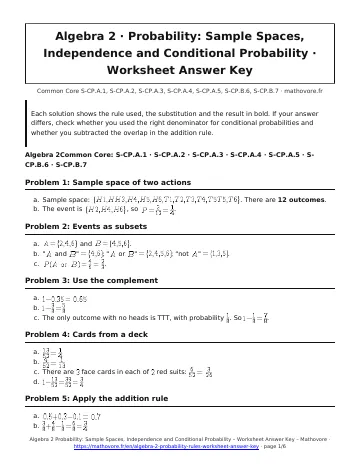
See every chapter on the Algebra 2 math page.