

This algebra 2 exponential models worksheet gives 24 problems on exponential functions and the number e, ordered from easy to hard, with a separate answer key.
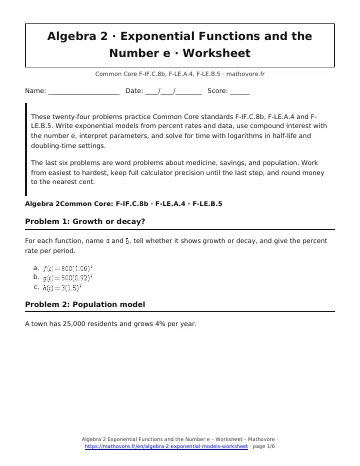
These twenty-four problems practice Common Core standards F-IF.C.8b, F-LE.A.4 and F-LE.B.5. Write exponential models from percent rates and data, use compound interest with the number e, interpret parameters, and solve for time with logarithms in half-life and doubling-time settings.
The last six problems are word problems about medicine, savings, and population. Work from easiest to hardest, keep full calculator precision until the last step, and round money to the nearest cent.
Algebra 2 Exponential Models Worksheet: problems 1–5
Problem 1: Growth or decay?
For each function, name \(a\) and \(b\), tell whether it shows growth or decay, and give the percent rate per period.
- \(f(t)=800(1.06)^{t}\)
- \(g(t)=500(0.92)^{t}\)
- \(h(t)=3(1.5)^{t}\)
Problem 2: Population model
A town has 25,000 residents and grows 4% per year.
- Write a model \(P(t)\).
- Find the population after 5 years and after 10 years, to the nearest whole number.
Problem 3: Depreciation model
A new car costs $28,000 and loses 15% of its value each year.
- Write a model \(V(t)\).
- Find its value after 4 years.
Problem 4: Evaluate powers of e
Use a calculator to evaluate each value to three decimal places.
- \(e^{2}\)
- \(e^{-1}\)
- \(e^{0.5}\)
Problem 5: Annual compounding
Find the balance of $1,200 invested at 5% interest compounded annually for 8 years.
Algebra 2 Exponential Models Worksheet: problems 6–10
Problem 6: Quarterly compounding
Find the balance of $3,000 invested at 6% compounded quarterly for 5 years.
Problem 7: Monthly compounding
Find the balance of $5,000 invested at 3.6% compounded monthly for 10 years.
Problem 8: Continuous compounding
Find the balance of $4,000 invested at 5% compounded continuously for 7 years.
Problem 9: Compare compounding methods
Compare four ways to compound $1,000 at 8% for 1 year.
- Find the balance for yearly, twice-a-year, monthly, and continuous compounding.
- How much more does continuous compounding earn than yearly compounding?
Problem 10: Interpret the parameters
Interpret each model in words.
- \(N(t)=1500(1.08)^{t}\), where \(N\) is the balance in dollars after \(t\) years
- \(C(t)=240(0.85)^{t}\), where \(C\) is the concentration of a medicine in mg/L \(t\) hours after a dose
Algebra 2 Exponential Models Worksheet: problems 11–15
Problem 11: Find the rate from data
A bank balance grows from $400 to $441 in 2 years with the same percent increase each year. Find the yearly factor and the percent rate.
Problem 12: Model from two points
An exponential function \(f(t)=a\cdot b^{t}\) passes through the points shown.
- Find \(a\) and \(b\).
- Write \(f(t)\) and find \(f(5)\).
Problem 13: Equivalent forms of a rate
A balance follows \(A(t)=1000(1.08)^{t}\) with \(t\) in years.
- Rewrite \(A(t)\) as \(1000(b^{12})^{t}\) to find the equivalent monthly growth factor.
- What is the equivalent monthly growth rate, to the nearest hundredth of a percent?
Problem 14: Solve with logarithms
Solve \(3\cdot 2^{t}=50\) for \(t\). Give an exact answer and a decimal rounded to hundredths.
Problem 15: Time to reach a goal
Aisha invests $1,200 at 5% compounded annually. Solve \(1200(1.05)^{t}=2000\) to find when the balance reaches $2,000.
Algebra 2 Exponential Models Worksheet: problems 16–20
Problem 16: Doubling time
An investment grows 4% per year. Find its doubling time to the nearest hundredth of a year.
Problem 17: Half-life model
A 80 mg sample of a medicine has a half-life of 6 hours, so \(A(t)=80(\frac{1}{2})^{t/6}\).
- Find the amount after 18 hours.
- Find the amount after 15 hours, to the nearest hundredth of a mg.
Problem 18: Decay time with logs
A 100 g sample of an isotope has a half-life of 12 days. After how many days will 20 g remain? Round to hundredths.
Problem 19: Continuous growth model
A culture has 500 bacteria, and the count grows continuously as \(N(t)=500e^{kt}\). It reaches 2,000 after 6 hours.
- Find \(k\) to four decimal places.
- Predict the number of bacteria after 10 hours, to the nearest whole number.
Problem 20: Read a half-life from a graph
The graph shows the amount of a medicine in a patient.
- Read the half-life from the graph.
- Write a model \(A(t)\).
- Find the amount after 15 hours and the time when 1 mg remains.
Algebra 2 Exponential Models Worksheet: problems 21–24
Problem 21: Compare two accounts
Diego puts $2,000 in an account paying 5.2% compounded monthly. Priya puts $2,000 in an account paying 5.25% compounded continuously. Find each balance after 10 years and decide who has more.
Problem 22: Tripling time
Ethan invests money at 6% compounded continuously. How long until it triples? Round to hundredths.
Problem 23: Savings goal
Sofia invests $6,000 at 4.5% compounded monthly. Find how long it takes to reach $10,000, to the nearest hundredth of a year.
Problem 24: Shrinking town
A town of 40,000 residents loses 2.5% of its population each year.
- Write a model \(P(t)\).
- After how many whole years will the population first be below 30,000? Support your answer with calculations.

How to use this algebra 2 exponential models worksheet
Print this algebra 2 exponential models worksheet as a PDF, solve every problem on paper, then compare with the answer key.

See every chapter on the Algebra 2 math page.