
Key takeaway: This algebra 2 exponential worksheet answer key presents the model, the substitution and the rounded value for each of the 24 problems here, with one line of reasoning per step. Also, a small difference in the last decimal often comes from rounding too early. Then compare each growth factor with the key, because a wrong base changes every later number. Finally, check each logarithm answer by putting it back into the original equation.
Each solution shows the model, the substitution, and the rounded result in bold. Small differences in the last decimal can come from rounding too early, so keep full precision until the final step. Check every logarithm answer by substituting it back into the original equation.
Algebra 2 Exponential Worksheet Answer Key: problems 1–5
1. Growth or decay?
- \(a=800\), \(b=1.06\): growth of 6% per period.
- \(a=500\), \(b=0.92\): decay of 8% (since \(1-0.92=0.08\)).
- \(a=3\), \(b=1.5\): growth of 50%.
2. Population model
- \(P(t)=25000(1.04)^{t}\), because \(b=1+0.04\).
- \(P(5)=25000(1.04)^{5}\approx\) 30,416 and \(P(10)=25000(1.04)^{10}\approx\) 37,006.
3. Depreciation model
- \(V(t)=28000(0.85)^{t}\), since \(b=1-0.15=0.85\).
- \(V(4)=28000(0.85)^{4}\approx\) $14,616.17.
4. Evaluate powers of e
- \(e^{2}\approx\) 7.389
- \(e^{-1}=\frac{1}{e}\approx\) 0.368
- \(e^{0.5}=\sqrt{e}\approx\) 1.649
5. Annual compounding
\(A=1200(1.05)^{8}\), so the balance is $1,772.95.
Algebra 2 Exponential Worksheet Answer Key: problems 6–10
6. Quarterly compounding
\(A=3000(1+\frac{0.06}{4})^{4\cdot 5}=3000(1.015)^{20}\), so the balance is $4,040.57.
7. Monthly compounding
\(A=5000(1+\frac{0.036}{12})^{120}=5000(1.003)^{120}\), so the balance is $7,162.79.
8. Continuous compounding
\(A=4000e^{0.05\cdot 7}=4000e^{0.35}\), so the balance is $5,676.27.
9. Compare compounding methods
- Yearly: \(1000(1.08)\) = $1,080.00. Twice a year: \(1000(1.04)^{2}\) = $1,081.60. Monthly: \(1000(1+\frac{0.08}{12})^{12}\) = $1,083.00. Continuous: \(1000e^{0.08}\) = $1,083.29.
- $1,083.29 − $1,080.00 = $3.29 (using unrounded balances).
10. Interpret the parameters
- The account starts with $1,500 and grows 8% per year since \(1.08=1+0.08\). Each year the balance is multiplied by 1.08.
- The dose starts at 240 mg/L and the concentration falls 15% each hour, since \(0.85=1-0.15\).
Algebra 2 Exponential Worksheet Answer Key: problems 11–15
11. Find the rate from data
Let \(b\) be the yearly factor. Then \(400b^{2}=441\), so \(b^{2}=\frac{441}{400}\) and \(b=\frac{21}{20}=1.05\). The rate is 5% per year. Check: \(400(1.05)^{2}=441\).
12. Model from two points
- \(f(0)=a=6\). Then \(6b^{3}=48\), so \(b^{3}=8\) and \(b=2\) (so \(a=6\)).
- \(f(t)=6\cdot 2^{t}\), and \(f(5)=6\cdot 32=\)192.
13. Equivalent forms of a rate
- \(1.08^{t}=(1.08^{1/12})^{12t}\), so \(b=1.08^{1/12}\approx\) 1.00643.
- The monthly rate is \(b-1\approx\) 0.64% per month. This is less than \(\frac{8\%}{12}\approx 0.67\%\) because interest on interest builds up.
14. Solve with logarithms
Divide by 3: \(2^{t}=\frac{50}{3}\). Take the natural log: \(t\ln 2=\ln\frac{50}{3}\). So \(t=\frac{\ln(50/3)}{\ln 2}\approx\) 4.06.
15. Time to reach a goal
\(1.05^{t}=\frac{5}{3}\), so \(t=\frac{\ln(5/3)}{\ln 1.05}\approx\) 10.47 years. Check: \(1200(1.05)^{10.47}\approx 2000\).
Algebra 2 Exponential Worksheet Answer Key: problems 16–20
16. Doubling time
Solve \(1.04^{t}=2\): \(t=\frac{\ln 2}{\ln 1.04}\approx\) 17.67 years. The starting amount does not matter, because \(a\cdot 1.04^{t}=2a\) reduces to \(1.04^{t}=2\).
17. Half-life model
- \(A(18)=80(\frac{1}{2})^{3}=80\cdot\frac{1}{8}=\)10 mg.
- \(A(15)=80(\frac{1}{2})^{2.5}\approx\) 14.14 mg. This lies between 20 mg (12 h) and 10 mg (18 h).
18. Decay time with logs
Solve \(100(\frac{1}{2})^{t/12}=20\): \((\frac{1}{2})^{t/12}=\frac{1}{5}\), so \(\frac{t}{12}\ln\frac{1}{2}=\ln\frac{1}{5}\) and \(\frac{t}{12}=\frac{\ln 5}{\ln 2}\). Then \(t=12\cdot\frac{\ln 5}{\ln 2}\approx\) 27.86 days.
19. Continuous growth model
- \(500e^{6k}=2000\), so \(e^{6k}=4\) and \(k=\frac{\ln 4}{6}\approx\) 0.2310.
- \(N(10)=500e^{10k}=500\cdot 4^{10/6}\approx\) 5,040 bacteria.
20. Read a half-life from a graph
- The amount drops from 64 to 32 between \(t=0\) and \(t=3\), so the half-life is 3 hours.
- \(A(t)=64(\frac{1}{2})^{t/3}\).
- \(A(15)=64(\frac{1}{2})^{5}=\)2 mg. For 1 mg, \((\frac{1}{2})^{t/3}=\frac{1}{64}=(\frac{1}{2})^{6}\), so \(t=\)18 hours.
Algebra 2 Exponential Worksheet Answer Key: problems 21–24
21. Compare two accounts
Diego: \(2000(1+\frac{0.052}{12})^{120}\approx\) $3,360.28. Priya: \(2000e^{0.0525\cdot 10}=2000e^{0.525}\approx\) $3,380.92. Priya has more, by $20.64.
22. Tripling time
Solve \(Pe^{0.06t}=3P\): \(e^{0.06t}=3\), so \(0.06t=\ln 3\) and \(t=\frac{\ln 3}{0.06}\approx\) 18.31 years.
23. Savings goal
Solve \(6000(1.00375)^{12t}=10000\): \((1.00375)^{12t}=\frac{5}{3}\), so \(12t\ln 1.00375=\ln\frac{5}{3}\). Then \(t=\frac{\ln(5/3)}{12\ln 1.00375}\approx\) 11.37 years. Check: \(6000(1.00375)^{12(11.35)}\approx 10000\).
24. Shrinking town
- \(P(t)=40000(0.975)^{t}\).
- Solve \(40000(0.975)^{t}=30000\): \(0.975^{t}=0.75\), so \(t=\frac{\ln 0.75}{\ln 0.975}\approx\) 11.36. Check: \(P(11)\approx\) 30,277 is still above 30,000, and \(P(12)\approx\) 29,520 is below. The answer is 12 years.
How do you read the compound interest answers?
Problem 5 gives about $1,772.95, because \(1200(1.05)^{8}\approx 1772.95\). Then problem 6 gives about $4,040.57 for quarterly compounding over 5 years. Meanwhile, problem 8 gives \(4000e^{0.35}\approx 5676.27\). Because continuous growth uses e, no n appears. Likewise, problem 9 gives $1,080.00, $1,082.43, $1,083.00 and $1,083.29. Therefore, more frequent compounding helps, but the gains shrink.
Which model answers deserve a second look?
Problem 2 gives about 37,006 residents after ten years, and problem 3 gives about $14,616. Also, problem 11 gives a factor of 1.05, so the rate is 5 percent. However, problem 12 gives \(f(t)=6\cdot 2^{t}\), because \(a=6\) and \(b=2\). In addition, problem 4 gives 7.389, 0.368 and 1.649. As a result, check your calculator mode before you trust a decimal.
What do the time answers show?
Problem 14 gives \(t=\log_{2}\frac{50}{3}\approx 4.06\). Then problem 15 gives about 10.47 years, and problem 16 gives about 17.67 years. Meanwhile, problem 18 gives about 27.86 days. Because problem 19 doubles twice in 6 hours, \(k=\frac{\ln 4}{6}\approx 0.231\). Finally, problem 22 gives about 18.31 years, and problem 23 gives about 11.37 years.
What if your balance is slightly off?
Recompute with more digits in the base. Then compare the compounding count n with the problem. Also, confirm that you used the rate as a decimal. After that, round once at the end.

Printable PDF · Worksheet Answer Key
Algebra 2 Exponential Functions and the Number e worksheet answer key
Download the PDF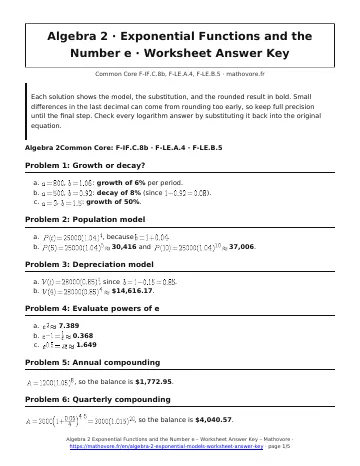
See every chapter on the Algebra 2 math page.