


This algebra 2 exponential models lesson explains exponential functions and the number e in one printable page, with definitions, a method and a worked example.
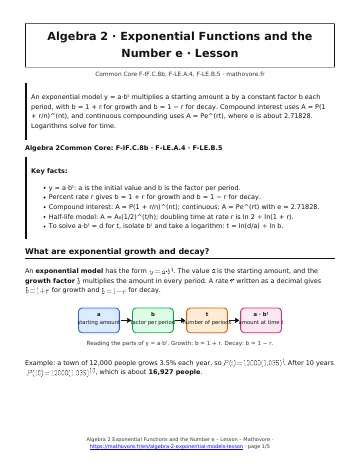
An exponential model y = a·bᵗ multiplies a starting amount a by a constant factor b each period, with b = 1 + r for growth and b = 1 − r for decay. Compound interest uses A = P(1 + r/n)^(nt), and continuous compounding uses A = Pe^(rt), where e is about 2.71828. Logarithms solve for time.
Algebra 2 Exponential Models Lesson: key facts
- y = a·bᵗ: a is the initial value and b is the factor per period.
- Percent rate r gives b = 1 + r for growth and b = 1 − r for decay.
- Compound interest: A = P(1 + r/n)^(nt); continuous: A = Pe^(rt) with e ≈ 2.71828.
- Half-life model: A = A₀(1/2)^(t/h); doubling time at rate r is ln 2 ÷ ln(1 + r).
- To solve a·bᵗ = d for t, isolate bᵗ and take a logarithm: t = ln(d/a) ÷ ln b.
What are exponential growth and decay?
An exponential model has the form \(y=a\cdot b^{t}\). The value \(a\) is the starting amount, and the growth factor \(b\) multiplies the amount in every period. A rate \(r\) written as a decimal gives \(b=1+r\) for growth and \(b=1-r\) for decay.
Example: a town of 12,000 people grows 3.5% each year, so \(P(t)=12000(1.035)^{t}\). After 10 years \(P(10)=12000(1.035)^{10}\), which is about 16,927 people.
Initial value: the amount at \(t=0\), which is the \(y\)-intercept \((0,a)\).
Growth or decay factor: the number \(b\) that multiplies the amount each period. If \(b>1\) the model grows, and if \(0< b< 1\) it decays.
Rate: the percent change per period, \(r=|b-1|\).
Changing the time unit changes the factor but not the story. A yearly factor of 1.08 equals a monthly factor of \(1.08^{1/12}\), about 1.0064, because twelve months must multiply to 1.08. Every graph of \(y=a\cdot b^{t}\) crosses the \(y\)-axis at \(a\) and never touches the \(t\)-axis, which is a horizontal asymptote.
How does compound interest lead to the number e?
With principal \(P\), annual rate \(r\), and \(n\) compounding periods per year, the balance after \(t\) years is \(A=P(1+\frac{r}{n})^{nt}\). As \(n\) grows, the balance approaches a limit, and the factor \((1+\frac{1}{n})^{n}\) approaches the irrational number \(e\approx 2.71828\). Compounding continuously gives \(A=Pe^{rt}\).
Invest $2,500 at 4% for 6 years. Quarterly: \(A=2500(1.01)^{24}\) gives $3,174.34. Continuous: \(A=2500e^{0.24}\) gives $3,178.12.
How do half-life and doubling time work?
A quantity with half-life \(h\) follows \(A(t)=A_{0}(\frac{1}{2})^{t/h}\). A sample of 80 mg with \(h=6\) hours has \(A(18)=80(\frac{1}{2})^{3}=10\) mg. To find an unknown time, isolate the power and take a logarithm: the equation \(1.05^{t}=2\) gives \(t=\frac{\ln 2}{\ln 1.05}\), so the doubling time at 5% growth is about 14.21 years.
Exponential Functions and the Number e: frequently asked questions
How do you turn a percent rate into a growth factor?
Write the rate as a decimal and add it for growth or subtract it for decay. A 6% increase gives b = 1.06, and a 15% decrease gives b = 0.85.
What is the number e?
The number e is about 2.71828. It is the limit of (1 + 1/n)ⁿ as n grows without bound, and it is the base used for continuous growth, as in A = Pe^(rt).
Does compounding more often always earn more?
Yes, but the gain shrinks quickly. At 6% on $1,000 for one year, yearly compounding earns $60.00 and monthly compounding earns $61.68, while continuous compounding earns only $61.84.
How do you solve for time in an exponential equation?
Isolate the exponential expression, take the natural log of both sides, and use the power rule. For 1200(1.05)^t = 2000, divide to get 1.05^t = 5/3, so t = ln(5/3) ÷ ln(1.05).
What is the difference between half-life and doubling time?
Half-life is the time for a decaying quantity to fall to half, and doubling time is the time for a growing quantity to reach twice its value. Both use the same idea: the amount changes by a fixed factor over a fixed time.
How to use this algebra 2 exponential models lesson
Use this algebra 2 exponential models lesson before the worksheet, then check what you learned with the quiz.

See every chapter on the Algebra 2 math page.