Key takeaway: This geometry modeling 3d worksheet answer key names the shape or formula, shows the substitution and ends with the result. Use it to check units, and compare your reasoning on the design problems step by step.
Each worked solution names the shape or formula, shows the substitution and ends with the final answer in bold. Use the answers to check units, and compare your reasoning for the design problems step by step.
Geometry Modeling 3d Worksheet Answer Key: problems 1–5
1. Slicing a cube
A cut parallel to a face of a cube is a square the same size as the face.
The area is \(6\times 6=36\text{ cm}^{2}\).
Answer: a square with area \(36\text{ cm}^{2}\).
2. Rectangle from a cylinder
The cross section is a rectangle. Its width is the diameter, \(2\times 4=8\text{ cm}\), and its height is \(10\text{ cm}\).
Area \(=8\times 10=80\text{ cm}^{2}\).
Answer: a rectangle, \(8\text{ cm}\) by \(10\text{ cm}\), area \(80\text{ cm}^{2}\).
3. Circle from a cylinder
The cross section is a circle with the same radius, \(5\text{ cm}\).
Area \(=\pi(5)^{2}=25\pi\approx 78.54\text{ cm}^{2}\). Circumference \(=2\pi(5)=10\pi\approx 31.42\text{ cm}\).
Answer: a circle; \(25\pi\text{ cm}^{2}\); \(10\pi\text{ cm}\).
4. Cutting a cone
(a) A circle. (b) An isosceles triangle with base \(2\times 3=6\text{ in}\) and height \(4\text{ in}\).
(c) Area \(=\frac{1}{2}(6)(4)=12\text{ in}^{2}\).
Answers: circle; triangle; \(12\text{ in}^{2}\).
5. Slicing a sphere
The radius of the sphere, the distance \(5\), and the slice radius form a right triangle with hypotenuse 13.
\(x^{2}+5^{2}=13^{2}\), so \(x^{2}=144\) and \(x=12\text{ in}\).
Area \(=\pi(12)^{2}=144\pi\approx 452.39\text{ in}^{2}\).
Answer: radius \(12\text{ in}\); area \(144\pi\text{ in}^{2}\).
Geometry Modeling 3d Worksheet Answer Key: problems 6–10
6. Slicing a pyramid
Halfway up, the cross section is a smaller square similar to the base with scale factor \(\frac{1}{2}\).
Side \(=\frac{1}{2}(10)=5\text{ cm}\). Area \(=5^{2}=25\text{ cm}^{2}\), which is \(\frac{1}{4}\) of the base area \(100\text{ cm}^{2}\).
Answer: a square with side \(5\text{ cm}\) and area \(25\text{ cm}^{2}\).
7. Slices of a prism
A cut parallel to a face is a rectangle congruent to that face.
The \(6\) by \(4\) faces give \(24\text{ cm}^{2}\). The \(6\) by \(3\) faces give \(18\text{ cm}^{2}\). The \(4\) by \(3\) faces give \(12\text{ cm}^{2}\).
Answer: \(24\text{ cm}^{2}\), \(18\text{ cm}^{2}\), \(12\text{ cm}^{2}\).
8. Rotating a rectangle
The solid is a cylinder with radius \(3\text{ cm}\) and height \(7\text{ cm}\).
\(V=\pi(3)^{2}(7)=63\pi\approx 197.92\text{ cm}^{3}\).
Answer: cylinder, \(r=3\text{ cm}\), \(h=7\text{ cm}\), \(V=63\pi\text{ cm}^{3}\).
9. Rotating a right triangle
The solid is a cone with radius \(6\text{ in}\) and height \(8\text{ in}\).
Slant height \(=\sqrt{6^{2}+8^{2}}=\sqrt{100}=10\text{ in}\).
\(V=\frac{1}{3}\pi(6)^{2}(8)=96\pi\approx 301.59\text{ in}^{3}\).
Answer: cone; slant height \(10\text{ in}\); \(V=96\pi\text{ in}^{3}\).
10. Rotating about the other leg
Now the radius is \(8\text{ in}\) and the height is \(6\text{ in}\): \(V=\frac{1}{3}\pi(8)^{2}(6)=128\pi\approx 402.12\text{ in}^{3}\).
Difference: \(128\pi-96\pi=32\pi\approx 100.53\text{ in}^{3}\).
Answer: \(128\pi\text{ in}^{3}\); \(32\pi\text{ in}^{3}\) more.
Geometry Modeling 3d Worksheet Answer Key: problems 11–15
11. Rotating a semicircle
The solid is a sphere with radius \(5\text{ cm}\).
\(V=\frac{4}{3}\pi(5)^{3}=\frac{500\pi}{3}\approx 523.60\text{ cm}^{3}\).
Answer: sphere; \(\frac{500\pi}{3}\approx 523.60\text{ cm}^{3}\).
12. Rotating a triangle about its altitude
The solid is a cone. The base of the triangle becomes the circle, so \(r=8: 2=4\text{ in}\), and \(h=5\text{ in}\).
\(V=\frac{1}{3}\pi(4)^{2}(5)=\frac{80\pi}{3}\approx 83.78\text{ in}^{3}\).
Answer: cone; \(\frac{80\pi}{3}\approx 83.78\text{ in}^{3}\).
13. Modeling a tree trunk
The radius is \(1\text{ ft}\). \(V=\pi(1)^{2}(30)=30\pi\approx 94.25\text{ ft}^{3}\).
Answer: about \(94.25\text{ ft}^{3}\).
14. Population density
Density \(=45{,}000: 30=1{,}500\).
Answer: 1,500 people per square mile.
15. Density of a county
Area \(=12\times 9=108\text{ mi}^{2}\).
Density \(=54{,}000: 108=500\).
Answer: \(108\text{ mi}^{2}\); 500 people per square mile.
Geometry Modeling 3d Worksheet Answer Key: problems 16–20
16. Heating a room
Volume \(=12\times 10\times 8=960\text{ ft}^{3}\).
BTUs \(=960\times 6=5{,}760\).
Answer: 5,760 BTUs.
17. Density of a metal block
Volume \(=5\times 4\times 3=60\text{ cm}^{3}\).
Density \(=162: 60=2.7\).
Answer: \(2.7\text{ g/cm}^{3}\).
18. Comparing towns
Town A: \(9{,}600: 12=800\) people per \(\text{mi}^{2}\). Town B: \(7{,}350: 7=1{,}050\) people per \(\text{mi}^{2}\).
\(1{,}050-800=250\).
Answer: Town B, by 250 people per square mile.
19. Fencing a pen
The length and width add to \(48: 2=24\text{ ft}\). Test pairs: \(8\times 16=128\), \(10\times 14=140\), \(11\times 13=143\), \(12\times 12=144\), and the areas then decrease.
The best pen is \(12\text{ ft}\) by \(12\text{ ft}\) with area \(144\text{ ft}^{2}\). Compared with \(128\text{ ft}^{2}\), it adds \(16\text{ ft}^{2}\).
Answer: \(12\text{ ft}\) by \(12\text{ ft}\); \(16\text{ ft}^{2}\) more.
20. Two soup cans
Volumes: A: \(\pi(9)(8)=72\pi\). B: \(\pi(16)(4.5)=72\pi\).
Surface area \(=2\pi r^{2}+2\pi rh\). A: \(18\pi+48\pi=66\pi\approx 207.35\text{ cm}^{2}\). B: \(32\pi+36\pi=68\pi\approx 213.63\text{ cm}^{2}\).
Answer: Can A needs less metal (\(66\pi\text{ cm}^{2}\) versus \(68\pi\text{ cm}^{2}\)).
Geometry Modeling 3d Worksheet Answer Key: problems 21–24
21. Sizing a water tank
Volume needed \(=1000: 7.5\approx 133.33\text{ ft}^{3}\).
\(\pi(3)^{2}h\ge 133.33\), so \(h\ge\frac{133.33}{9\pi}\approx 4.72\).
Rounding up to the next tenth so the tank holds enough: \(4.8\text{ ft}\).
22. Choosing a shipping box
Volumes: \(10\times 8\times 6=480\text{ in}^{3}\) and \(12\times 8\times 5=480\text{ in}^{3}\).
Surface areas: Box 1: \(2(80+60+48)=376\text{ in}^{2}\). Box 2: \(2(96+60+40)=392\text{ in}^{2}\).
Costs: \(376\times 0.02=\$7.52\) and \(392\times 0.02=\$7.84\).
Answer: Box 1 is cheaper by \(\$0.32\).
23. Banner grid
Margins use \(2\times 3=6\text{ in}\) and gutters use \(2\times 3=6\text{ in}\), so \(36-6-6=24\text{ in}\) remain for the columns.
Each column is \(24: 3=8\text{ in}\).
Answer: \(8\text{ in}\).
24. Crowded field
Area \(=120\times 80=9{,}600\text{ yd}^{2}\).
(a) \(14{,}400: 9{,}600=1.5\) people per \(\text{yd}^{2}\).
(b) Maximum \(=2\times 9{,}600=19{,}200\) people, so \(19{,}200-14{,}400=4{,}800\) more.
Answers: 1.5 people per square yard; 4,800 more people.
How do you read the solids answer key?
Begin with number 5, where the circle radius is 12 and the area is \(144\pi\) square inches. Number 9 gives a cone volume of \(96\pi\) cubic inches, and number 10 gives \(128\pi\). If you swapped them, you used the wrong leg as the axis.
Which density answers need extra care?
The county in problem 15 has area 108 square miles and density 500 per square mile. Problem 14 gives 1,500. Problem 24 has area 9,600 square yards, so 14,400 people give 1.5 per square yard. Always divide the amount by the area, not the reverse.
What should you notice in the modeling answers?
The tree trunk in problem 13 has radius 1 foot, so its volume is \(30\pi\) cubic feet, about 94.2. The pen in problem 19 reaches its maximum when the sides are equal at 12 feet.
Why might your volume differ?
Check radius against diameter first. Then see whether you cubed the units or left them linear. After that, recompute with the correct axis of rotation.

Printable PDF · Worksheet Answer Key
Geometry Cross Sections, Solids of Rotation and Geometric Modeling worksheet answer key
Download the PDF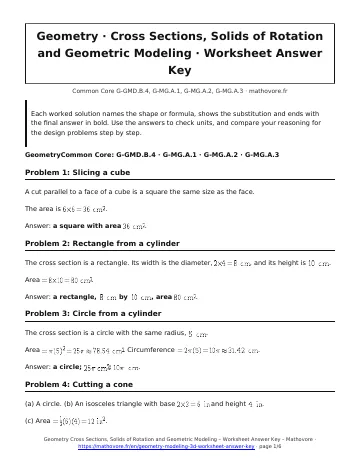
See every chapter on the Geometry math page.