


This geometry coordinate test checks coordinate geometry proofs in 45 minutes, with 9 questions for a total of 20 points.
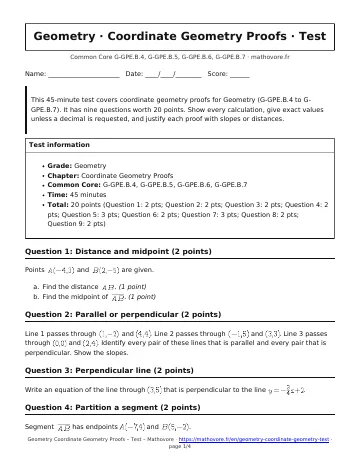
This 45-minute test covers coordinate geometry proofs for Geometry (G-GPE.B.4 to G-GPE.B.7). It has nine questions worth 20 points. Show every calculation, give exact values unless a decimal is requested, and justify each proof with slopes or distances.
- Grade: Geometry
- Chapter: Coordinate Geometry Proofs
- Common Core: G-GPE.B.4, G-GPE.B.5, G-GPE.B.6, G-GPE.B.7
- Time: 45 minutes
- Total: 20 points (Question 1: 2 pts; Question 2: 2 pts; Question 3: 2 pts; Question 4: 2 pts; Question 5: 3 pts; Question 6: 2 pts; Question 7: 3 pts; Question 8: 2 pts; Question 9: 2 pts)
Geometry Coordinate Test: questions 1–5
Question 1: Distance and midpoint (2 points)
Points \(A(-4,3)\) and \(B(2,-5)\) are given.
- Find the distance \(AB\). (1 point)
- Find the midpoint of \(\overline{AB}\). (1 point)
Question 2: Parallel or perpendicular (2 points)
Line 1 passes through \((1,-2)\) and \((4,4)\). Line 2 passes through \((-1,5)\) and \((3,3)\). Line 3 passes through \((0,0)\) and \((2,4)\). Identify every pair of these lines that is parallel and every pair that is perpendicular. Show the slopes.
Question 3: Perpendicular line (2 points)
Write an equation of the line through \((3,5)\) that is perpendicular to the line \(y=-\frac{3}{4}x+2\).
Question 4: Partition a segment (2 points)
Segment \(\overline{AB}\) has endpoints \(A(-7,4)\) and \(B(5,-2)\).
- Find the point that partitions \(\overline{AB}\) in the ratio \(1:2\) from \(A\). (1 point)
- Find the point that partitions \(\overline{AB}\) in the ratio \(3:1\) from \(A\). (1 point)
Question 5: Triangle perimeter and area (3 points)
Triangle \(PQR\) has vertices \(P(-2,-1)\), \(Q(6,-1)\) and \(R(2,5)\).
- Find the perimeter. Give the exact value and the value rounded to the nearest hundredth. (2 points)
- Find the area. (1 point)
Geometry Coordinate Test: questions 6–9
Question 6: Missing endpoint (2 points)
\(M(1,-2)\) is the midpoint of \(\overline{AB}\) and \(A\) is the point \((-5,4)\).
- Find the coordinates of \(B\). (1 point)
- Find the exact length of \(\overline{AB}\). (1 point)
Question 7: Prove a rectangle (3 points)
Quadrilateral \(JKLM\) has vertices \(J(-3,0)\), \(K(1,-2)\), \(L(4,4)\) and \(M(0,6)\). Prove that \(JKLM\) is a rectangle, then find its area.
Question 8: Campus map (2 points)
On Priya’s school map each unit is 50 feet. The gym is at \(G(1,2)\) and the cafeteria is at \(C(9,8)\). A straight walkway joins them.
- How long is the walkway in feet? (1 point)
- A bench is placed \(\frac{3}{4}\) of the way from the gym to the cafeteria. Find the coordinates of the bench. (1 point)
Question 9: Classify a triangle (2 points)
Triangle \(ABC\) has vertices \(A(-2,2)\), \(B(1,6)\) and \(C(5,3)\). Classify it as scalene, isosceles or equilateral, and decide whether it is a right triangle. Justify both answers.

How to use this geometry coordinate test
Take this geometry coordinate test without notes, then grade it with the test answer key out of 20 points.

See every chapter on the Geometry math page.