



This geometry coordinate lesson explains coordinate geometry proofs in one printable page, with definitions, a method and a worked example.
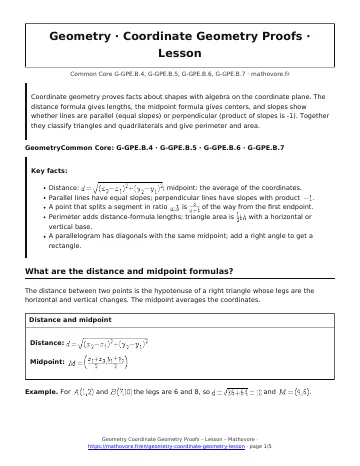
Coordinate geometry proves facts about shapes with algebra on the coordinate plane. The distance formula gives lengths, the midpoint formula gives centers, and slopes show whether lines are parallel (equal slopes) or perpendicular (product of slopes is -1). Together they classify triangles and quadrilaterals and give perimeter and area.
Geometry Coordinate Lesson: key facts
- Distance: \(d=\sqrt{(x_2-x_1)^{2}+(y_2-y_1)^{2}}\); midpoint: the average of the coordinates.
- Parallel lines have equal slopes; perpendicular lines have slopes with product \(-1\).
- A point that splits a segment in ratio \(a:b\) is \(\frac{a}{a+b}\) of the way from the first endpoint.
- Perimeter adds distance-formula lengths; triangle area is \(\frac{1}{2}bh\) with a horizontal or vertical base.
- A parallelogram has diagonals with the same midpoint; add a right angle to get a rectangle.
What are the distance and midpoint formulas?
The distance between two points is the hypotenuse of a right triangle whose legs are the horizontal and vertical changes. The midpoint averages the coordinates.
Distance: \(d=\sqrt{(x_2-x_1)^{2}+(y_2-y_1)^{2}}\)
Midpoint: \(M=(\frac{x_1+x_2}{2},\frac{y_1+y_2}{2})\)
Example. For \(A(1,2)\) and \(B(7,10)\) the legs are 6 and 8, so \(d=\sqrt{36+64}=10\) and \(M=(4,6)\).
How do slopes show parallel and perpendicular lines?
The slope is \(m=\frac{y_2-y_1}{x_2-x_1}\). Parallel lines have equal slopes. Perpendicular lines have slopes whose product is \(-1\), so one slope is the opposite reciprocal of the other. A horizontal line is perpendicular to a vertical line.
How do you find a point that partitions a segment in a ratio?
To split \(\overline{AB}\) in the ratio \(a:b\) measured from \(A\), travel the fraction \(\frac{a}{a+b}\) of the run and of the rise. For \(A(-3,2)\), \(B(9,10)\) and ratio \(1:3\), the fraction is \(\frac{1}{4}\): \(P=(-3+3,\,2+2)=(0,4)\).
How do you find perimeter and area on the coordinate plane?
Add the side lengths from the distance formula to get the perimeter. For a triangle with a horizontal base, the area is \(\frac{1}{2}bh\). The triangle with vertices \((1,1)\), \((7,1)\) and \((4,5)\) has base 6 and height 4, so its area is 12; its sides are 6, 5 and 5, so its perimeter is 16.
How do you prove a figure type with coordinates?
- Plot the points and make a conjecture.
- Compute the slopes, the lengths, or both.
- Match the results to a definition: a parallelogram has two pairs of parallel sides, a rectangle is a parallelogram with a right angle, a rhombus has four equal sides.
- State the conclusion with its reason.
Example. Prove that \(A(1,2)\), \(B(5,0)\), \(C(8,6)\), \(D(4,8)\) form a rectangle.
| Statements | Reasons |
|---|---|
| \(\text{slope }AB=\frac{0-2}{5-1}=-\frac{1}{2}\) and \(\text{slope }DC=\frac{6-8}{8-4}=-\frac{1}{2}\) | Slope formula |
| \(\text{slope }BC=2\) and \(\text{slope }AD=2\) | Slope formula |
| \(AB\parallel DC\) and \(BC\parallel AD\) | Equal slopes mean parallel lines |
| \(-\frac{1}{2}\cdot 2=-1\) | Product of the slopes at B |
| \(\angle B\) is a right angle, so \(ABCD\) is a rectangle | Perpendicular sides; a parallelogram with a right angle is a rectangle |
Coordinate Geometry Proofs: frequently asked questions
How do I know if two lines are perpendicular using slopes?
Multiply the slopes. If the product is \(-1\), the lines are perpendicular. For example, \(\frac{2}{3}\) and \(-\frac{3}{2}\) multiply to \(-1\), so those lines meet at a right angle.
What does a ratio of 2:3 mean when partitioning a segment?
The point is \(\frac{2}{2+3}=\frac{2}{5}\) of the way from the first endpoint to the second. Multiply that fraction by the run and by the rise, then add the results to the first endpoint.
How can I prove a quadrilateral is a parallelogram?
Show that both pairs of opposite sides have equal slopes, or show that the two diagonals have the same midpoint. Either result proves that the opposite sides are parallel or that the diagonals bisect each other.
When should I use the distance formula instead of counting squares?
Count squares only for horizontal or vertical segments. A slanted segment needs \(d=\sqrt{(x_2-x_1)^{2}+(y_2-y_1)^{2}}\), for example \(\sqrt{3^{2}+4^{2}}=5\).
How do I find the area of a triangle on the coordinate plane?
Pick a horizontal or vertical side as the base, measure the perpendicular height from the opposite vertex, and use \(A=\frac{1}{2}bh\). A base of 8 and a height of 6 give an area of 24.
How to use this geometry coordinate lesson
Use this geometry coordinate lesson before the worksheet, then check what you learned with the quiz.

See every chapter on the Geometry math page.