
This geometry parallelograms lesson explains parallelograms and special quadrilaterals in one printable page, with definitions, a method and a worked example.
A parallelogram is a quadrilateral with both pairs of opposite sides parallel. Its opposite sides and opposite angles are congruent, its consecutive angles are supplementary, and its diagonals bisect each other. Rectangles, rhombuses and squares are special parallelograms, while trapezoids and kites have properties of their own.
Geometry Parallelograms Lesson: key facts
- Standard G-CO.C.11 covers proving and using theorems about parallelograms.
- In every parallelogram, opposite sides and angles are congruent, consecutive angles add to 180 degrees, and diagonals bisect each other.
- Any one of five conditions proves a quadrilateral is a parallelogram, such as diagonals that bisect each other.
- A rectangle has congruent diagonals, a rhombus has perpendicular diagonals, and a square has both.
- An isosceles trapezoid has congruent diagonals, and a kite has perpendicular diagonals.
What is a parallelogram and which properties does it have?
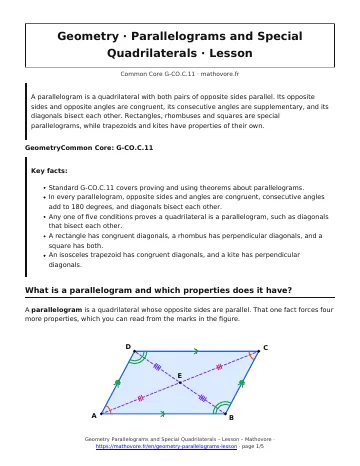
A parallelogram is a quadrilateral whose opposite sides are parallel. That one fact forces four more properties, which you can read from the marks in the figure.
- Opposite sides are congruent: \(AB=DC\) and \(BC=AD\).
- Opposite angles are congruent: \(m\angle A=m\angle C\) and \(m\angle B=m\angle D\).
- Consecutive angles are supplementary: \(m\angle A+m\angle B=180^{\circ}\).
- The diagonals bisect each other: \(AE=EC\) and \(BE=ED\).
How can you prove that a quadrilateral is a parallelogram?
Each property above has a converse. A quadrilateral is a parallelogram if any one of these is true:
| Condition | Why it is enough |
|---|---|
| Both pairs of opposite sides are parallel | This is the definition. |
| Both pairs of opposite sides are congruent | Triangles formed by a diagonal are congruent (SSS). |
| Both pairs of opposite angles are congruent | Consecutive angles then add to \(180^{\circ}\). |
| The diagonals bisect each other | The four small triangles are congruent in pairs (SAS). |
| One pair of opposite sides is both parallel and congruent | A diagonal creates congruent triangles (SAS). |
What do rectangles, rhombuses and squares add?
Each of these is a parallelogram with an extra property, so it keeps every parallelogram property.
| Figure | Extra properties |
|---|---|
| Rectangle | Four right angles; diagonals are congruent. |
| Rhombus | Four congruent sides; diagonals are perpendicular and bisect the angles. |
| Square | Both a rectangle and a rhombus, so all of the above. |
How are trapezoids and kites different?
A trapezoid has exactly one pair of parallel sides. In an isosceles trapezoid the legs are congruent, each pair of base angles is congruent, and the diagonals are congruent. A kite has two pairs of congruent adjacent sides and no congruent opposite sides. Its diagonals are perpendicular, and one diagonal bisects the other.
How do you use these properties to find missing measures?
- Name the relationship (opposite, consecutive, or diagonal) from the figure.
- Write an equation from the matching theorem.
- Solve for the variable, then substitute to find each measure.
- Check that the measures fit the figure.
Worked example. In parallelogram \(ABCD\), \(m\angle A=(6x-5)^{\circ}\) and \(m\angle B=(2x+25)^{\circ}\). These are consecutive angles, so \((6x-5)+(2x+25)=180\). Then \(8x+20=180\) and \(x=20\). So \(m\angle A=115^{\circ}\) and \(m\angle B=65^{\circ}\), and \(115+65=180\).
Parallelograms and Special Quadrilaterals: frequently asked questions
Is every rectangle a parallelogram?
Yes. A rectangle has two pairs of parallel opposite sides, so it meets the definition of a parallelogram. It also has extra properties: four right angles and congruent diagonals.
Do the diagonals of a parallelogram have to be congruent?
No. The diagonals of every parallelogram bisect each other, but they are congruent only in a rectangle (and therefore a square). A parallelogram with a slanted shape has one long and one short diagonal.
What is the quickest way to prove a quadrilateral is a parallelogram?
Show that one pair of opposite sides is both parallel and congruent, or show that the diagonals bisect each other. Each of these needs only one fact, so they are usually shorter than proving two pairs of sides.
How many pairs of parallel sides does a trapezoid have?
Exactly one pair in this lesson. The parallel sides are the bases, and the other two sides are the legs. If a quadrilateral had two pairs of parallel sides, it would be a parallelogram.
What is the difference between a rhombus and a kite?
A rhombus has four congruent sides and is a parallelogram. A kite has two pairs of congruent adjacent sides, and its opposite sides are not congruent. Both have perpendicular diagonals, but only a rhombus has diagonals that bisect each other.
How to use this geometry parallelograms lesson
Use this geometry parallelograms lesson before the worksheet, then check what you learned with the quiz.

See every chapter on the Geometry math page.