This geometry rigid transformations quiz asks 10 multiple-choice questions on rigid transformations, and each answer comes with a short explanation.
This 10-question quiz checks translations, reflections, rotations, rigid versus non-rigid rules and symmetry on the coordinate plane. Choose the one best answer for each question.
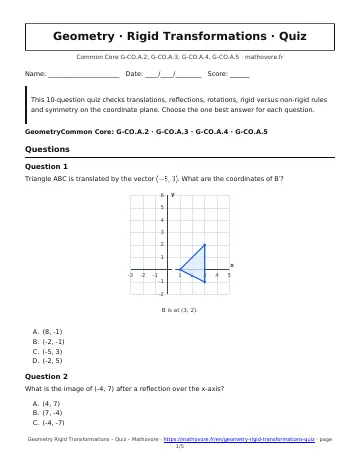
Triangle ABC is translated by the vector \(\langle -5,\,3\rangle\). What are the coordinates of B′?B is at (3, 2).
A(8, -1)
B(-2, -1)
C(-5, 3)
D(-2, 5)
Question 2
What is the image of (-4, 7) after a reflection over the x-axis?
A(4, 7)
B(7, -4)
C(-4, -7)
D(4, -7)
Question 3
What is the image of (2, -6) after a reflection over the line y = x?
A(-6, 2)
B(6, -2)
C(-2, 6)
D(2, 6)
Question 4
What is the image of (3, -5) after a rotation of 90° counterclockwise about the origin?
A(-5, -3)
B(-3, 5)
C(5, 3)
D(-5, 3)
Question 5
Which rule does NOT describe a rigid transformation?
A(x, y) to (3x, 3y)
B(x, y) to (x − 6, y + 1)
C(x, y) to (−x, y)
D(x, y) to (y, x)
Question 6
How many lines of symmetry does a regular pentagon have?Regular pentagon.
A10
B3
C1
D5
Question 7
What is the smallest positive rotation about its center that maps a regular hexagon onto itself?
A\(30^{\circ}\)
B\(120^{\circ}\)
C\(60^{\circ}\)
D\(90^{\circ}\)
Question 8
Triangle ABC is reflected to triangle A′B′C′. Which line is the line of reflection?Pre-image and image.
Athe y-axis
Bthe line x = -1
Cthe line y = x
Dthe line x = 1
Question 9
The point (2, -1) is reflected over the y-axis and then translated by the vector ⟨0, 5⟩. What is the final point?
A(2, 4)
B(-2, 4)
C(-2, -6)
D(2, -6)
Question 10
A rotation of 90° about the origin maps segment AB, which is 7 units long, onto segment A′B′. How long is A′B′?
A14 units
B3.5 units
C49 units
D7 units
🎉 Quiz complete!
0 / 10
How does this quiz work?
Read each question, choose one answer among A, B, C and D, then check it: a short explanation appears after every answer. Your score out of 10 is shown at the end, and you can restart the quiz as often as you like.
What should you review before the quiz?
Reread the key facts of the lesson and the worked example. If a question is hard, go back to the matching part of the lesson, then try the quiz again. Write your work on scrap paper: most mistakes come from skipping a step, not from the idea itself.
Remember:
Standards G-CO.A.2 to G-CO.A.5 cover transformations as functions, symmetry, precise definitions and drawing images.
Translations, reflections and rotations preserve distance and angle measure; dilations and stretches do not.
Reflection over y = x swaps coordinates: (x, y) becomes (y, x).
A 90-degree counterclockwise rotation about the origin sends (x, y) to (-y, x).
A regular n-sided polygon has n lines of symmetry and rotational symmetry of 360/n degrees.
How to use this geometry rigid transformations quiz
Retake this geometry rigid transformations quiz until every answer is right, then move on to the worksheet and the test.