This geometry rigid transformations worksheet answer key solves all 25 problems of the rigid transformations worksheet step by step.
This answer key gives a full worked solution for each problem on the rigid transformations worksheet. Use it to compare image coordinates, vectors and symmetry counts, and to check each rule you applied.
Geometry Rigid Transformations Worksheet Answer Key: problems 1–5
Problem 1: Translate points
- Add the components: \((3+(-5),\,-2+4)\) = \((-2,\,2)\).
- \((-4+7,\,6+(-9))\) = \((3,\,-3)\).
Problem 2: Translate a triangle
Add 3 to each x-coordinate and subtract 5 from each y-coordinate.
\(A^{\prime}(4,\,-4)\), \(B^{\prime}(7,\,-4)\), \(C^{\prime}(5,\,-1)\).
Problem 3: Reflect points over the axes
- The x-axis reflection changes the sign of y: \((-3,\,-5)\).
- The y-axis reflection changes the sign of x: \((3,\,5)\).
- \((4,\,7)\).
Problem 4: Reflect a triangle over the y-axis
Change the sign of each x-coordinate.
\(D^{\prime}(5,\,1)\), \(E^{\prime}(2,\,1)\), \(F^{\prime}(4,\,5)\).
Problem 5: Reflect over y = x
Swap the coordinates.
- \((-6,\,2)\)
- \((-1,\,-4)\)
- \((5,\,0)\)
Geometry Rigid Transformations Worksheet Answer Key: problems 6–10
Problem 6: Reflect over a vertical line
The y-coordinate stays the same. The new x-coordinate is \(2(3)-x\).
- \(2(3)-(-1)=7\): \((7,\,4)\)
- \(2(3)-5=1\): \((1,\,-2)\)
- The point is on the line, so it stays: \((3,\,6)\)
Problem 7: Rotate points 90 degrees
Use \((x,\,y)\) becomes \((-y,\,x)\).
- \((-1,\,4)\)
- \((-2,\,-3)\)
- \((5,\,0)\)
Problem 8: Rotate 180 degrees and clockwise
- \((x,\,y)\) becomes \((-x,\,-y)\): \((5,\,-2)\).
- A \(90^{\circ}\) clockwise turn sends \((x,\,y)\) to \((y,\,-x)\): \((6,\,-2)\).
Problem 9: Rotate a triangle
Use \((x,\,y)\) becomes \((-y,\,x)\) for each vertex.
\(G^{\prime}(-1,\,1)\), \(H^{\prime}(-1,\,5)\), \(J^{\prime}(-3,\,1)\).
Problem 10: Find the translation vector
Compare \(P(-5,\,3)\) with \(P^{\prime}(1,\,0)\): \(1-(-5)=6\) and \(0-3=-3\). The other vertices agree.
The vector is \(\langle 6,\,-3\rangle\).
Geometry Rigid Transformations Worksheet Answer Key: problems 11–15
Problem 11: Find the line of reflection
The line of reflection is the perpendicular bisector of \(\overline{AA^{\prime}}\). \(A(-4,\,3)\) and \(A^{\prime}(-4,\,-1)\) have the same x-coordinate, so the line is horizontal, through the midpoint \((-4,\,\frac{3+(-1)}{2})=(-4,\,1)\).
The line is \(y=1\).
Problem 12: Rigid or not?
- Image endpoints (4, −1) and (7, 3): length \(\sqrt{3^{2}+4^{2}}=5\). Rigid (a translation).
- Image endpoints (0, 0) and (6, 8): length 10. Not rigid (a dilation).
- Image endpoints (0, 0) and (3, −4): length 5. Rigid (a reflection).
- Image endpoints (0, 0) and (9, 4): length \(\sqrt{81+16}=\sqrt{97}\), about 9.85. Not rigid.
- Image endpoints (0, 0) and (−4, 3): length 5. Rigid (a rotation of 90° counterclockwise).
Problem 13: Compare distances
- \(AB=\sqrt{(4-1)^{2}+(6-2)^{2}}=\sqrt{9+16}=5\).
- \(A^{\prime}(-2,\,4)\) and \(B^{\prime}(1,\,8)\): \(A^{\prime}B^{\prime}=\sqrt{9+16}=5\).
- \(A^{\prime}(2,\,2)\) and \(B^{\prime}(8,\,6)\): \(A^{\prime}B^{\prime}=\sqrt{36+16}=\sqrt{52}\), about 7.21.
The translation keeps length 5, so it is rigid. The stretch changes it, so it is not rigid.
Problem 14: Symmetry of a rectangle
- One line joins the midpoints of the long sides and one joins the midpoints of the short sides, so there are 2 lines. The diagonals are not lines of symmetry because the rectangle is not a square.
- The rectangle maps onto itself after a turn of \(180^{\circ}\) and a full turn of \(360^{\circ}\).
Problem 15: Symmetry of a regular hexagon
A regular polygon with \(n\) sides has \(n\) lines of symmetry, so a hexagon has 6 lines.
The smallest turn is \(360 : 6=60\) degrees. The rotations are \(60^{\circ}\), \(120^{\circ}\), \(180^{\circ}\), \(240^{\circ}\) and \(300^{\circ}\).
Geometry Rigid Transformations Worksheet Answer Key: problems 16–20
Problem 16: Symmetries of other shapes
- 0 lines. It maps onto itself after a rotation of \(180^{\circ}\) about its center.
- 1 line (through the midpoints of the parallel sides). It has no rotational symmetry other than a full turn.
- 5 lines. The smallest rotation is \(360 : 5=72\), so \(72^{\circ}\), \(144^{\circ}\), \(216^{\circ}\) and \(288^{\circ}\).
Problem 17: Translate, then reflect
- \((2,\,3)\) becomes \((-2,\,4)\) after the translation, then \((-2,\,-4)\) after the reflection.
- \((0,\,-2)\) becomes \((-4,\,-1)\), then \((-4,\,1)\).
Problem 18: Rotate, then reflect
- After the rotation: \(K^{\prime}(-1,\,1)\), \(L^{\prime}(-1,\,3)\), \(M^{\prime}(-4,\,1)\). After the reflection over the y-axis: \(K^{\prime\prime}(1,\,1)\), \(L^{\prime\prime}(1,\,3)\), \(M^{\prime\prime}(4,\,1)\).
- Each final point is the original with its coordinates swapped, for example \(L(3,\,1)\) to \(L^{\prime\prime}(1,\,3)\). The single transformation is a reflection over the line \(y=x\).
Problem 19: Describe a sequence
The orientation of the triangle is flipped, so use a reflection. One answer: reflect over the x-axis, then translate by \(\langle 7,\,-2\rangle\).
Reflection: \(A^{\prime}(-5,\,-1)\), \(B^{\prime}(-2,\,-1)\), \(C^{\prime}(-5,\,-3)\). Translation: \(A^{\prime\prime}(2,\,-3)\), \(B^{\prime\prime}(5,\,-3)\), \(C^{\prime\prime}(2,\,-5)\), which matches the final image.
Problem 20: Video game character
Translation: \((3-7,\,-4+6)\) = \((-4,\,2)\).
Rotation: \((x,\,y)\) becomes \((-y,\,x)\), so \((-4,\,2)\) becomes \((-2,\,-4)\).
Geometry Rigid Transformations Worksheet Answer Key: problems 21–25
Problem 21: Park statues
The y-coordinate stays 3. The new x-coordinate is \(2(1)-(-6)=8\).
The second statue is at \((8,\,3)\). Check: the walkway \(x=1\) is halfway between \(-6\) and \(8\).
Problem 22: Logo design
A \(180^{\circ}\) rotation sends \((x,\,y)\) to \((-x,\,-y)\).
\((-2,\,-1)\), \((-5,\,-1)\), \((-3,\,-4)\).
Problem 23: Pinwheel
The blades are equally spaced, so the smallest turn is \(360 : 8=45\) degrees.
All rotations are multiples of \(45^{\circ}\): \(45^{\circ}\), \(90^{\circ}\), \(135^{\circ}\), \(180^{\circ}\), \(225^{\circ}\), \(270^{\circ}\), \(315^{\circ}\), \(360^{\circ}\).
Problem 24: Perimeter after a sequence
Translation: \(A^{\prime}(2,\,-2)\), \(B^{\prime}(5,\,-2)\), \(C^{\prime}(2,\,2)\). Reflection: \(A^{\prime\prime}(2,\,2)\), \(B^{\prime\prime}(5,\,2)\), \(C^{\prime\prime}(2,\,-2)\).
Original side lengths: \(AB=3\), \(AC=4\), \(BC=\sqrt{9+16}=5\), perimeter \(12\). The image sides are 3, 4 and 5 as well, so the perimeter is 12 both times . Rigid transformations preserve length.
Problem 25: Does order matter?
Translate first: \((1,\,2)\) becomes \((4,\,2)\), then \((-4,\,2)\).
Reflect first: \((1,\,2)\) becomes \((-1,\,2)\), then \((2,\,2)\).
The results differ, so Priya is wrong: the order of a sequence matters.
How to use this geometry rigid transformations worksheet answer key
Read this geometry rigid transformations worksheet answer key after trying each problem yourself, and redo any problem you missed.

Printable PDF · Worksheet Answer Key
Geometry Rigid Transformations worksheet answer key
Download the PDF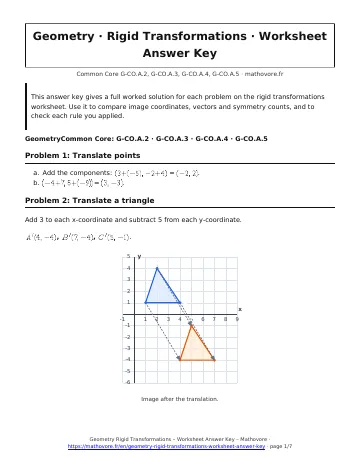
See every chapter on the Geometry math page.