


This answer key gives a full worked solution for each problem on the rigid transformations worksheet. Use it to compare image coordinates, vectors and symmetry counts, and to check each rule you applied.
Problem 1: Translate points
- Add the components: \((3+(-5),\,-2+4)\) = \((-2,\,2)\).
- \((-4+7,\,6+(-9))\) = \((3,\,-3)\).
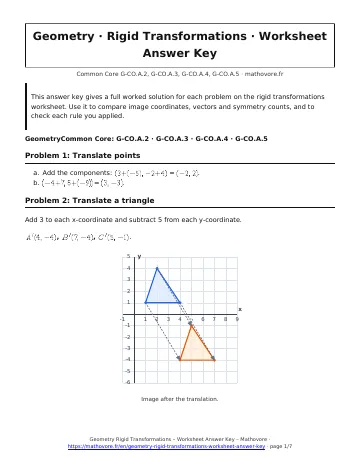
Problem 2: Translate a triangle
Add 3 to each x-coordinate and subtract 5 from each y-coordinate.
\(A^{\prime}(4,\,-4)\), \(B^{\prime}(7,\,-4)\), \(C^{\prime}(5,\,-1)\).
Problem 3: Reflect points over the axes
- The x-axis reflection changes the sign of y: \((-3,\,-5)\).
- The y-axis reflection changes the sign of x: \((3,\,5)\).
- \((4,\,7)\).
Problem 4: Reflect a triangle over the y-axis
Change the sign of each x-coordinate.
\(D^{\prime}(5,\,1)\), \(E^{\prime}(2,\,1)\), \(F^{\prime}(4,\,5)\).
Problem 5: Reflect over y = x
Swap the coordinates.
- \((-6,\,2)\)
- \((-1,\,-4)\)
- \((5,\,0)\)
Problem 6: Reflect over a vertical line
The y-coordinate stays the same. The new x-coordinate is \(2(3)-x\).
- \(2(3)-(-1)=7\): \((7,\,4)\)
- \(2(3)-5=1\): \((1,\,-2)\)
- The point is on the line, so it stays: \((3,\,6)\)
Problem 7: Rotate points 90 degrees
Use \((x,\,y)\) becomes \((-y,\,x)\).
- \((-1,\,4)\)
- \((-2,\,-3)\)
- \((5,\,0)\)
Problem 8: Rotate 180 degrees and clockwise
- \((x,\,y)\) becomes \((-x,\,-y)\): \((5,\,-2)\).
- A \(90^{\circ}\) clockwise turn sends \((x,\,y)\) to \((y,\,-x)\): \((6,\,-2)\).
Problem 9: Rotate a triangle
Use \((x,\,y)\) becomes \((-y,\,x)\) for each vertex.
\(G^{\prime}(-1,\,1)\), \(H^{\prime}(-1,\,5)\), \(J^{\prime}(-3,\,1)\).
Problem 10: Find the translation vector
Compare \(P(-5,\,3)\) with \(P^{\prime}(1,\,0)\): \(1-(-5)=6\) and \(0-3=-3\). The other vertices agree.
The vector is \(\langle 6,\,-3\rangle\).
Problem 11: Find the line of reflection
The line of reflection is the perpendicular bisector of \(\overline{AA^{\prime}}\). \(A(-4,\,3)\) and \(A^{\prime}(-4,\,-1)\) have the same x-coordinate, so the line is horizontal, through the midpoint \((-4,\,\frac{3+(-1)}{2})=(-4,\,1)\).
The line is \(y=1\).
Problem 12: Rigid or not?
- Image endpoints (4, −1) and (7, 3): length \(\sqrt{3^{2}+4^{2}}=5\). Rigid (a translation).
- Image endpoints (0, 0) and (6, 8): length 10. Not rigid (a dilation).
- Image endpoints (0, 0) and (3, −4): length 5. Rigid (a reflection).
- Image endpoints (0, 0) and (9, 4): length \(\sqrt{81+16}=\sqrt{97}\), about 9.85. Not rigid.
- Image endpoints (0, 0) and (−4, 3): length 5. Rigid (a rotation of 90° counterclockwise).
Problem 13: Compare distances
- \(AB=\sqrt{(4-1)^{2}+(6-2)^{2}}=\sqrt{9+16}=5\).
- \(A^{\prime}(-2,\,4)\) and \(B^{\prime}(1,\,8)\): \(A^{\prime}B^{\prime}=\sqrt{9+16}=5\).
- \(A^{\prime}(2,\,2)\) and \(B^{\prime}(8,\,6)\): \(A^{\prime}B^{\prime}=\sqrt{36+16}=\sqrt{52}\), about 7.21.
The translation keeps length 5, so it is rigid. The stretch changes it, so it is not rigid.
Problem 14: Symmetry of a rectangle
- One line joins the midpoints of the long sides and one joins the midpoints of the short sides, so there are 2 lines. The diagonals are not lines of symmetry because the rectangle is not a square.
- The rectangle maps onto itself after a turn of \(180^{\circ}\) and a full turn of \(360^{\circ}\).
Problem 15: Symmetry of a regular hexagon
A regular polygon with \(n\) sides has \(n\) lines of symmetry, so a hexagon has 6 lines.
The smallest turn is \(360 : 6=60\) degrees. The rotations are \(60^{\circ}\), \(120^{\circ}\), \(180^{\circ}\), \(240^{\circ}\) and \(300^{\circ}\).
Problem 16: Symmetries of other shapes
- 0 lines. It maps onto itself after a rotation of \(180^{\circ}\) about its center.
- 1 line (through the midpoints of the parallel sides). It has no rotational symmetry other than a full turn.
- 5 lines. The smallest rotation is \(360 : 5=72\), so \(72^{\circ}\), \(144^{\circ}\), \(216^{\circ}\) and \(288^{\circ}\).
Problem 17: Translate, then reflect
- \((2,\,3)\) becomes \((-2,\,4)\) after the translation, then \((-2,\,-4)\) after the reflection.
- \((0,\,-2)\) becomes \((-4,\,-1)\), then \((-4,\,1)\).
Problem 18: Rotate, then reflect
- After the rotation: \(K^{\prime}(-1,\,1)\), \(L^{\prime}(-1,\,3)\), \(M^{\prime}(-4,\,1)\). After the reflection over the y-axis: \(K^{\prime\prime}(1,\,1)\), \(L^{\prime\prime}(1,\,3)\), \(M^{\prime\prime}(4,\,1)\).
- Each final point is the original with its coordinates swapped, for example \(L(3,\,1)\) to \(L^{\prime\prime}(1,\,3)\). The single transformation is a reflection over the line \(y=x\).
Problem 19: Describe a sequence
The orientation of the triangle is flipped, so use a reflection. One answer: reflect over the x-axis, then translate by \(\langle 7,\,-2\rangle\).
Reflection: \(A^{\prime}(-5,\,-1)\), \(B^{\prime}(-2,\,-1)\), \(C^{\prime}(-5,\,-3)\). Translation: \(A^{\prime\prime}(2,\,-3)\), \(B^{\prime\prime}(5,\,-3)\), \(C^{\prime\prime}(2,\,-5)\), which matches the final image.
Problem 20: Video game character
Translation: \((3-7,\,-4+6)\) = \((-4,\,2)\).
Rotation: \((x,\,y)\) becomes \((-y,\,x)\), so \((-4,\,2)\) becomes \((-2,\,-4)\).
Problem 21: Park statues
The y-coordinate stays 3. The new x-coordinate is \(2(1)-(-6)=8\).
The second statue is at \((8,\,3)\). Check: the walkway \(x=1\) is halfway between \(-6\) and \(8\).
Problem 22: Logo design
A \(180^{\circ}\) rotation sends \((x,\,y)\) to \((-x,\,-y)\).
\((-2,\,-1)\), \((-5,\,-1)\), \((-3,\,-4)\).
Problem 23: Pinwheel
The blades are equally spaced, so the smallest turn is \(360 : 8=45\) degrees.
All rotations are multiples of \(45^{\circ}\): \(45^{\circ}\), \(90^{\circ}\), \(135^{\circ}\), \(180^{\circ}\), \(225^{\circ}\), \(270^{\circ}\), \(315^{\circ}\), \(360^{\circ}\).
Problem 24: Perimeter after a sequence
Translation: \(A^{\prime}(2,\,-2)\), \(B^{\prime}(5,\,-2)\), \(C^{\prime}(2,\,2)\). Reflection: \(A^{\prime\prime}(2,\,2)\), \(B^{\prime\prime}(5,\,2)\), \(C^{\prime\prime}(2,\,-2)\).
Original side lengths: \(AB=3\), \(AC=4\), \(BC=\sqrt{9+16}=5\), perimeter \(12\). The image sides are 3, 4 and 5 as well, so the perimeter is 12 both times . Rigid transformations preserve length.
Problem 25: Does order matter?
Translate first: \((1,\,2)\) becomes \((4,\,2)\), then \((-4,\,2)\).
Reflect first: \((1,\,2)\) becomes \((-1,\,2)\), then \((2,\,2)\).
The results differ, so Priya is wrong: the order of a sequence matters.
See every chapter on the Geometry math page.