


This geometry reasoning proof worksheet gives 23 problems on logic and two-column proofs, ordered from easy to hard, with a separate answer key.
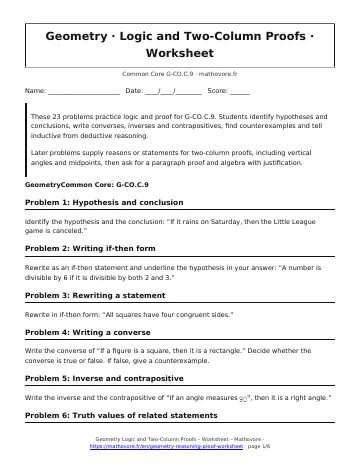
These 23 problems practice logic and proof for G-CO.C.9. Students identify hypotheses and conclusions, write converses, inverses and contrapositives, find counterexamples and tell inductive from deductive reasoning.
Later problems supply reasons or statements for two-column proofs, including vertical angles and midpoints, then ask for a paragraph proof and algebra with justification.
Geometry Reasoning Proof Worksheet: problems 1–5
Problem 1: Hypothesis and conclusion
Identify the hypothesis and the conclusion: “If it rains on Saturday, then the Little League game is canceled.”
Problem 2: Writing if-then form
Rewrite as an if-then statement and underline the hypothesis in your answer: “A number is divisible by 6 if it is divisible by both 2 and 3.”
Problem 3: Rewriting a statement
Rewrite in if-then form: “All squares have four congruent sides.”
Problem 4: Writing a converse
Write the converse of “If a figure is a square, then it is a rectangle.” Decide whether the converse is true or false. If false, give a counterexample.
Problem 5: Inverse and contrapositive
Write the inverse and the contrapositive of “If a polygon is a square, then it has four sides.”
Geometry Reasoning Proof Worksheet: problems 6–10
Problem 6: Truth values of related statements
Consider “If a number is a multiple of 4, then it is even.” Write the converse, inverse and contrapositive, and decide whether each of the four statements is true or false. Give a counterexample for each false one.
Problem 7: Counterexample with primes
Find a counterexample to: “If a number is prime, then it is odd.”
Problem 8: Counterexample with squares
Find a counterexample to: “If \(x^{2}=49\), then \(x=7\).”
Problem 9: Counterexample with angles
Maya claims: “If two angles are supplementary, then they form a linear pair.” Use the figure to show that her claim is false.
Problem 10: Inductive pattern of dots
The figure shows the first four dot patterns. Use inductive reasoning to find the number of dots in Pattern 5 and Pattern 6, and write a rule for Pattern n.
Geometry Reasoning Proof Worksheet: problems 11–15
Problem 11: Inductive or deductive?
Decide whether each argument uses inductive or deductive reasoning.
- The first five Saturdays of the season were sunny, so Maya concludes the next Saturday will be sunny.
- Every even number is divisible by 2. The number 148 is even, so 148 is divisible by 2.
- Diego measures the angles of three triangles, finds each sum is \(180^{\circ}\), and concludes every triangle has an angle sum of \(180^{\circ}\).
- Every triangle has an angle sum of \(180^{\circ}\). Polygon XYZ is a triangle, so its angle sum is \(180^{\circ}\).
Problem 12: Making a conjecture
Look at these sums: \(3+5=8\), \(7+9=16\), \(11+5=16\), \(1+13=14\). Write a conjecture about the sum of two odd numbers.
Problem 13: Disproving a conjecture
Ethan conjectures: “The sum of two numbers is always greater than either number.” Find a counterexample.
Problem 14: Naming properties of equality
Name the property that justifies each statement.
- If \(AB=CD\), then \(CD=AB\).
- If \(m\angle 1=m\angle 2\) and \(m\angle 2=m\angle 3\), then \(m\angle 1=m\angle 3\).
- \(PQ=PQ\).
- If \(3x=15\), then \(x=5\).
Problem 15: Supplying reasons
Copy and complete the reasons.
Given: \(3x+7=22\). Prove: \(x=5\).
| Statements | Reasons |
|---|---|
| 1. \(3x+7=22\) | 1. ____ |
| 2. \(3x=15\) | 2. ____ |
| 3. \(x=5\) | 3. ____ |
Geometry Reasoning Proof Worksheet: problems 16–20
Problem 16: Supplying statements
Angles 1 and 2 together form a right angle, so they are complementary. Copy and complete the statements.
Given: \(\angle 1\) and \(\angle 2\) are complementary; \(m\angle 1=35^{\circ}\). Prove: \(m\angle 2=55^{\circ}\).
| Statements | Reasons |
|---|---|
| 1. ____ | 1. Given |
| 2. ____ | 2. Definition of complementary angles |
| 3. ____ | 3. Substitution Property of Equality |
| 4. ____ | 4. Subtraction Property of Equality |
Problem 17: Midpoint proof
Copy and complete the reasons.
Given: M is the midpoint of \(\overline{ST}\); \(ST=24\). Prove: \(SM=12\).
| Statements | Reasons |
|---|---|
| 1. M is the midpoint of \(\overline{ST}\); \(ST=24\) | 1. Given |
| 2. \(SM=MT\) | 2. ____ |
| 3. \(SM+MT=ST\) | 3. ____ |
| 4. \(SM+SM=24\) | 4. ____ |
| 5. \(2(SM)=24\) | 5. ____ |
| 6. \(SM=12\) | 6. ____ |
Problem 18: Vertical angles proof
Lines ℓ and m intersect to form angles 1, 2, 3 and 4. Copy and complete the reasons to prove that \(\angle 2\) ≅ \(\angle 4\).
| Statements | Reasons |
|---|---|
| 1. Lines ℓ and m intersect | 1. Given |
| 2. \(\angle 2\) and \(\angle 3\) are a linear pair; \(\angle 3\) and \(\angle 4\) are a linear pair | 2. ____ |
| 3. \(\angle 2\) and \(\angle 3\) are supplementary; \(\angle 3\) and \(\angle 4\) are supplementary | 3. ____ |
| 4. \(m\angle 2+m\angle 3=180^{\circ}\); \(m\angle 3+m\angle 4=180^{\circ}\) | 4. Definition of supplementary angles |
| 5. \(m\angle 2+m\angle 3=m\angle 3+m\angle 4\) | 5. ____ |
| 6. \(m\angle 2=m\angle 4\) | 6. ____ |
| 7. \(\angle 2\) ≅ \(\angle 4\) | 7. ____ |
Problem 19: Paragraph proof
Write a paragraph proof. Given: \(\angle A\) and \(\angle B\) are complementary; \(\angle C\) and \(\angle B\) are complementary. Prove: \(\angle A\) ≅ \(\angle C\).
Problem 20: Contrapositive in context
A school rule says: “If a student is on the honor roll, then the student has a GPA of at least 3.5.” Priya’s GPA is 3.2. What can you conclude about Priya, and which related statement did you use?
Geometry Reasoning Proof Worksheet: problems 21–23
Problem 21: Chaining conditionals
Two rules are true: “If it snows more than 6 inches, then school is closed” and “If school is closed, then the bake sale moves to Sunday.” Write one conditional that links them. Aisha hears that 8 inches of snow fell. What follows?
Problem 22: Solve and justify
Lines ℓ and m intersect. \(m\angle 1\)\(=(3x+14)^{\circ}\) and \(m\angle 3\)\(=(5x-6)^{\circ}\). Find x and \(m\angle 2\), and give a reason for each step.
Problem 23: Writing a biconditional
Consider “If a polygon is a triangle, then it has exactly three sides.” Write the converse, decide whether it is true, and then write a biconditional statement.

How to use this geometry reasoning proof worksheet
Print this geometry reasoning proof worksheet as a PDF, solve every problem on paper, then compare with the answer key.

See every chapter on the Geometry math page.