


Each solution names the statement, the reason or the counterexample. For proofs, check that every reason is Given, a definition, a postulate, a property or a theorem, and that the last statement is the Prove.
Problem 1: Hypothesis and conclusion
Hypothesis (after if): it rains on Saturday. Conclusion (after then): the Little League game is canceled.
Problem 2: Writing if-then form
If a number is divisible by both 2 and 3, then it is divisible by 6. The hypothesis is “a number is divisible by both 2 and 3.” The words after if in the original sentence form the hypothesis.
Problem 3: Rewriting a statement
If a figure is a square, then it has four congruent sides.
Problem 4: Writing a converse
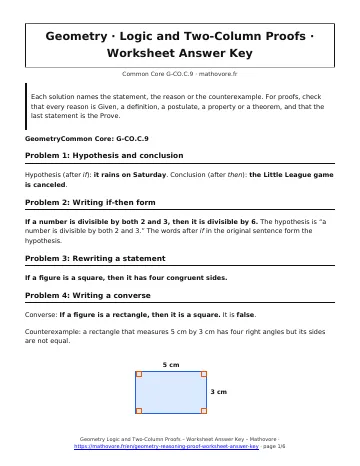
Converse: If a figure is a rectangle, then it is a square. It is false.
Counterexample: a rectangle that measures 5 cm by 3 cm has four right angles but its sides are not equal.
Problem 5: Inverse and contrapositive
Inverse (negate both parts): If an angle does not measure \(90^{\circ}\), then it is not a right angle.
Contrapositive (swap and negate): If an angle is not a right angle, then it does not measure \(90^{\circ}\).
Problem 6: Truth values of related statements
- Statement: true (every multiple of 4 is even).
- Converse: “If a number is even, then it is a multiple of 4.” False; counterexample 6.
- Inverse: “If a number is not a multiple of 4, then it is not even.” False; counterexample 6.
- Contrapositive: “If a number is not even, then it is not a multiple of 4.” True, matching the statement.
Problem 7: Counterexample with primes
The number 2 is prime, because its only factors are 1 and 2, but it is even. The hypothesis is true and the conclusion is false, so the statement is false.
Problem 8: Counterexample with squares
Let \(x=-7\). Then \((-7)^{2}=49\), so the hypothesis is true, but \(x\neq 7\). \(x=-7\) is a counterexample.
Problem 9: Counterexample with angles
\(100+80=180\), so the angles are supplementary and the hypothesis is true. They do not share a side, so they are not a linear pair and the conclusion is false.
The two angles in the figure are a counterexample.
Problem 10: Inductive pattern of dots
Counts: 2, 6, 12, 20. The differences are 4, 6, 8, so the next differences are 10 and 12.
Pattern 5: \(20+10=30\). Pattern 6: \(30+12=42\).
Pattern n is a rectangle with n rows and n + 1 columns: \(n(n+1)\). Check: \(5\times 6=30\) and \(6\times 7=42\).
Problem 11: Inductive or deductive?
- Inductive: it generalizes from a pattern of cases.
- Deductive: it applies a general fact to a specific case.
- Inductive: three measured cases suggest a rule but do not prove it.
- Deductive: it applies a known theorem to a specific triangle.
Problem 12: Making a conjecture
Every sum is even. Conjecture: the sum of two odd numbers is even. This is inductive reasoning, so it is a conjecture until it is proven.
Problem 13: Disproving a conjecture
Try a negative number: \(-3+5=2\) and \(2 < 5\). The sum 2 is not greater than 5. The numbers \(-3\) and 5 are a counterexample.
Problem 14: Naming properties of equality
- Symmetric Property.
- Transitive Property.
- Reflexive Property.
- Division Property of Equality (divide both sides by 3).
Problem 15: Supplying reasons
| Statements | Reasons |
|---|---|
| 1. \(3x+7=22\) | 1. Given |
| 2. \(3x=15\) | 2. Subtraction Property of Equality (subtract 7 from both sides) |
| 3. \(x=5\) | 3. Division Property of Equality (divide both sides by 3) |
Check: \(3(5)+7=22\).
Problem 16: Supplying statements
| Statements | Reasons |
|---|---|
| 1. \(\angle 1\) and \(\angle 2\) are complementary; \(m\angle 1=35^{\circ}\) | 1. Given |
| 2. \(m\angle 1+m\angle 2=90^{\circ}\) | 2. Definition of complementary angles |
| 3. \(35^{\circ}+m\angle 2=90^{\circ}\) | 3. Substitution Property of Equality |
| 4. \(m\angle 2=55^{\circ}\) | 4. Subtraction Property of Equality |
Check: \(35+55=90\).
Problem 17: Midpoint proof
| Statements | Reasons |
|---|---|
| 1. M is the midpoint of \(\overline{ST}\); \(ST=24\) | 1. Given |
| 2. \(SM=MT\) | 2. Definition of midpoint |
| 3. \(SM+MT=ST\) | 3. Segment Addition Postulate |
| 4. \(SM+SM=24\) | 4. Substitution Property of Equality |
| 5. \(2(SM)=24\) | 5. Combining like terms |
| 6. \(SM=12\) | 6. Division Property of Equality |
Problem 18: Vertical angles proof
| Statements | Reasons |
|---|---|
| 1. Lines ℓ and m intersect | 1. Given |
| 2. \(\angle 2\) and \(\angle 3\) are a linear pair; \(\angle 3\) and \(\angle 4\) are a linear pair | 2. Definition of linear pair |
| 3. \(\angle 2\) and \(\angle 3\) are supplementary; \(\angle 3\) and \(\angle 4\) are supplementary | 3. Linear Pair Postulate |
| 4. \(m\angle 2+m\angle 3=180^{\circ}\); \(m\angle 3+m\angle 4=180^{\circ}\) | 4. Definition of supplementary angles |
| 5. \(m\angle 2+m\angle 3=m\angle 3+m\angle 4\) | 5. Transitive Property of Equality (both sums equal 180) |
| 6. \(m\angle 2=m\angle 4\) | 6. Subtraction Property of Equality (subtract \(m\angle 3\)) |
| 7. \(\angle 2\) ≅ \(\angle 4\) | 7. Definition of congruent angles |
Problem 19: Paragraph proof
Because \(\angle A\) and \(\angle B\) are complementary, \(m\angle A+m\angle B=90^{\circ}\). Because \(\angle C\) and \(\angle B\) are complementary, \(m\angle C+m\angle B=90^{\circ}\). Both sums equal \(90^{\circ}\), so \(m\angle A+m\angle B=m\angle C+m\angle B\) by the Transitive Property of Equality. Subtracting \(m\angle B\) from both sides gives \(m\angle A=m\angle C\). Angles with equal measures are congruent, so \(\angle A\) ≅ \(\angle C\).
Problem 20: Contrapositive in context
Contrapositive: “If a student does not have a GPA of at least 3.5, then the student is not on the honor roll.” Since \(3.2 < 3.5\), Priya’s GPA is below 3.5.
Priya is not on the honor roll. The contrapositive is true because the original rule is true.
Problem 21: Chaining conditionals
Link the conclusion of the first rule to the hypothesis of the second: If it snows more than 6 inches, then the bake sale moves to Sunday.
Eight inches is more than 6 inches, so the hypothesis is true. Therefore the bake sale moves to Sunday.
Problem 22: Solve and justify
1. \(3x+14=5x-6\): Vertical Angles Theorem (\(\angle 1\) ≅ \(\angle 3\)).
2. \(20=2x\): Addition and Subtraction Properties of Equality. 3. \(x=10\): Division Property of Equality.
4. \(m\angle 1\)\(=3(10)+14=44^{\circ}\): Substitution. 5. \(\angle 1\) and \(\angle 2\) are a linear pair, so they are supplementary: \(m\angle 2\)\(=180-44=136^{\circ}\). 136°.
Problem 23: Writing a biconditional
Converse: If the measure of an angle is \(90^{\circ}\), then it is a right angle. It is true by the definition of a right angle.
Biconditional: An angle is a right angle if and only if its measure is \(90^{\circ}\).
See every chapter on the Geometry math page.