This algebra 1 systems worksheet answer key solves all 22 problems of the graphing linear inequalities and systems of inequalities worksheet step by step.
Each solution gives the boundary line, the line type, the test point and the shading decision, so you can see where a graph went wrong. Compare the described region with your own drawing, and confirm any point you chose by substituting it into every inequality.
Algebra 1 Systems Worksheet Answer Key: problems 1–5
Problem 1: Test a point
Substitute \(x=2\) and \(y=1\): \(1<3(2)\), which is \(1<6\). True.
Yes, \((2, 1)\) is a solution.
Problem 2: Points on the boundary
- \(2(3)+3(2)=12\), and \(12\ge 12\) is true because \(\ge\) allows equality. Yes.
- \(2(1)+3(2)=8\), and \(8\ge 12\) is false. No.
Problem 3: Solid or dashed
- \(>\): dashed.
- \(\le\): solid.
- \(<\): dashed.
- \(\ge\): solid.
A line is solid only when the symbol includes equality.
Problem 4: Graph y > x + 2
The boundary \(y=x+2\) has y-intercept \(2\) and slope \(1\). The symbol \(>\) makes it dashed.
Test \((0, 0)\): \(0>0+2\) is false, so shade the side that does not contain the origin: above the line.
Problem 5: Graph y ≤ −2x + 3
The boundary \(y=-2x+3\) passes through \((0, 3)\) and \((1, 1)\). The symbol \(\le\) makes it solid.
Test \((0, 0)\): \(0\le 3\) is true, so shade the side with the origin: below the line.
Algebra 1 Systems Worksheet Answer Key: problems 6–10
Problem 6: Graph with a negative fractional slope
The boundary passes through \((0,2)\) and, using fall \(2\) and run \(3\), through \((3,0)\) and \((6,-2)\). It is solid because of \(\le\).
Test \((0,0)\): \(0\le 2\) is true, so shade below the line, where the origin is.
Problem 7: Standard form
Set \(y=0\): \(2x=6\), so \(x=3\). Set \(x=0\): \(3y=6\), so \(y=2\). The boundary joins \((3, 0)\) and \((0, 2)\) and is dashed.
Test \((0, 0)\): \(0<6\) is true, so shade the side that contains the origin.
Problem 8: Divide by a negative
Divide every term by \(-3\) and reverse the symbol: \(y\le -2x+3\).
The symbol \(\le\) gives a solid line. The test point \((0, 0)\) gives \(0\le 3\), true, so the shading is below the line.
Problem 9: Vertical and horizontal
\(x\ge -2\): draw a solid vertical line through \(x=-2\) and shade everything to its right.
\(y<3\): draw a dashed horizontal line through \(y=3\) and shade everything below it.
Problem 10: Write from a graph: dashed
The line passes through \((0, 1)\) and \((2, 5)\), so the slope is \(\frac{5-1}{2-0}=2\) and the equation is \(y=2x+1\).
The line is dashed, so the symbol is strict. The shaded side is below the line, and the origin is shaded: \(0<2(0)+1\) is true.
The inequality is \(y<2x+1\).
Algebra 1 Systems Worksheet Answer Key: problems 11–15
Problem 11: Write from a graph: solid
The line passes through \((0, 2)\) and \((2, 0)\), so the slope is \(\frac{0-2}{2-0}=-1\) and the equation is \(y=-x+2\).
The line is solid and the shading is above it. Check a shaded point such as \((2, 2)\): \(2\ge -2+2=0\) is true.
The inequality is \(y\ge -x+2\).
Problem 12: Check points in a system
- \((0, 0)\): \(0>-1\) true; \(0\le 5\) true. Solution.
- \((3, 1)\): \(1>2\) false. Not a solution.
- \((2, 2)\): \(2>1\) true; \(2\le 3\) true. Solution.
- \((4, 2)\): \(2>3\) false. Not a solution.
- \((-1, 4)\): \(4>-2\) true; \(4\le 6\) true. Solution.
\((0, 0)\), \((2, 2)\) and \((-1, 4)\) are solutions.
Problem 13: Graph a system
Both boundaries are dashed. \(y=-x+4\) passes through \((0, 4)\) and \((4, 0)\); shade below. \(y=2x-5\) passes through \((0, -5)\) and \((3, 1)\); shade above.
Set \(-x+4=2x-5\): \(9=3x\), so \(x=3\) and \(y=1\). The boundaries meet at \((3, 1)\).
Test the corner: \(1<-3+4=1\) is false, so \((3, 1)\) is not a solution. The solution region is the overlap to the left of that point.
Problem 14: A triangular region
\(x\ge 0\) shades right of the y-axis and \(y\ge 0\) shades above the x-axis. The line \(x+y=6\) joins \((6, 0)\) and \((0, 6)\); shade below it. All three lines are solid.
The corners are \((0, 0)\), \((6, 0)\) and \((0, 6)\).
Test \((2, 3)\): \(2\ge 0\), \(3\ge 0\) and \(2+3=5\le 6\) are all true, so it is a solution.
Problem 15: A rectangular region
The inequalities form four solid boundaries: \(x=-2\), \(x=3\), \(y=1\) and \(y=4\).
The corners are \((-2, 1)\), \((3, 1)\), \((3, 4)\) and \((-2, 4)\).
The width is \(3-(-2)=5\) and the height is \(4-1=3\), so the area is \(5\times 3=\) 15 square units.
Algebra 1 Systems Worksheet Answer Key: problems 16–20
Problem 16: No overlap
The boundary lines have the same slope \(1\), so they are parallel. \(y>x+3\) shades above the upper line, and \(y<x-1\) shades below the lower line.
A solution would need \(x+3<y<x-1\), which would make \(x+3<x-1\), or \(3<-1\). That is false.
The shaded regions never overlap, so there is no solution.
Problem 17: Concert budget
The total cost must be at most \(\$150\): \(15x+25y\le 150\).
- \(15(4)+25(3)=60+75=135\le 150\). Yes.
- \(15(5)+25(3)=75+75=150\le 150\). Yes, exactly the budget.
- \(15(2)+25(5)=30+125=155>150\). No.
Problem 18: Bake sale limits
At most 60 items: \(x+y\le 60\). At least 20 cookies: \(y\ge 20\). Counts cannot be negative: \(x\ge 0\).
- \((35, 25)\): \(60\le 60\) and \(25\ge 20\). Possible.
- \((45, 20)\): \(45+20=65>60\). Not possible.
- \((30, 15)\): \(15<20\). Not possible.
- \((20, 20)\): \(40\le 60\) and \(20\ge 20\). Possible.
Possible: \((35, 25)\) and \((20, 20)\).
Problem 19: Yard work hours
Time: \(2x+y\le 10\). Counts: \(x\ge 0\) and \(y\ge 0\).
The line \(2x+y=10\) meets the axes at \((5, 0)\) and \((0, 10)\). The corners are \((0, 0)\), \((5, 0)\) and \((0, 10)\).
3 lawns and 4 walks: \(2(3)+4=10\le 10\). Fits.
4 lawns and 3 walks: \(2(4)+3=11>10\). Does not fit.
Problem 20: Lemonade goal
Earnings: \(2x+3y\ge 60\). Cookie limit: \(y\le 25\).
- \((15, 10)\): \(30+30=60\ge 60\) and \(10\le 25\). Meets both.
- \((10, 10)\): \(20+30=50<60\). Fails.
- \((30, 25)\): \(60+75=135\ge 60\) and \(25\le 25\). Meets both.
(15, 10) and (30, 25) work.
Algebra 1 Systems Worksheet Answer Key: problems 21–22
Problem 21: Find the error
Mistake 1: the symbol \(>\) is strict, so the line must be dashed.
Mistake 2: test \((0, 0)\): \(3(0)-2(0)=0>6\) is false, so the origin side must not be shaded.
Boundary: \(y=0\) gives \(x=2\); \(x=0\) gives \(y=-3\). Test \((4, 0)\): \(12>6\) is true, so shade the side containing \((4, 0)\), which is below and to the right of the line.
Problem 22: Garden fence
The perimeter is \(2x+2y\le 40\), which simplifies to \(x+y\le 20\). With the minimums: \(x\ge 8\) and \(y\ge 4\).
Corners: \(x=8,\ y=4\) gives \((8, 4)\). With \(y=4\), \(x+4=20\) gives \((16, 4)\). With \(x=8\), \(8+y=20\) gives \((8, 12)\).
Test \((10, 8)\): \(10\ge 8\), \(8\ge 4\) and \(18\le 20\) are all true, so a 10 ft by 8 ft garden is allowed.
How to use this algebra 1 systems worksheet answer key
Read this algebra 1 systems worksheet answer key after trying each problem yourself, and redo any problem you missed.

Printable PDF · Worksheet Answer Key
Algebra 1 Graphing Linear Inequalities and Systems of Inequalities worksheet answer key
Download the PDF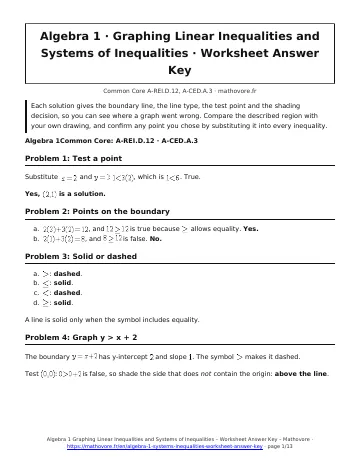
See every chapter on the Algebra 1 math page.