

Key takeaway: This 45-minute algebra 1 key features graphs test spreads 20 points across eight questions. Coverage includes intercepts, vertex and symmetry, intervals of increase and decrease, end behavior, average rate of change and comparing functions.
Show your work, and include units wherever a question has a context. No calculator is needed. A scoring guide is published separately for teachers. Students should plan their time, because the last three questions take longer than the first five.
This 45-minute test has 8 questions worth 20 points. It covers intercepts, vertex and symmetry, intervals of increase and decrease, end behavior, average rate of change and comparing functions. Show your work and include units where a question has a context. No calculator is needed.
- Grade: Algebra 1
- Chapter: Key Features of Graphs and Rate of Change
- Common Core: F-IF.B.4, F-IF.B.6, F-IF.C.9
- Time: 45 minutes
- Total: 20 points (Question 1: 3 pts; Question 2: 3 pts; Question 3: 2 pts; Question 4: 2 pts; Question 5: 2 pts; Question 6: 3 pts; Question 7: 2 pts; Question 8: 3 pts)
Algebra 1 Key Features Graphs Test: questions 1–5
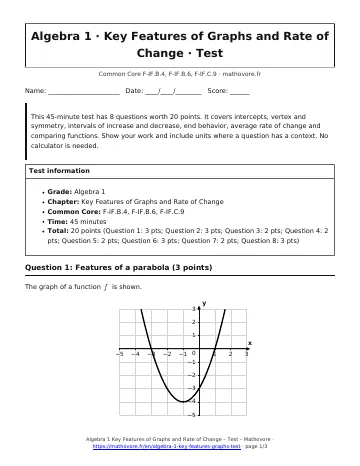
1. Features of a parabola (3 points)
The graph of a function \(f\) is shown.
- Find the \(x\)-intercepts. (1 point)
- Find the \(y\)-intercept. (1 point)
- Find the vertex and tell whether it is a maximum or a minimum. (1 point)
2. Increasing and decreasing (3 points)
Use the graph of \(f\).
- Give the intervals where \(f\) is increasing. (1 point)
- Give the intervals where \(f\) is decreasing. (1 point)
- State the relative minimum value and the \(x\)-value where it occurs. (1 point)
3. End behavior (2 points)
Describe the end behavior.
- \(f(x)=-x^{2}+4\): what happens to \(f(x)\) as \(x\) gets very large? (1 point)
- \(g(x)=2^{x}\): what happens to \(g(x)\) as \(x\) gets very negative? (1 point)
4. Symmetry of a parabola (2 points)
Let \(f(x)=x^{2}-8x+10\). Find the equation of the axis of symmetry (1 point) and the coordinates of the vertex (1 point).
5. Average rate of change (2 points)
Find the average rate of change of \(f(x)=x^{2}+x\) from \(x=1\) to \(x=4\).
Algebra 1 Key Features Graphs Test: questions 6–8
6. Biking distance (3 points)
The graph shows the distance Noah biked, in miles, \(t\) hours after he started.
- Find the average rate of change from \(t=0\) to \(t=2\), with units. (1 point)
- Find the average rate of change from \(t=2\) to \(t=4\), with units. (1 point)
- During which of the two intervals was Noah faster? Explain. (1 point)
7. Compare two functions (2 points)
Function \(f\) is \(f(x)=4x-5\). Function \(g\) is given by the table.
| \(x\) | 0 | 1 | 2 | 3 |
|---|---|---|---|---|
| \(g(x)\) | 3 | 5 | 7 | 9 |
- Which function has the greater rate of change? (1 point)
- Which function has the greater value when \(x=10\)? (1 point)
8. Ball height (3 points)
A ball’s height in feet after \(t\) seconds is \(h(t)=-16t^{2}+32t+6\).
- Find the maximum height and the time when it happens. (1 point)
- Find \(h(0)\) and explain what it means. (1 point)
- Find the average rate of change from \(t=0\) to \(t=1\), with units. (1 point)

What does the algebra 1 key features graphs test ask?
Question 1 finds the intercepts and the vertex from a parabola. Next, question 2 gives intervals of increase and decrease for a graph made of four line segments. Then question 3 describes end behavior for \(f(x)=-x^{2}+4\) and another function.
After that, question 4 asks for the axis of symmetry and vertex of \(x^{2}-8x+10\), and question 5 finds an average rate of change for \(x^{2}+x\) from 1 to 4.
How are the last questions built?
Question 6 reads Noah’s biking graph, so you describe distance and speed in miles and hours. Question 7 compares \(f(x)=4x-5\) with a table that rises by 2 each step. Finally, question 8 gives \(h(t)=-16t^{2}+32t+6\) and asks how high the ball goes and when.
Therefore, practice completing the square or using the axis formula quickly.
Which slips cost points?
First, some students reverse the interval endpoints. Next, others describe end behavior with the word up when the outputs go down. Also, a few forget units in the biking question. Consequently, reread each line before moving on.
What can you do the night before?
Draw one parabola and label every feature. Then compute an average rate on two intervals and notice that the numbers differ. After that, compare an equation with a table in a short paragraph. Finally, rehearse the checklist: intercepts, turns, intervals, ends and units.

See every chapter on the Algebra 1 math page.