Key takeaway: Eight questions share 20 points in this algebra 1 functions notation test. It checks whether a relation is a function, evaluates notation, reads values from a graph, interprets outputs and finds domain and range.
The test fits a 45-minute period, and calculators are not needed. Show your work and include units in every word problem. A scoring guide is published for teachers, and students never see it during the test. Allow a calculator-free classroom.
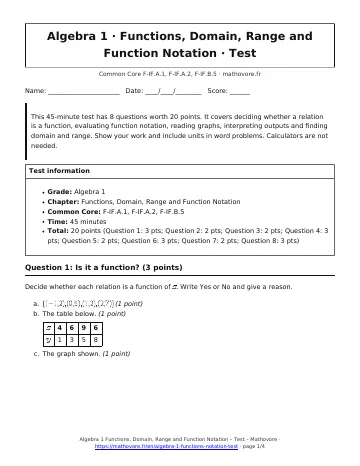
This 45-minute test has 8 questions worth 20 points. It covers deciding whether a relation is a function, evaluating function notation, reading graphs, interpreting outputs and finding domain and range. Show your work and include units in word problems. Calculators are not needed.
- Grade: Algebra 1
- Chapter: Functions, Domain, Range and Function Notation
- Common Core: F-IF.A.1, F-IF.A.2, F-IF.B.5
- Time: 45 minutes
- Total: 20 points (Question 1: 3 pts; Question 2: 2 pts; Question 3: 2 pts; Question 4: 3 pts; Question 5: 2 pts; Question 6: 3 pts; Question 7: 2 pts; Question 8: 3 pts)
Algebra 1 Functions Notation Test: questions 1–5
1. Is it a function? (3 points)
Decide whether each relation is a function of \(x\). Write Yes or No and give a reason.
- \(\{(-1,2),(0,5),(1,2),(2,7)\}\) (1 point)
- The table below. (1 point)
\(x\) 4 6 9 6 \(y\) 1 3 5 8 - The graph shown. (1 point)
2. Evaluate a quadratic (2 points)
Let \(f(x)=x^{2}-4x+1\). Find each value.
- \(f(-2)\) (1 point)
- \(f(5)\) (1 point)
3. Evaluate and solve (2 points)
Let \(g(x)=-3x+8\).
- Find \(g(-4)\). (1 point)
- Find \(x\) so that \(g(x)=-7\). (1 point)
4. Read values from a graph (3 points)
The graph of a function \(f\) is shown.
- Find \(f(0)\). (1 point)
- Find \(f(1)\). (1 point)
- Find all values of \(x\) for which \(f(x)=0\). (1 point)
5. Ticket profit (2 points)
A school play earns a profit of \(P(n)=6n-150\) dollars when \(n\) tickets are sold.
- Find \(P(40)\) and explain what it means. (1 point)
- Find \(n\) when \(P(n)=0\) and explain what it means. (1 point)
Algebra 1 Functions Notation Test: questions 6–8
6. Domain and range of a graph (3 points)
The graph of a function is a line segment. Its left endpoint is a closed point and its right endpoint is an open point.
- State the domain with an inequality. (1 point)
- State the range with an inequality. (1 point)
- Is the situation modeled by this graph discrete or continuous? Explain. (1 point)
7. Notebook sale (2 points)
Notebooks cost \(\$2.50\) each. A student may buy 1 to 8 notebooks, so the cost is \(N(k)=2.5k\).
- State the domain. (1 point)
- State the range. (1 point)
8. Rocket launch (3 points)
A toy rocket is launched upward. Its height in feet after \(t\) seconds is \(h(t)=-16t^{2}+64t\).
- Find \(h(3)\). (1 point)
- Find \(h(4)\) and explain what it means. (1 point)
- State a reasonable domain and range for this situation. (1 point)

What does the algebra 1 functions notation test ask?
Question 1 decides whether several relations are functions and asks for a reason. Next, question 2 evaluates \(f(x)=x^{2}-4x+1\) at -2 and 5. Then question 3 evaluates \(g(x)=-3x+8\) at -4 and solves \(g(x)=-7\).
After that, question 4 reads values from a graph, and question 5 explains \(P(40)\) for a school play with profit \(P(n)=6n-150\).
How do the last questions work?
Question 6 gives a segment with a closed left end and an open right end, so the inequality signs matter. Notebooks cost $2.50 each in question 7, and a student may buy 1 to 8, so the domain is a list of whole numbers. Finally, question 8 launches a toy rocket with \(h(t)=-16t^{2}+64t\).
Therefore, practice writing a domain with inequalities and with a list.
Which mistakes cost points?
First, some students forget parentheses and square a negative incorrectly. Next, others swap the input and output in a story. Also, a few write a closed circle where the graph shows an open one. As a result, double-check every endpoint.
How should you get ready for test day?
Write a one-line reminder for each skill: test, evaluate, interpret and describe. Then practice each with a new example. After that, explain two stories aloud, naming the input, the output and the units. Finally, solve one full question under a timer.

See every chapter on the Algebra 1 math page.