



Ten multiple-choice questions check how well you can tell linear from exponential patterns, read growth and decay factors, write models and use compound interest. Choose the one correct answer, then read the explanation to learn from any mistake.
Algebra 1Common Core: F-LE.A.1a · F-LE.A.1c · F-LE.A.2 · F-LE.A.3 · F-IF.C.8b · F-LE.B.5
🎯 Exponential Growth and Decay – Algebra 1 math quiz
Question 1
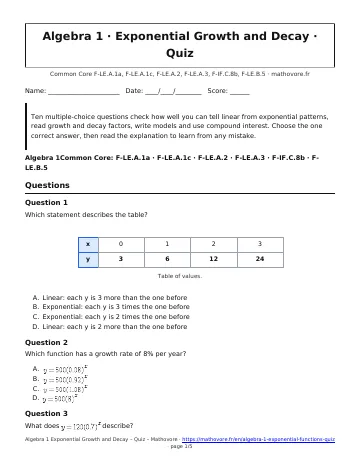
Which statement describes the table?Table of values.
A
Linear: each y is 3 more than the one before
B
Exponential: each y is 3 times the one before
C
Exponential: each y is 2 times the one before
D
Linear: each y is 2 more than the one before
Question 2
Which function has a growth rate of 8% per year?
A
\(y=500(0.08)^{x}\)
B
\(y=500(0.92)^{x}\)
C
\(y=500(1.08)^{x}\)
D
\(y=500(8)^{x}\)
Question 3
What does \(y=120(0.7)^{x}\) describe?
A
Decay of 70% per step
B
Decay of 30% per step
C
Growth of 70% per step
D
Growth of 30% per step
Question 4
Let \(f(x)=5\cdot2^{x}\). The figure shows the order of operations. What is \(f(3)\)?Order of operations in the function.
A
\(30\)
B
\(125\)
C
\(1000\)
D
\(40\)
Question 5
A video has 50 views today and the views triple every week. Which function gives the views after \(x\) weeks?
A
\(y=50(3)^{x}\)
B
\(y=3(50)^{x}\)
C
\(y=50+3x\)
D
\(y=150x\)
Question 6
Which equation matches the graph?An exponential graph.
A
\(y=4(3)^{x}\)
B
\(y=3x+9\)
C
\(y=3(12)^{x}\)
D
\(y=3(4)^{x}\)
Question 7
Sofia deposits $1,000 at 5% interest compounded yearly. What is the balance after 2 years?
A
\(\$1,100.00\)
B
\(\$1,102.50\)
C
\(\$1,050.00\)
D
\(\$1,052.50\)
Question 8
A population is \(N(t)=250(1.04)^{t}\). What does 1.04 mean?
A
The population grows by 4% each year
B
The population grows by 4 people each year
C
The population grows by 104% each year
D
The population shrinks by 4% each year
Question 9
Let \(g(x)=2^{x}\) and \(h(x)=4x+10\). For which whole number \(x\) does \(g\) first exceed \(h\)?
A
\(x=4\)
B
\(x=6\)
C
\(x=3\)
D
\(x=5\)
Question 10
The figure shows a car that loses 10% each year. What is its value after 2 years?A car loses 10% of its value each year.
A
\(\$16,200\)
B
\(\$16,000\)
C
\(\$18,000\)
D
\(\$14,000\)
🎉 Quiz complete!
0 / 10
Remember:
- Linear functions add a constant difference; exponential functions multiply by a constant factor.
- In \(y=a\cdot b^{x}\), \(a\) is the value at \(x=0\) and \(b\) is the factor per step.
- Growth by \(r\) means \(b=1+r\); decay by \(r\) means \(b=1-r\).
- Compound interest: \(A=P(1+\frac{r}{n})^{nt}\).
- An exponential function eventually passes every linear function.
See every chapter on the Algebra 1 math page.