
Key takeaway: This algebra 1 exponential functions worksheet gives you 24 printable problems on growth, decay and compound interest. It practices the F-LE standards plus F-IF.C.8b, and every item asks for a clear model.
The set starts with evaluating \(f(x)=3\cdot 2^{x}\) and ends with word problems about savings, medicine and cell cultures. Work in pencil, because the factor is easy to misread. Solutions with full steps are published on their own page, so you can attempt every problem first and check afterward.
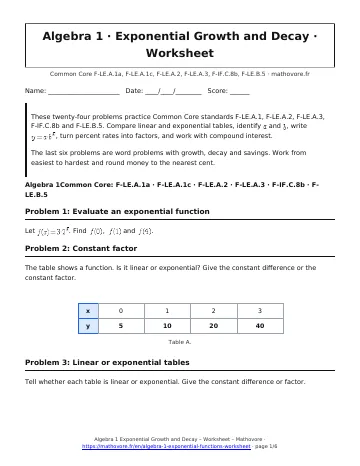
These twenty-four problems practice Common Core standards F-LE.A.1, F-LE.A.2, F-LE.A.3, F-IF.C.8b and F-LE.B.5. Compare linear and exponential tables, identify \(a\) and \(b\), write \(y=a\cdot b^{x}\), turn percent rates into factors, and work with compound interest.
The last six problems are word problems with growth, decay and savings. Work from easiest to hardest and round money to the nearest cent.
Algebra 1 Exponential Functions Worksheet: problems 1–5
1. Evaluate an exponential function
Let \(f(x)=3\cdot2^{x}\). Find \(f(0)\), \(f(1)\) and \(f(4)\).
2. Constant factor
The table shows a function. Is it linear or exponential? Give the constant difference or the constant factor.
3. Linear or exponential tables
Tell whether each table is linear or exponential. Give the constant difference or factor.
4. Identify a and b
For each function, name the starting value \(a\) and the factor \(b\). Then tell whether it shows growth or decay.
- \(y=7(3)^{x}\)
- \(y=250(0.9)^{x}\)
- \(y=0.5(4)^{x}\)
5. Percent rate from the factor
Each factor \(b\) describes a percent change per step. State the percent and whether it is growth or decay.
- \(b=1.08\)
- \(b=0.95\)
- \(b=1.5\)
- \(b=0.6\)
Algebra 1 Exponential Functions Worksheet: problems 6–10
6. Factor from the percent rate
Write the factor \(b\) for each situation.
- A value grows 12% each year.
- A value decays 7% each year.
- A population grows 100% each year.
- A value loses 35% each year.
7. Equation from a table
Write an exponential function \(y=a\cdot b^{x}\) for the table.
8. Decay from a table
The values 1000, 600, 360, 216 are the outputs at \(x=0,1,2,3\) of an exponential function. Write the function.
9. Equation from two points
Write an exponential function whose graph passes through the given points.
- \((0,5)\) and \((2,45)\)
- \((0,96)\) and \((3,12)\)
10. Equation from a graph
The graph of an exponential function is shown. Identify \(a\) and \(b\) and write the equation.
Algebra 1 Exponential Functions Worksheet: problems 11–15
11. Evaluate growth
Let \(y=400(1.05)^{x}\). Find \(y\) when \(x=3\). Round to the nearest cent.
12. Evaluate decay
Let \(y=900(0.8)^{x}\). Find \(y\) when \(x=4\).
13. Exponential versus linear
The graph shows \(g(x)=2^{x}\) and \(h(x)=5x+3\). Make a table of values for whole numbers \(x=0\) to \(5\). For which whole number \(x\) does \(g\) first exceed \(h\)?
14. Interpret the parameters
A town’s population is \(P(t)=12000(0.97)^{t}\), where \(t\) is the number of years since 2020. Explain what 12,000 and 0.97 mean. Find the population in 2023, to the nearest person.
15. Compound interest, yearly
Priya deposits $2,000 in an account that pays 3% interest compounded yearly. Find the balance after 4 years.
Algebra 1 Exponential Functions Worksheet: problems 16–20
16. Compounding twice a year
Noah invests $1,000 at 6% for 2 years. Compare the balance when interest is compounded yearly with the balance when it is compounded twice a year. How much more does he earn with twice a year?
17. Equivalent forms of an exponential
The value of an account is \(y=300(1.01)^{12t}\), where \(t\) is in years. (a) What is the monthly growth rate? (b) Find the yearly growth factor and the yearly growth rate to the nearest tenth of a percent. (c) Find \(y\) after 2 years, to the nearest cent.
18. Half-life model
An 80-gram sample of a substance decays by \(y=80(0.5)^{t/10}\), where \(t\) is in years. Find the amount left after 20 years and after 30 years. What is the half-life?
19. Video views
A video has 150 views on day 0, and the number of views doubles every day. Write a function for the views \(V\) after \(d\) days. Predict the views on day 7.
20. Car depreciation
A new car costs $24,000 and loses 15% of its value each year. Write a function for its value \(V\) after \(t\) years. Find the value after 3 years.
Algebra 1 Exponential Functions Worksheet: problems 21–24
21. Two savings plans
Liam compares two plans. Plan A starts with $20 and adds $15 each week: \(A(w)=20+15w\). Plan B starts with $2 and doubles every week: \(B(w)=2\cdot2^{w}\). In which week does Plan B first have more money than Plan A?
22. Medicine in the body
A patient takes a 200 mg dose. The amount in the body falls 12% every hour. Write a function for the amount \(M\) after \(h\) hours. Find \(M(3)\) to the nearest hundredth of a milligram, and find the first whole hour at which less than 100 mg remains.
23. Growing cell culture
A lab culture starts with 500 cells and grows 20% every hour. Write a function for the number of cells \(N\) after \(t\) hours. Find the first whole hour when the culture has more than 1,000 cells, and predict \(N(5)\) to the nearest whole cell.
24. Interest: simple versus compound
Priya and Diego each put $800 in an account. Priya’s pays 5% compounded yearly. Diego’s pays simple interest of $40 per year (5% of $800). Write a function for each balance after \(t\) years, and compare the balances after 10 years.

What is on this algebra 1 exponential functions worksheet?
Problems 1 to 3 evaluate and classify. Next, problems 4 to 6 link the factor b to a percent rate. Then problems 7 to 10 build equations from tables, points and graphs. After that, problems 11 to 14 evaluate growth and decay, and problem 13 compares \(2^{x}\) with \(5x+3\).
Finally, problems 15 to 18 cover compound interest and half-life. The last six problems are word problems, such as the 80-gram sample and the video that doubles daily.
Which problems need extra care?
Problem 8 gives 1000, 600, 360 and 216. Because each output is 0.6 times the last, the factor is 0.6, not 0.4. Problem 17 changes a yearly exponent into a monthly rate, so read the 12t carefully.
In problem 16, compare yearly and half-yearly compounding for $1,000 at 6%. Also, keep four decimals until the end, since early rounding changes the cents.
How do the real-world problems use exponential models?
A new car in problem 20 costs $24,000 and loses 15% yearly, so its factor is 0.85. Similarly, a lab culture in problem 23 grows 20% each hour from 500 cells. Meanwhile, a 200 mg dose in problem 22 falls 12% every hour.
Therefore, write the starting value first. Then choose the factor. Finally, test one input, because a quick check catches a wrong factor.
What routine keeps the factor straight?
First, circle the starting value. Next, write the percent as a decimal. Then add it for growth or subtract it for decay. Also, test the model at \(x=0\). If the output is not the start, fix the rule. Afterward, test \(x=1\), so the factor shows itself.
What is a smart next step with this worksheet?
Solve the problems in order, then compare each factor with the solutions. Redo the compound interest items with new deposits, such as $500 at 4%. Once the answers feel steady, try the quiz and watch whether tables, graphs and word problems still flow.

See every chapter on the Algebra 1 math page.