


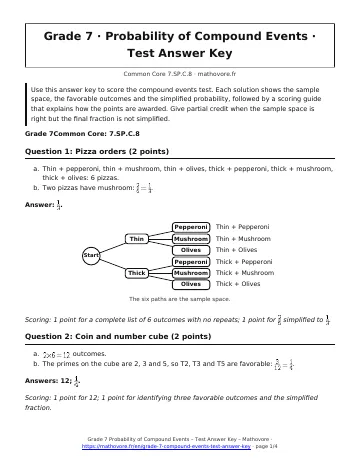
Question 1: Pizza orders (2 points)
- Thin + pepperoni, thin + mushroom, thin + olives, thick + pepperoni, thick + mushroom, thick + olives: 6 pizzas.
- Two pizzas have mushroom: \(\frac{2}{6}=\frac{1}{3}\).
Answer: \(\frac{1}{3}\).
Scoring: 1 point for a complete list of 6 outcomes with no repeats; 1 point for \(\frac{2}{6}\) simplified to \(\frac{1}{3}\).
Question 2: Coin and number cube (2 points)
- \(2\times 6=12\) outcomes.
- The primes on the cube are 2, 3 and 5, so T2, T3 and T5 are favorable: \(\frac{3}{12}=\frac{1}{4}\).
Answers: 12; \(\frac{1}{4}\).
Scoring: 1 point for 12; 1 point for identifying three favorable outcomes and the simplified fraction.
Question 3: Table of sums (2 points)
- See the completed table.
- Sums of 6, 7 or 8 occur 3 + 2 + 1 = 6 times out of 16: \(\frac{6}{16}=\frac{3}{8}\).
Answer: \(\frac{3}{8}\).
Scoring: 1 point for a table with all 16 sums correct; 1 point for \(\frac{6}{16}\) simplified to \(\frac{3}{8}\).
Question 4: Draw without replacement (2 points)
- R1R2, R1B, R2R1, R2B, BR1, BR2 (6 outcomes).
- Exactly one red: R1B, R2B, BR1, BR2, so \(\frac{4}{6}=\frac{2}{3}\).
Answer: \(\frac{2}{3}\).
Scoring: 1 point for all 6 ordered pairs; 1 point for \(\frac{4}{6}=\frac{2}{3}\).
Question 5: Sums of two number cubes (3 points)
- Sum 8 appears 5 times : \(\frac{5}{36}\).
- Sums 2, 3 and 4 appear 1 + 2 + 3 = 6 times : \(\frac{6}{36}=\frac{1}{6}\).
- Sum 5 appears 4 times and sum 10 appears 3 times : \(\frac{7}{36}\).
Answers: \(\frac{5}{36}\), \(\frac{1}{6}\), \(\frac{7}{36}\).
Scoring: 1 point for each part: counting the favorable cells correctly and writing the fraction over 36.
Question 6: Predict from probability (2 points)
- The sample space has \(3\times 2=6\) outcomes and only 3H is favorable: \(\frac{1}{6}\).
- \(\frac{1}{6}\times 120=20\).
Answers: \(\frac{1}{6}\); 20 times .
Scoring: 1 point for \(\frac{1}{6}\); 1 point for 20.
Question 7: Simulate three children (3 points)
- The ten digits 0 to 9 include five even (0, 2, 4, 6, 8) and five odd digits, so each child is a girl with probability \(\frac{1}{2}\).
- Only 482 and 246 have all digits even: \(\frac{2}{12}=\frac{1}{6}\).
- GGG, GGB, GBG, GBB, BGG, BGB, BBG, BBB is 8 outcomes and only GGG is favorable: \(\frac{1}{8}\).
Answers: equal chance; \(\frac{1}{6}\); \(\frac{1}{8}\).
Scoring: 1 point for noting 5 even and 5 odd digits; 1 point for \(\frac{2}{12}=\frac{1}{6}\); 1 point for the 8-outcome sample space and \(\frac{1}{8}\).
Question 8: Lunch tree diagram (2 points)
- Two of the six paths end in soup: \(\frac{2}{6}=\frac{1}{3}\).
- One path is Veggie + Apple: \(\frac{1}{6}\).
Answers: \(\frac{1}{3}\); \(\frac{1}{6}\).
Scoring: 1 point for each correct simplified probability.
Question 9: Design a simulation (2 points)
Let 1 and 2 mean a hit (2 of 6 numbers is \(\frac{1}{3}\)) and 3, 4, 5, 6 mean no hit. One trial is two rolls of the cube, one for each at-bat. Do many trials, for example 50, and count the trials with at least one roll of 1 or 2. The estimate is that count divided by the number of trials.
Scoring: 1 point for a correct model of one at-bat (two numbers of six for a hit); 1 point for a trial of two rolls, many trials and counting trials with at least one hit.
20 points
See every chapter on the Grade 7 math page.