Key takeaway: This grade 7 compound test answer key helps you mark nine questions worth 20 points together. Every solution displays the sample space, the favorable outcomes, and the simplified probability, and a scoring rule explains how points are earned.
Reward a correct sample space even when the fraction slips. Accept any valid list, table, or tree, because the answer matters more than the format. Equivalent fractions earn credit too, though a simplified form is preferred. Brief notes call out typical slips.
Use this answer key to score the compound events test. Each solution shows the sample space, the favorable outcomes and the simplified probability, followed by a scoring guide that explains how the points are awarded. Give partial credit when the sample space is right but the final fraction is not simplified.
Grade 7 Compound Test Answer Key: questions 1–5
1. Pizza orders (2 points)
- Thin + pepperoni, thin + mushroom, thin + olives, thick + pepperoni, thick + mushroom, thick + olives: 6 pizzas.
- Two pizzas have mushroom: \(\frac{2}{6}=\frac{1}{3}\).
Answer: \(\frac{1}{3}\).
Scoring: 1 point for a complete list of 6 outcomes with no repeats; 1 point for \(\frac{2}{6}\) simplified to \(\frac{1}{3}\).
2. Coin and number cube (2 points)
- \(2\times 6=12\) outcomes.
- The primes on the cube are 2, 3 and 5, so T2, T3 and T5 are favorable: \(\frac{3}{12}=\frac{1}{4}\).
Answers: 12; \(\frac{1}{4}\).
Scoring: 1 point for 12; 1 point for identifying three favorable outcomes and the simplified fraction.
3. Table of sums (2 points)
- See the completed table.
- Sums of 6, 7 or 8 occur 3 + 2 + 1 = 6 times out of 16: \(\frac{6}{16}=\frac{3}{8}\).
Answer: \(\frac{3}{8}\).
Scoring: 1 point for a table with all 16 sums correct; 1 point for \(\frac{6}{16}\) simplified to \(\frac{3}{8}\).
4. Draw without replacement (2 points)
- R1R2, R1B, R2R1, R2B, BR1, BR2 (6 outcomes).
- Exactly one red: R1B, R2B, BR1, BR2, so \(\frac{4}{6}=\frac{2}{3}\).
Answer: \(\frac{2}{3}\).
Scoring: 1 point for all 6 ordered pairs; 1 point for \(\frac{4}{6}=\frac{2}{3}\).
5. Sums of two number cubes (3 points)
- Sum 8 appears 5 times : \(\frac{5}{36}\).
- Sums 2, 3 and 4 appear 1 + 2 + 3 = 6 times : \(\frac{6}{36}=\frac{1}{6}\).
- Sum 5 appears 4 times and sum 10 appears 3 times : \(\frac{7}{36}\).
Answers: \(\frac{5}{36}\), \(\frac{1}{6}\), \(\frac{7}{36}\).
Scoring: 1 point for each part: counting the favorable cells correctly and writing the fraction over 36.
Grade 7 Compound Test Answer Key: questions 6–9
6. Predict from probability (2 points)
- The sample space has \(3\times 2=6\) outcomes and only 3H is favorable: \(\frac{1}{6}\).
- \(\frac{1}{6}\times 120=20\).
Answers: \(\frac{1}{6}\); 20 times .
Scoring: 1 point for \(\frac{1}{6}\); 1 point for 20.
7. Simulate three children (3 points)
- The ten digits 0 to 9 include five even (0, 2, 4, 6, 8) and five odd digits, so each child is a girl with probability \(\frac{1}{2}\).
- Only 482 and 246 have all digits even: \(\frac{2}{12}=\frac{1}{6}\).
- GGG, GGB, GBG, GBB, BGG, BGB, BBG, BBB is 8 outcomes and only GGG is favorable: \(\frac{1}{8}\).
Answers: equal chance; \(\frac{1}{6}\); \(\frac{1}{8}\).
Scoring: 1 point for noting 5 even and 5 odd digits; 1 point for \(\frac{2}{12}=\frac{1}{6}\); 1 point for the 8-outcome sample space and \(\frac{1}{8}\).
8. Lunch tree diagram (2 points)
- Two of the six paths end in soup: \(\frac{2}{6}=\frac{1}{3}\).
- One path is Veggie + Apple: \(\frac{1}{6}\).
Answers: \(\frac{1}{3}\); \(\frac{1}{6}\).
Scoring: 1 point for each correct simplified probability.
9. Design a simulation (2 points)
Let 1 and 2 mean a hit (2 of 6 numbers is \(\frac{1}{3}\)) and 3, 4, 5, 6 mean no hit. One trial is two rolls of the cube, one for each at-bat. Do many trials, for example 50, and count the trials with at least one roll of 1 or 2. The estimate is that count divided by the number of trials.
Scoring: 1 point for a correct model of one at-bat (two numbers of six for a hit); 1 point for a trial of two rolls, many trials and counting trials with at least one hit.
Scoring summary
20 points: add the points of every question of this grade 7 compound test answer key.
Which answers belong to the first questions?
Six outcomes appear in the pizza list, since two crusts times three toppings gives 6. The coin and cube question has 12 outcomes. The marble draw without replacement has six ordered pairs, and the sample space must name R1, R2, and B separately.
How does a grade 7 compound test answer key score a simulation?
Award one point for assigning numbers that match the probability, one for describing the repeated trials, and one for explaining how to compute the estimate. For the baseball player, using 1 and 2 as hits matches one third. A plan that uses 1 through 3 matches one half instead, so the first point is lost.
How should the table of sums be graded?
Two four-sided cubes produce 16 outcomes. A complete table has four rows and four columns, and each cell holds a sum from 2 to 8. Give one point for a full table and one for a correct probability read from it.
What partial credit fits the tree diagram question?
Give one point for a correct tree and one for the final fraction. If the tree shows all six lunch combinations, the student earns the first point even when the probability is wrong. However, a tree with missing branches earns no credit for the count.
Turn the scores into a reteaching plan
Mark whether points were lost in the sample space, the count, or the simplification. Then give the largest group one fresh coin-and-spinner problem to list from scratch. Finally, offer the quiz again and compare group totals.

Printable PDF · Test Answer Key
Grade 7 Probability of Compound Events test answer key
Download the PDF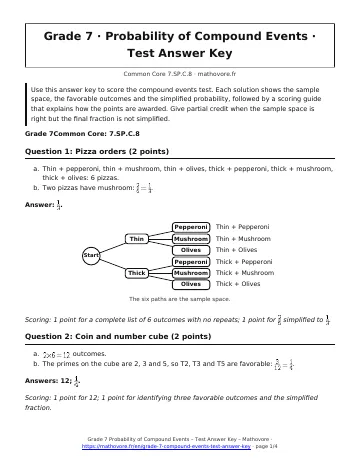
See every chapter on the Grade 7 math page.