Key takeaway: This precalculus sequences series worksheet answer key explains all 25 solutions, from sigma sums to limits. First, each entry names the formula. Then it shows the substitution and bolds the final value. Standards A-SSE.B.4 and A-APR.C.5 guide the topics. Use the key to locate the exact step where a count, a ratio or a sign went wrong, and then redo that step on your own.
Every solution below shows the formula used, the substitution and the final value in bold. Use it to find the exact step where a mistake crept in, especially for ratios, term counts and signs in binomial expansions.
Precalculus Sequences Series Worksheet Answer Key: problems 1–5
1. Evaluate a sum
Substitute \(k=1,2,3,4,5\) into \(3k-1\): 2, 5, 8, 11, 14.
\(2+5+8+11+14=\)40
2. Sums of powers
- \(1+4+9+16=\)30
- \(1+2+4+8=\)15
3. Write in sigma notation
- Each term is \(3k\) for \(k=1\) to 5: \(\sum_{k=1}^{5}3k\)
- Each term is \(2^{k}\) for \(k=1\) to 5: \(\sum_{k=1}^{5}2^{k}\)
4. Explicit and recursive rules
- Common difference 4. Explicit: \(a_{n}=5+4(n-1)=4n+1\). Recursive: \(a_{1}=5\), \(a_{n}=a_{n-1}+4\). \(a_{20}=4(20)+1=\)81
- Common ratio 3. Explicit: \(a_{n}=2\cdot 3^{n-1}\). Recursive: \(a_{1}=2\), \(a_{n}=3a_{n-1}\). \(a_{6}=2\cdot 3^{5}=2\cdot 243=\)486
5. Find the nth term
- \(a_{20}=7+4(19)=7+76=\)83
- \(7+4(n-1)=103\Rightarrow 4(n-1)=96\Rightarrow n-1=24\), so term 25
Precalculus Sequences Series Worksheet Answer Key: problems 6–10
6. Arithmetic series
\(d=7\), so \(a_{15}=12+7(14)=110\).
\(S_{15}=\frac{15(12+110)}{2}=15\cdot 61=\)915
7. Decreasing series
\(d=-3\). Solve \(100-3(n-1)=1\): \(n-1=33\), so \(n=34\) terms.
\(S_{34}=\frac{34(100+1)}{2}=17\cdot 101=\)1,717
8. Finite geometric series
- \(r=2\): \(S_{8}=\frac{3(1-2^{8})}{1-2}=\frac{3(-255)}{-1}=\)765
- \(r=\frac{1}{3}\), \(n=5\): \(S_{5}=\frac{81(1-\frac{1}{243})}{\frac{2}{3}}=81\cdot\frac{242}{243}\cdot\frac{3}{2}=\)121
9. Does it converge?
- \(r=\frac{1}{2}\), \(|r| < 1\): converges to \(\frac{8}{1-1/2}=\)16
- \(r=2\): diverges
- \(r=-\frac{1}{3}\): converges to \(\frac{9}{1+1/3}=\frac{9}{4/3}=\)27/4
- \(r=1.1\): diverges
10. Infinite geometric sum
- \(r=\frac{1}{3}\): \(\frac{12}{1-1/3}=12\cdot\frac{3}{2}=\)18
- \(\frac{5}{1-0.2}=\frac{5}{0.8}=\)6.25
Precalculus Sequences Series Worksheet Answer Key: problems 11–15
11. Repeating decimals
- \(0.27+0.0027+\) … has \(a_{1}=0.27\), \(r=0.01\): \(\frac{0.27}{0.99}=\frac{27}{99}=\)3/11
- \(a_{1}=0.6\), \(r=0.1\): \(\frac{0.6}{0.9}=\)2/3
12. Pascal's triangle
Each entry is the sum of the two above it: row 5 is 1, 5, 10, 10, 5, 1 and row 6 is 1, 6, 15, 20, 15, 6, 1.
- The missing entries are 10, 15 and 20.
- Row 7: 1, 7, 21, 35, 35, 21, 7, 1
13. Expand a binomial
- Row 5 is 1, 5, 10, 10, 5, 1: \(x^{5}+5\cdot 2x^{4}+10\cdot 4x^{3}+10\cdot 8x^{2}+5\cdot 16x+32=\)\(x^{5}+10x^{4}+40x^{3}+80x^{2}+80x+32\)
- Row 3 is 1, 3, 3, 1 with \(b=-3\): \(x^{3}+3(-3)x^{2}+3(9)x+(-27)=\)\(x^{3}-9x^{2}+27x-27\)
14. Binomial with a coefficient
Row 4 is 1, 4, 6, 4, 1 with \(a=2x\) and \(b=-1\).
\((2x)^{4}+4(2x)^{3}(-1)+6(2x)^{2}(1)+4(2x)(-1)+1=\)\(16x^{4}-32x^{3}+24x^{2}-8x+1\)
15. Find a specific term
- The \(x^{3}\) term is \(C(7,3)\,x^{3}\,3^{4}=35\cdot 81\,x^{3}\). The coefficient is 2,835.
- \(C(6,2)(2x)^{2}(1)^{4}=15\cdot 4x^{2}=\)\(60x^{2}\)
Precalculus Sequences Series Worksheet Answer Key: problems 16–20
16. Limit of a sequence
- \(a_{10}=\frac{31}{12}\approx 2.5833\); \(a_{100}=\frac{301}{102}\approx 2.9510\); \(a_{1000}=\frac{3001}{1002}\approx 2.9950\)
- Divide top and bottom by \(n\): \(\frac{3+1/n}{1+2/n}\to\frac{3}{1}\). The limit is 3.
17. Limit from a graph
- No. Substituting \(x=3\) gives \(\frac{0}{0}\), which is why the graph has an open circle.
- Values near 3 approach the height of the hole: 6.
18. Limit by factoring
- \(\frac{(x+4)(x-3)}{x-3}=x+4\) for \(x\neq 3\), so the limit is 7.
- \(\frac{(x+5)(x-5)}{x-5}=x+5\) for \(x\neq 5\), so the limit is 10.
19. When does it converge?
- The ratio is \(\frac{x}{3}\). Convergence needs \(|\frac{x}{3}| < 1\), so \(-3 < x < 3\).
- \(r=\frac{1}{3}\): \(\frac{1}{1-1/3}=\)3/2
- \(r=-\frac{1}{2}\): \(\frac{1}{1+1/2}=\)2/3
20. Theater seats
The seats rise by 3 each row, so \(a_{n}=4+3(n-1)\).
Rows 1 to 6: \(S_{6}=\frac{6(4+19)}{2}=\)69 seats.
Row 20 has \(a_{20}=4+57=61\) seats, so \(S_{20}=\frac{20(4+61)}{2}=\)650 seats.
Precalculus Sequences Series Worksheet Answer Key: problems 21–25
21. Doubling savings
Geometric with \(a_{1}=0.01\), \(r=2\), \(n=12\).
\(S_{12}=\frac{0.01(1-2^{12})}{1-2}=0.01(4095)=\)$40.95
22. Salary raises
Recursive: \(a_{1}=40000\), \(a_{n}=a_{n-1}+2500\).
Year 10: \(a_{10}=40000+9(2500)=\)$62,500.
Total: \(S_{10}=\frac{10(40000+62500)}{2}=\)$512,500.
23. Bouncing ball
Down 10 ft first. After that each bounce goes up and down: heights 6, 3.6, 2.16, … form a geometric series with \(a_{1}=6\), \(r=0.6\).
Up-and-down total: \(2\cdot\frac{6}{1-0.6}=2\cdot 15=30\).
Distance: \(10+30=\)40 feet.
24. Medicine in the body
Day 1: 100 mg. Day 2: \(100+0.2(100)=120\) mg. Day 3: \(100+0.2(120)=124\) mg, so 124 mg.
Day \(n\) is \(100(1+0.2+0.2^{2}+\) … \()\). The long-run total is \(\frac{100}{1-0.2}=\)125 mg.
25. Cleaning a pond
The points level off near 9 pounds.
Exactly: \(a_{1}=6\), \(r=\frac{1}{3}\), so the total is \(\frac{6}{1-1/3}=6\cdot\frac{3}{2}=\)9 pounds.
What are the key answers for problems 1 to 11?
Start with the sums: problem 1 gives 40, and problem 2 gives 30 and 15. The total in problem 6 is 915, because the last term is 110. For problem 7, there are 34 terms, so the sum equals 1717. Finally, problem 10 yields 18 and 6.25.
How do you verify the binomial answers?
First, set \(x=1\) in your expansion and compare it with the original power. For \((2x-1)^4\), the coefficients \(16, -32, 24, -8, 1\) add to 1, which matches \((2-1)^4\). Therefore this check catches almost every sign error.
What are the answers to the limit problems?
In problem 17, the open circle shows that \(f(3)\) is undefined, yet the limit is 6. Then factoring in problem 18 gives limits of 7 and 10. Also, the series in problem 19 converges when \(|x|<3\), because the ratio is \(\frac{x}{3}\).
What do the word-problem totals mean?
Doubling savings in problem 21 total 4095 cents, which is 40.95 dollars. Meanwhile, the bouncing ball in problem 23 travels 40 feet, since the first fall is 10 feet and the bounces add 30. As a result, the filter in problem 25 removes 9 pounds of algae overall.
Why do arithmetic and geometric sums need different checks?
First, an arithmetic sum averages the first and last terms, then multiplies by the count. For problem 6, that average is 110 plus 20 over two, so the pattern holds. In contrast, a geometric sum depends on the ratio. Therefore, you should confirm the ratio before using any formula. Also, count the terms twice, since one missing term moves the whole sum. As a result, a quick recount saves points.
How can you test a series that converges?
Next, compare the ratio of consecutive terms with 1. If the ratio stays below 1 in size, the infinite sum exists. However, a ratio of 1 or more means the series diverges. For instance, the common ratio \(\frac{x}{3}\) in problem 19 forces \(|x|<3\). Then the sum equals the first term over \(1-r\). Finally, substitute a value inside the interval to verify.
What should you write when a limit problem has a hole?
First, factor the top and the bottom. Next, cancel the shared factor and name it. Then substitute the number into what remains. For instance, problem 18 gives 7 once the common factor disappears. In addition, mention that the original function is still undefined at that point. Therefore, the limit and the function value stay separate ideas. Finally, sketch the open circle to prove it.
How do the word-problem answers connect to sequences?
Also, each application hides a sequence. The doubling savings in problem 21 form a geometric list, so the total uses a ratio of 2. Meanwhile, the bouncing ball in problem 23 shrinks by a fixed fraction each time. Because of that, the distance becomes an infinite sum. As a result, you can model a story with the same two formulas.
How can you grade your own sequences work quickly?
First, read down the bold results and tick every one that matches yours. Next, circle each miss in a second color. Then label the miss: wrong count, wrong ratio or wrong sign. For example, a count error usually moves a total by one term. Likewise, a ratio error ruins every later term. Because of that, the repair differs by label. After that, rework just the broken line. Therefore, the review stays short. Finally, jot a one-line reminder for the next quiz. Also, repeat the exercise a week later. As a result, the habit sticks.
What does sigma notation hide in the first answers?
First, read the lower and upper bounds aloud. Next, count how many integers sit between them, including both ends. Then plug the first index into the rule. For example, a sum from 3 to 12 has ten terms, not nine. Also, a rule such as \(2k+1\) starts at 7 when \(k=3\). Because of that, the first term rarely equals the one you expect. Therefore, write it out before you apply a formula. In addition, check the last term the same way. As a result, the sum formula receives correct inputs. Finally, compare the total with a rough estimate.
How should you fix the problems you got wrong?
First, sort the misses into three piles: counting terms, finding ratios and signs in expansions. Next, redo one problem per pile without notes. Then create a similar problem with different numbers, and check it with the shortcut sums you just reviewed.

Printable PDF · Worksheet Answer Key
Precalculus Series, Binomial Theorem and an Introduction to Limits worksheet answer key
Download the PDF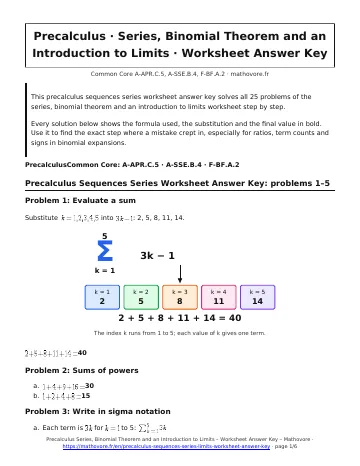
See every chapter on the Precalculus math page.