


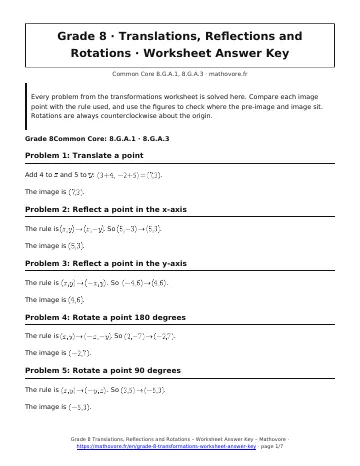
Every problem from the transformations worksheet is solved here. Compare each image point with the rule used, and use the figures to check where the pre-image and image sit. Rotations are always counterclockwise about the origin.
Problem 1: Translate a point
Add 4 to \(x\) and 5 to \(y\): \((3+4,\,-2+5)=(7,3)\).
The image is \((7,3)\).
Problem 2: Reflect a point in the x-axis
The rule is \((x,y)\to(x,-y)\). So \((5,-3)\to(5,3)\).
The image is \((5,3)\).
Problem 3: Reflect a point in the y-axis
The rule is \((x,y)\to(-x,y)\). So \((-4,6)\to(4,6)\).
The image is \((4,6)\).
Problem 4: Rotate a point 180 degrees
The rule is \((x,y)\to(-x,-y)\). So \((2,-7)\to(-2,7)\).
The image is \((-2,7)\).
Problem 5: Rotate a point 90 degrees
The rule is \((x,y)\to(-y,x)\). So \((3,5)\to(-5,3)\).
The image is \((-5,3)\).
Problem 6: Rotate a point 270 degrees
The rule is \((x,y)\to(y,-x)\). So \((4,-1)\to(-1,-4)\).
The image is \((-1,-4)\).
Problem 7: Translate a triangle
Add 3 to each \(x\) and subtract 4 from each \(y\).
\(J^{\prime}(-1,-2)\), \(K^{\prime}(2,-2)\), \(L^{\prime}(-1,1)\).
The image is triangle \(J^{\prime}K^{\prime}L^{\prime}\) as listed.
Problem 8: Reflect a triangle
Change the sign of each \(x\)-coordinate: \((x,y)\to(-x,y)\).
\(P^{\prime}(-1,1)\), \(Q^{\prime}(-4,2)\), \(R^{\prime}(-2,5)\).
Problem 9: Reflect a trapezoid
Change the sign of each \(y\)-coordinate: \((x,y)\to(x,-y)\).
\(A^{\prime}(-5,-2)\), \(B^{\prime}(-1,-2)\), \(C^{\prime}(-2,-5)\), \(D^{\prime}(-4,-5)\).
The top side of length 3 and the bottom side of length 4 keep their lengths, so the image is congruent.
Problem 10: Rotate a triangle 90 degrees
Use \((x,y)\to(-y,x)\) on each vertex.
\(D^{\prime}(-1,2)\), \(E^{\prime}(-1,5)\), \(F^{\prime}(-4,2)\).
Problem 11: Rotate a parallelogram
Use \((x,y)\to(-x,-y)\).
\(W^{\prime}(-1,-1)\), \(X^{\prime}(-5,-1)\), \(Y^{\prime}(-6,-3)\), \(Z^{\prime}(-2,-3)\).
Opposite sides of the image are still parallel.
Problem 12: Rotate a triangle 270 degrees
Use \((x,y)\to(y,-x)\).
\(G^{\prime}(1,3)\), \(H^{\prime}(4,3)\), \(I^{\prime}(1,1)\).
Problem 13: Describe a translation
For \(A\): \(x\) changes from \(-2\) to \(3\), which is \(+5\). \(y\) changes from \(1\) to \(-3\), which is \(-4\).
Check \(B\): \((0+5,\,4-4)=(5,0)\).
The translation is 5 units right and 4 units down, \((x,y)\to(x+5,y-4)\).
Problem 14: Identify the reflection
\(A(2,1)\) goes to \(A^{\prime}(2,-1)\): the \(x\)-coordinate stays and the \(y\)-coordinate changes sign. \(C(2,3)\) goes to \((2,-3)\), which agrees.
It is a reflection across the \(x\)-axis, \((x,y)\to(x,-y)\).
Problem 15: Identify the rotation
Test \(A(1,2)\) with the three rules. \(90^{\circ}\) gives \((-2,1)\). \(180^{\circ}\) gives \((-1,-2)\). \(270^{\circ}\) gives \((2,-1)\), which matches \(A^{\prime}\).
Check \(B(4,2)\): \((y,-x)=(2,-4)\).
The rotation is \(270^{\circ}\) counterclockwise.
Problem 16: Write the rule
In both pairs the \(y\)-coordinate is unchanged and the \(x\)-coordinate changes sign.
It is a reflection across the \(y\)-axis, \((x,y)\to(-x,y)\).
Problem 17: What stays the same
A reflection is a rigid motion, so it keeps segment lengths and angle measures.
\(D^{\prime}E^{\prime}=6\text{ cm}\), \(E^{\prime}F^{\prime}=8\text{ cm}\), and \(\angle E^{\prime}=90^{\circ}\).
Problem 18: Parallel lines
Images: \(p^{\prime}\) joins \((-1,-1)\) and \((-3,-5)\); \(q^{\prime}\) joins \((-3,-1)\) and \((-5,-5)\).
Slope of \(p^{\prime}\): \(\frac{-5-(-1)}{-3-(-1)}=\frac{-4}{-2}=2\). Slope of \(q^{\prime}\): \(\frac{-5-(-1)}{-5-(-3)}=\frac{-4}{-2}=2\).
The slopes are equal, so the images are parallel.
Problem 19: Translate, then reflect
Step 1, \((x-2,\,y-3)\): \(A^{\prime}(-1,-1)\), \(B^{\prime}(1,-1)\), \(C^{\prime}(-1,2)\).
Step 2, \((x,y)\to(-x,y)\): \(A^{\prime}^{\prime}\)=\((1,-1)\), \(B^{\prime}^{\prime}\)=\((-1,-1)\), \(C^{\prime}^{\prime}\)=\((1,2)\).
The final image has vertices \((1,-1)\), \((-1,-1)\), \((1,2)\).
Problem 20: Rotate, then reflect
Step 1, \((-y,x)\): \((-1,1)\), \((-1,4)\), \((-3,4)\).
Step 2, \((x,-y)\): \((-1,-1)\), \((-1,-4)\), \((-3,-4)\).
The final image has vertices \((-1,-1)\), \((-1,-4)\), \((-3,-4)\).
Problem 21: Park map
Reflect across the \(y\)-axis: \((-6,2)\to(6,2)\).
The benches have the same \(y\)-coordinate, so the distance is \(6-(-6)=12\) units.
The second bench is at \((6,2)\), and the benches are 12 yards apart.
Problem 22: Game piece
First card: \((3,2)\to(-2,3)\). Second card: \((-2,3)\to(-3,-2)\).
Directly, \(180^{\circ}\) gives \((-3,-2)\).
The piece is at \((-3,-2)\), the same as one \(180^{\circ}\) rotation.
Problem 23: Wallpaper stamp
The 4th stamp is 3 translations from the first, so it has moved \(3\times 4=12\) units right.
\((1+12,\,1)=(13,1)\).
The vertex is at \((13,1)\).
Problem 24: Find the original point
The rule is \((x,y)\to(y,-x)\). So \(y=-3\) and \(-x=8\), which gives \(x=-8\).
Check: \((-8,-3)\to(-3,8)\).
The original point is \(Q(-8,-3)\).
Problem 25: Two reflections
First: \((3,2)\to(3,-2)\). Second: \((3,-2)\to(-3,-2)\).
A \(180^{\circ}\) rotation sends \((3,2)\) to \((-3,-2)\) too.
The result is \((-3,-2)\), equal to a \(180^{\circ}\) rotation.
Problem 26: Legs and the right angle
Image: \(A^{\prime}(-1,1)\), \(B^{\prime}(-1,5)\), \(C^{\prime}(-4,5)\).
Original legs: \(AB=5-1=4\) and \(BC=4-1=3\).
Image legs: \(A^{\prime}B^{\prime}=5-1=4\) (vertical) and \(B^{\prime}C^{\prime}=-1-(-4)=3\) (horizontal).
A vertical and a horizontal segment meet at \(90^{\circ}\), so the right angle and both lengths are preserved.
See every chapter on the Grade 8 math page.