



This answer key shows every step for the 22 worksheet problems on lines of best fit. Compare your reasoning, not just your final answers, and use the figures to check where gaps and predictions come from.
Problem 1: Judge the fit
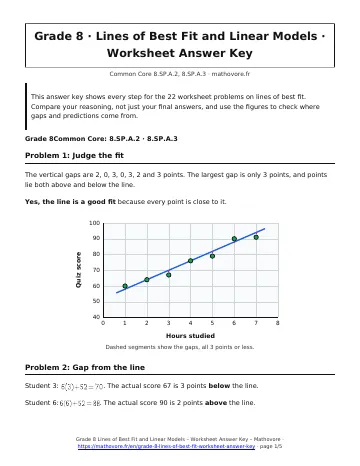
The vertical gaps are 2, 0, 3, 0, 3, 2 and 3 points. The largest gap is only 3 points, and points lie both above and below the line.
Yes, the line is a good fit because every point is close to it.
Problem 2: Gap from the line
Student 3: \(6(3)+52=70\). The actual score 67 is 3 points below the line.
Student 6: \(6(6)+52=88\). The actual score 90 is 2 points above the line.
Problem 3: Slope from two points
\(m=\frac{17-5}{30-10}=\frac{12}{20}\).
The slope is \(0.6\).
Problem 4: Find the y-intercept
Substitute into \(y=mx+b\): \(64=6(2)+b\), so \(64=12+b\).
Subtract 12: \(b=52\).
Problem 5: Write the equation
Slope: \(m=\frac{30-10}{5-1}=\frac{20}{4}=5\).
Use \((1,10)\): \(10=5(1)+b\), so \(b=5\).
Check with \((5,30)\): \(5(5)+5=30\). The equation is \(y=5x+5\).
Problem 6: A poor fit
The gaps are 7, 15, 16, 8, 11, 13 and 3 points, which are large. The points go up and down with no trend.
No, a line is not a good model, and shoe size does not help predict the score.
Problem 7: A curved pattern
The points rise quickly, level off, and then fall, so they form a curve. The line is below the points in the middle (gaps up to 16 feet) and above them at the ends.
A straight line cannot follow a curved pattern, so it is a poor model.
Problem 8: Sign of the slope
The slope is \(-2\), which is negative because the points fall from left to right.
Each extra year of age lowers the predicted value by $2,000.
Problem 9: Meaning of the intercept
When \(x=0\), \(y=26\).
The y-intercept is 26: a brand-new car is predicted to be worth $26,000.
Problem 10: Predict a score
\(y=6(4.5)+52=27+52=79\).
The predicted score is 79.
Problem 11: Equation from the graph
The y-intercept is the height at \(x=0\): \(b=4\).
Slope: \(m=\frac{22-4}{10-0}=\frac{18}{10}=1.8\).
The equation is \(y=1.8x+4\).
Problem 12: Meaning in context
The slope 1.8 means the plant grows about 1.8 cm per day.
The y-intercept 4 means the plant was about 4 cm tall when measuring began (day 0).
Problem 13: Predict plant height
Day 7: \(1.8(7)+4=12.6+4=16.6\) cm.
Day 15: \(1.8(15)+4=27+4=31\) cm.
The day 7 prediction is more reliable because 7 is inside the data (days 0 to 10), while day 15 is outside it.
Problem 14: Compare two lines
Line P predicts 4, 6.5, 9, 11.5, 14, so the gaps are 0, 0.5, 0, 0.5, 0. The total is 1.
Line Q predicts 3, 6, 9, 12, 15, so the gaps are 1, 0, 0, 1, 1. The total is 3.
Line P fits better because its total gap is smaller.
Problem 15: Slope in context
The slope is 2. For each 1\(^{\circ}\text{F}\) increase in temperature, the stand is predicted to sell 2 more cups.
Problem 16: Is the intercept meaningful?
When \(x=0\), \(y=-108\).
A stand cannot sell \(-108\) cups, and \(0^{\circ}\text{F}\) is far from the data (60 to 90). The intercept has no real meaning here.
Problem 17: Bike ride model
The slope 0.25 means Priya rides about 0.25 mile each minute. The y-intercept is 0: after 0 minutes she has gone 0 miles, which makes sense.
\(0.25\times 60=15\), so her speed is 15 miles per hour.
Problem 18: Bike predictions
45 minutes: \(0.25(45)=11.25\) miles.
9 miles: \(0.25x=9\), so \(x=9: 0.25=36\).
She rides 11.25 miles in 45 minutes and needs 36 minutes for 9 miles.
Problem 19: Spot the outlier
The point \((6,12)\) is far from the pattern.
The line predicts \(3(6)+10=28\) at week 6. The gap is \(28-12=16\), so the point is 16 free throws below the line. All other gaps are 2 or less.
Problem 20: Phone battery
(a) Slope \(-12\): the battery drops about 12 percentage points each hour. Intercept 100: the battery starts full.
(b) \(-12x+100=28\) gives \(-12x=-72\), so \(x=6\) hours.
(c) At 12 hours, \(-12(12)+100=-44\). A battery cannot be below 0%, so no. The battery would be empty at \(x=\frac{100}{12}\approx 8.3\) hours.
Problem 21: Saving for a bike
(a) She saves about $15 per week; she started with $40.
(b) \(15(10)+40=190\), so $190.
(c) \(15w+40=250\), so \(15w=210\) and \(w=14\) weeks.
Problem 22: Hot cocoa sales
(a) Slope \(-1.5\): for each 1\(^{\circ}\text{F}\) rise, sales fall by about 1.5 cups.
(b) \(-1.5(45)+140=-67.5+140=72.5\), so about 72 or 73 cups.
(c) \(-1.5x+140=20\) gives \(x=\frac{120}{1.5}=80\), so \(80^{\circ}\text{F}\). This is outside the data (30 to 70), so it is not very reliable.
See every chapter on the Grade 8 math page.