



Each solution names the rule used, shows the exponent arithmetic and ends with the final answer in bold. If an answer differs, rewrite the expression as repeated factors to see which rule applies.
Problem 1: Expand and evaluate
\(2^{5}=2\cdot2\cdot2\cdot2\cdot2\). Multiply: 4, 8, 16, 32. Answer: \(32\).
Problem 2: Write as a power
Four factors of 5 give \(5^{4}\). Evaluate: \(25\cdot25=625\). Answer: \(5^{4}=625\).
Problem 3: Product rule
Same base, so add exponents: \(4+2=6\). Then \(3^{6}=729\). Answer: \(3^{6}=729\).
Problem 4: Product with a large base
Add exponents: \(5+3=8\). Answer: \(7^{8}\) (which equals 5,764,801).
Problem 5: Quotient rule
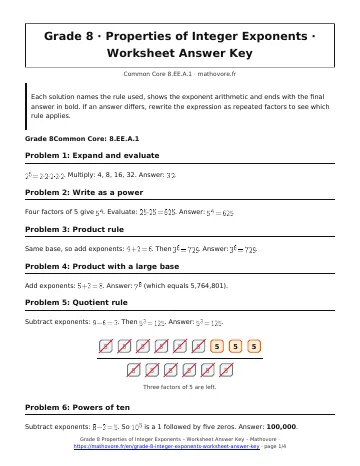
Subtract exponents: \(9-6=3\). Then \(5^{3}=125\). Answer: \(5^{3}=125\).
Problem 6: Powers of ten
Subtract exponents: \(8-3=5\). So \(10^{5}\) is a 1 followed by five zeros. Answer: 100,000.
Problem 7: Power of a power
Multiply exponents: \(3\cdot2=6\). Then \(2^{6}=64\). Answer: \(2^{6}=64\).
Problem 8: Power of a larger base
\(2\cdot3=6\), so the expression is \(4^{6}\). Evaluate: \(4^{3}=64\) and \(64\cdot64=4096\). Answer: \(4^{6}=4096\).
Problem 9: Zero exponent
Any nonzero base to the power 0 is 1. So \(9^{0}=1\) and \((-6)^{0}=1\). For the third, \(4\cdot3^{0}=4\cdot1=4\). Answers: \(1,\ 1,\ 4\).
Problem 10: Negative exponents
Continue dividing by 2: \(2^{0}=1\), then \(\frac{1}{2}\), \(\frac{1}{4}\), \(\frac{1}{8}\). So \(2^{-3}=\)\(\frac{1}{8}\). Also \(5^{-2}=\frac{1}{5^{2}}=\)\(\frac{1}{25}\).
Problem 11: Negative power of ten
\(10^{-4}=\frac{1}{10^{4}}=\frac{1}{10,000}\). As a decimal, that is four places after the point. Answer: \(\frac{1}{10,000}=0.0001\).
Problem 12: Mixed exponents
Add exponents: \(2+(-5)=-3\). Then \(3^{-3}=\frac{1}{3^{3}}\). Answer: \(\frac{1}{27}\).
Problem 13: Negative plus positive
\(-2+5=3\), so the product is \(4^{3}\). Evaluate: \(64\).
Problem 14: Quotient with a negative result
\(3-5=-2\), so the quotient is \(6^{-2}\). Then \(6^{-2}=\frac{1}{36}\). Answer: \(\frac{1}{36}\).
Problem 15: Negative power of a power
Multiply exponents: \(-2\cdot2=-4\). Then \(3^{-4}=\frac{1}{81}\). Answer: \(\frac{1}{81}\).
Problem 16: Power of a product
\((2\cdot5)^{3}=2^{3}\cdot5^{3}=8\cdot125=1000\). Also \((\frac{2}{3})^{3}=\frac{2^{3}}{3^{3}}=\frac{8}{27}\). Answers: \(1000\) and \(\frac{8}{27}\).
Problem 17: Fraction base, negative exponent
A negative exponent flips the fraction: \((\frac{3}{2})^{-2}=(\frac{2}{3})^{2}=\frac{4}{9}\). Answer: \(\frac{4}{9}\).
Problem 18: Find the missing exponent
First: \(?+4=9\), so \(?=5\). Second: \(8-?=3\), so \(?=5\). Third: \(81=3^{4}\), so \(\frac{1}{81}=3^{-4}\). Answers: \(5,\ 5,\ -4\).
Problem 19: Multi-step expression
Inside the parentheses: \(5+(-2)=3\), so \(3^{3}\). Power rule: \((3^{3})^{2}=3^{6}\). Divide: \(6-4=2\), so \(3^{2}\). Answer: \(9\).
Problem 20: Which is greater?
\(2^{-4}=\frac{1}{16}\) and \(3^{-2}=\frac{1}{9}\). Since \(\frac{1}{9}>\frac{1}{16}\), \(3^{-2}\) is greater. Answer: Maya is not right.
Problem 21: Doubling colony
(a) After 10 doublings, \(2^{10}=1024\) cells. (b) At hour 0 no doubling has happened, so the count is 1, and \(2^{0}=1\). Answer: 1,024 cells.
Problem 22: Gigabytes and kilobytes
Divide: \(\frac{10^{9}}{10^{3}}=10^{9-3}=10^{6}\). Answer: 1,000,000 kilobytes.
Problem 23: Find Noah's error
He multiplied the bases, but the rule adds exponents and keeps the base: \(2^{3}\cdot2^{4}=2^{7}=128\). His \(4^{7}\) (16,384) is far too big. Answer: \(2^{7}=128\).
Problem 24: Find Priya's error
A negative exponent means a reciprocal, not a negative number. \(2^{-3}=\frac{1}{2^{3}}=\frac{1}{8}\). Answer: \(\frac{1}{8}\).
See every chapter on the Grade 8 math page.