



Every problem has a full worked solution with the rule used and the final coordinates or length in bold. Check each step, not just the final answer, and redraw any figure you missed on graph paper.
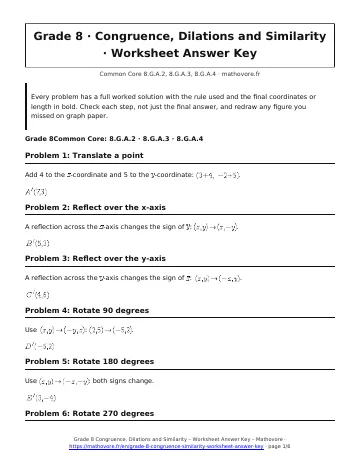
Problem 1: Translate a point
Add 4 to the \(x\)-coordinate and 5 to the \(y\)-coordinate: \((3+4,\ -2+5)\).
\(A^{\prime}(7, 3)\)
Problem 2: Reflect over the x-axis
A reflection across the \(x\)-axis changes the sign of \(y\): \((x,y)\to(x,-y)\).
\(B^{\prime}(5, 3)\)
Problem 3: Reflect over the y-axis
A reflection across the \(y\)-axis changes the sign of \(x\): \((x,y)\to(-x,y)\).
\(C^{\prime}(4, 6)\)
Problem 4: Rotate 90 degrees
Use \((x,y)\to(-y,x)\): \((2,5)\to(-5,2)\).
\(D^{\prime}(-5, 2)\)
Problem 5: Rotate 180 degrees
Use \((x,y)\to(-x,-y)\): both signs change.
\(E^{\prime}(3, -4)\)
Problem 6: Rotate 270 degrees
Use \((x,y)\to(y,-x)\): \((6,-1)\to(-1,-6)\).
\(F^{\prime}(-1, -6)\)
Problem 7: Dilate a point
Multiply both coordinates by 3: \((3\cdot4,\ 3\cdot(-6))\).
\(G^{\prime}(12, -18)\)
Problem 8: Shrink a point
Multiply both coordinates by \(\frac{1}{4}\): \(12: 4=3\) and \(8: 4=2\).
\(H^{\prime}(3, 2)\)
Problem 9: Translate a triangle
Subtract 4 from each \(x\) and add 2 to each \(y\).
\(A(2,1)\to A^{\prime}(-2,3)\), \(B(5,1)\to B^{\prime}(1,3)\), \(C(2,3)\to C^{\prime}(-2,5)\).
\(A^{\prime}(-2,3)\), \(B^{\prime}(1,3)\), \(C^{\prime}(-2,5)\)
Problem 10: Name the motion
Each \(y\)-coordinate is unchanged and each \(x\)-coordinate changes sign: \(D(1,1)\to D^{\prime}(-1,1)\), \(E(5,1)\to E^{\prime}(-5,1)\), \(F(1,3)\to F^{\prime}(-1,3)\).
A reflection across the \(y\)-axis, \((x,y)\to(-x,y)\).
Problem 11: Reflect a triangle
Use \((x,y)\to(x,-y)\).
\(G^{\prime}(1,-2)\), \(H^{\prime}(4,-2)\), \(I^{\prime}(4,-5)\)
Problem 12: Rotate a triangle
Use \((x,y)\to(-y,x)\): \(J(2,1)\to(-1,2)\), \(K(5,1)\to(-1,5)\), \(L(5,3)\to(-3,5)\).
\(J^{\prime}(-1,2)\), \(K^{\prime}(-1,5)\), \(L^{\prime}(-3,5)\)
Problem 13: Dilate a triangle
Multiply each coordinate by \(\frac{1}{2}\): \(M(2,4)\to(1,2)\), \(N(6,4)\to(3,2)\), \(O(2,8)\to(1,4)\).
\(M^{\prime}(1,2)\), \(N^{\prime}(3,2)\), \(O^{\prime}(1,4)\)
Problem 14: Rigid motions keep size
A reflection is a rigid motion, so it keeps lengths and angle measures.
\(A^{\prime}B^{\prime}=6\text{ in}\) and \(\angle B^{\prime}=52^{\circ}\).
Problem 15: Dilation and lengths
Lengths are multiplied by 3: \(4\cdot3=12\), \(7\cdot3=21\), \(9\cdot3=27\). Angle measures do not change in a dilation.
Sides \(12\text{ in}\), \(21\text{ in}\), \(27\text{ in}\); angle \(38^{\circ}\).
Problem 16: Find the scale factor
Divide: \(10: 2=5\) and \(15: 3=5\), so \(k=5\).
\(B(-4,1)\to(5\cdot(-4),\ 5\cdot1)\).
\(k=5\) and \(B^{\prime}(-20,5)\).
Problem 17: A reducing dilation
Divide: \(-2: (-6)=\frac{1}{3}\) and \(3: 9=\frac{1}{3}\), so \(k=\frac{1}{3}\).
\(Q(12,-3)\to(\frac{12}{3},\ \frac{-3}{3})\).
\(k=\frac{1}{3}\) and \(Q^{\prime}(4,-1)\).
Problem 18: Two moves in a row
Reflect across the \(x\)-axis: \((1,-1)\), \((4,-1)\), \((4,-3)\).
Translate 3 units left (subtract 3 from each \(x\)): \((-2,-1)\), \((1,-1)\), \((1,-3)\).
Final vertices \((-2,-1)\), \((1,-1)\), \((1,-3)\). Both moves are rigid motions, so the final triangle is congruent to \(RST\).
Problem 19: Similar rectangles
Widths: \(10: 4=\frac{5}{2}\). Heights: \(15: 6=\frac{5}{2}\). Both ratios match, and all angles are \(90^{\circ}\).
Yes, the rectangles are similar with scale factor \(\frac{5}{2}=2.5\).
Problem 20: Missing side of a triangle
Scale factor: \(12: 8=\frac{3}{2}\) and \(9: 6=\frac{3}{2}\).
The hypotenuse grows by the same factor: \(x=10\cdot\frac{3}{2}=15\).
\(k=\frac{3}{2}\) and \(x=15\text{ in}\).
Problem 21: Enlarging a photo
Scale factor: \(10: 4=\frac{5}{2}\).
Height: \(6\cdot\frac{5}{2}=15\).
Scale factor \(\frac{5}{2}\); the photo is 15 inches tall.
Problem 22: Logo on a screen
Banner: \(4.5: 3=1.5\), so \(k=1.5\) and the height is \(2\cdot1.5=3\) inches.
Sticker: height scale \(1.5: 2=0.75\), so the width is \(3\cdot0.75=2.25\) inches.
Banner: \(k=1.5\), height 3 in. Sticker width: 2.25 in.
Problem 23: Describe a sequence
Lengths: \(AB=3\) and \(DE=6\), \(AC=2\) and \(DF=4\), so \(k=2\). Dilate: \((1,1),(4,1),(1,3)\to(2,2),(8,2),(2,6)\).
Then \((2,2)\to(-3,1)\) needs 5 units left and 1 unit down; check \((8,2)\to(3,1)\) and \((2,6)\to(-3,5)\).
Dilate by \(k=2\), then translate 5 left and 1 down. The triangles are similar, not congruent.
Problem 24: Game character
Dilate by 1.5: \((3,6)\), \((9,6)\), \((3,15)\).
Reflect across the \(y\)-axis: \((-3,6)\), \((-9,6)\), \((-3,15)\).
The horizontal side runs from \(x=-9\) to \(x=-3\): \(6\) units. Check: \(4\cdot1.5=6\).
Vertices \((-3,6)\), \((-9,6)\), \((-3,15)\); horizontal side 6 units.
See every chapter on the Grade 8 math page.