


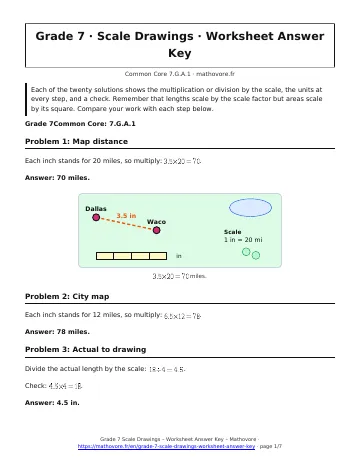
Problem 1: Map distance
Each inch stands for 20 miles, so multiply: \(3.5\times 20=70\).
Answer: 70 miles.
Problem 2: City map
Each inch stands for 12 miles, so multiply: \(6.5\times 12=78\).
Answer: 78 miles.
Problem 3: Actual to drawing
Divide the actual length by the scale: \(18: 4=4.5\).
Check: \(4.5\times 4=18\).
Answer: 4.5 in.
Problem 4: Furniture plan
Divide the actual length by the scale: \(7: 5=1.4\).
Check: \(1.4\times 5=7\).
Answer: 1.4 in.
Problem 5: Find the scale
Divide actual length by drawing length: \(30: 6=5\).
Check: \(6\times 5=30\).
Answer: \(1\text{ in}=5\text{ ft}\).
Problem 6: Model airplane
Divide the actual length by the model length: \(28: 4=7\).
Check: \(4\times 7=28\).
Answer: \(1\text{ in}=7\text{ ft}\).
Problem 7: Scale as a ratio
Convert 3 feet to inches: \(3\times 12=36\text{ in}\).
So \(1\text{ in}\) stands for \(36\text{ in}\).
Answer: \(1:36\).
Problem 8: Yards to a ratio
Convert 10 yards to inches: \(10\times 36=360\text{ in}\).
So \(1\text{ in}\) stands for \(360\text{ in}\).
Answer: \(1:360\).
Problem 9: Half-inch scale
If \(\frac{1}{2}\text{ in}\) stands for \(3\text{ ft}\), then \(1\text{ in}\) stands for \(6\text{ ft}\).
Length: \(5\times 6=30\text{ ft}\). Width: \(3\times 6=18\text{ ft}\).
Answer: \(30\text{ ft}\) by \(18\text{ ft}\).
Problem 10: Blueprint of a room
Length: \(9\times 4=36\text{ ft}\). Width: \(6\times 4=24\text{ ft}\).
Area: \(36\times 24=864\text{ ft}^{2}\).
Check with the drawing area: \(9\times 6=54\text{ in}^{2}\), and \(54\times 4^{2}=864\).
Answer: \(36\text{ ft}\) by \(24\text{ ft}\), area \(864\text{ ft}^{2}\).
Problem 11: Classroom floor
Length: \(7\times 3=21\text{ ft}\). Width: \(5\times 3=15\text{ ft}\).
Area: \(21\times 15=315\text{ ft}^{2}\).
Check with the plan area: \(7\times 5=35\text{ in}^{2}\), and \(35\times 3^{2}=315\).
Answer: \(21\text{ ft}\) by \(15\text{ ft}\), area \(315\text{ ft}^{2}\).
Problem 12: Area from a drawing
Actual length: \(5\times 3=15\text{ ft}\). Actual width: \(2\times 3=6\text{ ft}\).
Actual area: \(15\times 6=90\text{ ft}^{2}\). Drawing area: \(5\times 2=10\text{ in}^{2}\).
\(90: 10=9=3^{2}\).
Answer: \(90\text{ ft}^{2}\); the actual area is 9 times the drawing area.
Problem 13: Scale from area
Drawing area: \(3\times 2=6\text{ in}^{2}\).
The area scales by the square of the scale: \(864: 6=144\), and \(144=12^{2}\), so \(1\text{ in}=12\text{ ft}\).
Actual length: \(3\times 12=36\text{ ft}\). Actual width: \(2\times 12=24\text{ ft}\). Check: \(36\times 24=864\).
Answer: \(1\text{ in}=12\text{ ft}\); \(36\text{ ft}\) by \(24\text{ ft}\).
Problem 14: A new scale
Actual lengths: \(4\times 6=24\text{ ft}\) and \(2.5\times 6=15\text{ ft}\).
New drawing: \(24: 3=8\text{ in}\) and \(15: 3=5\text{ in}\).
Answer: \(8\text{ in}\) by \(5\text{ in}\).
Problem 15: Redraw a triangle
(a) Multiply by 20: \(1.5\times 20=30\text{ ft}\), \(2\times 20=40\text{ ft}\), \(2.5\times 20=50\text{ ft}\).
(b) Divide by 10: \(30: 10=3\text{ in}\), \(40: 10=4\text{ in}\), \(50: 10=5\text{ in}\).
(c) Perimeter: \(3+4+5=12\text{ in}\).
(a) 30 ft, 40 ft, 50 ft; (b) 3 in, 4 in, 5 in; (c) \(12\text{ in}\)
Problem 16: Playground plan
Actual length: \(1.5\times 8=12\text{ ft}\). Actual width: \(1\times 8=8\text{ ft}\).
Perimeter: \(2(12+8)=40\text{ ft}\). Area: \(12\times 8=96\text{ ft}^{2}\).
Answer: perimeter \(40\text{ ft}\), area \(96\text{ ft}^{2}\).
Problem 17: Soccer field
Divide each actual length by 20: \(120: 20=6\text{ in}\) and \(60: 20=3\text{ in}\).
The paper is \(8.5\text{ in}\) by \(11\text{ in}\). Since \(6\le 8.5\) and \(3\le 11\), the drawing fits.
Answer: \(6\text{ in}\) by \(3\text{ in}\); yes, it fits.
Problem 18: New floor
Actual length: \(4\times 5=20\text{ ft}\). Actual width: \(3\times 5=15\text{ ft}\).
Area: \(20\times 15=300\text{ ft}^{2}\).
Cost: \(300\times 2.50=750\).
Answer: \(300\text{ ft}^{2}\), cost \(\$750\).
Problem 19: Road trip
Total map length: \(2.4+3.1=5.5\text{ in}\).
Actual distance: \(5.5\times 15=82.5\text{ mi}\).
Time: \(82.5: 55=1.5\text{ h}\).
Answer: \(82.5\text{ mi}\); \(1.5\) hours.
Problem 20: Park map on paper
At \(1\text{ in}=40\text{ ft}\): \(450: 40=11.25\text{ in}\), which is more than \(9\text{ in}\). It does not fit.
At \(1\text{ in}=50\text{ ft}\): \(450: 50=9\text{ in}\) and \(270: 50=5.4\text{ in}\). Both fit.
At \(1\text{ in}=60\text{ ft}\): \(7.5\text{ in}\) by \(4.5\text{ in}\) fits, but it is smaller.
Answer: \(1\text{ in}=50\text{ ft}\), drawing \(9\text{ in}\) by \(5.4\text{ in}\).
See every chapter on the Grade 7 math page.