Key takeaway: This grade 7 proportional test answer key attaches a verdict, a reason, and a point split to each of the ten questions, for 20 points overall, so grading stays fair. Give one point for the correct decision and one for the explanation or the constant. Accept equivalent forms, such as 5/2 for 2.5, because both name the same rate.
Look for equal ratios or the origin as the reason. A student who cites equal differences has made the most common error.
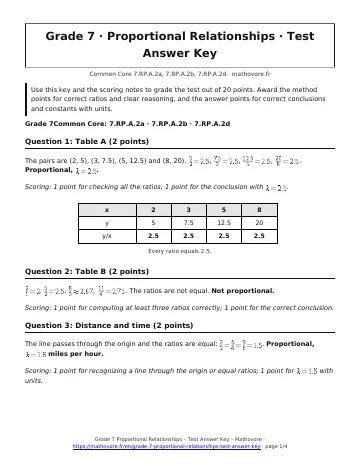
Use this key and the scoring notes to grade the test out of 20 points. Award the method points for correct ratios and clear reasoning, and the answer points for correct conclusions and constants with units.
Grade 7 Proportional Test Answer Key: questions 1–5
1. Table A (2 points)
The pairs are (2, 5), (3, 7.5), (5, 12.5) and (8, 20). \(\frac{5}{2}=2.5\), \(\frac{7.5}{3}=2.5\), \(\frac{12.5}{5}=2.5\), \(\frac{20}{8}=2.5\). Proportional, \(k=2.5\).
Scoring: 1 point for checking all the ratios; 1 point for the conclusion with \(k=2.5\).
2. Table B (2 points)
\(\frac{2}{1}=2\), \(\frac{5}{2}=2.5\), \(\frac{8}{3}\approx 2.67\), \(\frac{11}{4}=2.75\). The ratios are not equal. Not proportional.
Scoring: 1 point for computing at least three ratios correctly; 1 point for the correct conclusion.
3. Distance and time (2 points)
The line passes through the origin and the ratios are equal: \(\frac{3}{2}=\frac{6}{4}=\frac{9}{6}=1.5\). Proportional, \(k=1.5\) miles per hour.
Scoring: 1 point for recognizing a line through the origin or equal ratios; 1 point for \(k=1.5\) with units.
4. Graph B (2 points)
The line is straight, but it crosses the \(y\)-axis at \((0,1)\), not at \((0,0)\). Also \(\frac{3}{1}=3\) and \(\frac{5}{2}=2.5\) are different. It is not proportional.
Scoring: 1 point for the conclusion; 1 point for a correct reason (misses the origin or unequal ratios).
5. Printer (2 points)
(a) \(k=\frac{45}{9}=5\). 5 pages per minute
(b) The point \((1,5)\) means that the printer prints 5 pages in 1 minute.
Scoring: 1 point for each part.
Grade 7 Proportional Test Answer Key: questions 6–10
6. Gym membership (2 points)
\(\frac{30}{1}=30\), \(\frac{40}{2}=20\), \(\frac{50}{3}\approx 16.67\). The ratios are different, and 0 months would cost $20 rather than $0. Not proportional.
Scoring: 1 point for correct ratios or noting the starting fee; 1 point for the conclusion.
7. Flour and loaves (2 points)
Loaves per cup: \(\frac{3}{2}=1.5\), so \(k=1.5\). Cups per loaf: \(\frac{2}{3}\), so \(k=\frac{2}{3}\).
\(1.5\) loaves per cup; \(\frac{2}{3}\) cup per loaf.
Scoring: 1 point for each constant.
8. Missing values (2 points)
\(k=\frac{14}{4}=3.5\). Check: \(\frac{21}{6}=3.5\). Missing \(x\): \(28: 3.5=8\). Missing \(y\): \(3.5\times 10=35\).
\(x=8\) and \(y=35\)
Scoring: 1 point for each missing value.
9. Reading a point (2 points)
(a) \(k=\frac{10}{4}=2.5\). $2.50 per ounce
(b) \(2.5\times 6=15\). $15
Scoring: 1 point for each part.
10. Who is faster? (2 points)
Ethan: \(\frac{6}{2}=3\) mph. Noah: \(\frac{12}{5}=2.4\) mph. \(3-2.4=0.6\).
Ethan is faster, by 0.6 mile per hour.
Scoring: 1 point for both speeds; 1 point for the correct comparison and difference.
Scoring summary
20 points: add the points of every question of this grade 7 proportional test answer key.
Where do the table points go in the grade 7 proportional test answer key?
Table A is proportional with k = 2.5, since 5 over 2 and 7.5 over 3 are both 2.5. Table B is not proportional, because 2 over 1 is 2 while 5 over 2 is 2.5. Award the second point only when the ratios appear. The missing-values question gives 8 and 35, using k = 3.5.
What are the answers to the contextual questions?
The printer prints 5 pages per minute. The gym totals $30, $40, and $50 give ratios 30, 20, and about 17, so the plan is not proportional. For the trail mix graph, k is 2.5 dollars per ounce, and the point (4, 10) means 4 ounces cost $10. Noah and Ethan are compared by unit rate, and Ethan’s rate is 3 miles per hour.
What partial credit fits the graph questions?
For a graph, accept either the phrase line through the origin or a ratio check from a labeled point. A straight line that skips zero earns the first point but not the second. Therefore the reason matters as much as the verdict.
Use the scores for reteaching
Check where points were lost: ratios, origin, or units. Then ask pairs to explain a missed question aloud to each other. Finally, give the quiz a few days later to see whether the reasons now include ratios.

See every chapter on the Grade 7 math page.