Key takeaway: This geometry parallelograms worksheet answer key names the theorem and shows each calculation for every problem. Compare your reasoning, not just the numbers, and use the check step at the end of each solution to catch sign and arithmetic slips.
Every solution below names the theorem it uses and shows each calculation. Compare your reasoning, not just your final numbers, and use the check step at the end of each solution to catch sign and arithmetic slips. Proof reasons are listed in full, so you can rewrite them in your own words.
Geometry Parallelograms Worksheet Answer Key: problems 1–5
1. Opposite sides
Opposite sides of a parallelogram are congruent. So \(CD=AB=12\text{ in}\) and \(DA=BC=7\text{ in}\).
CD = 12 in, DA = 7 in
2. Opposite and consecutive angles
Opposite angles are congruent, so \(m\angle C=m\angle A=68^{\circ}\). Consecutive angles are supplementary, so \(m\angle B=180^{\circ}-68^{\circ}=112^{\circ}\). Then \(m\angle D=m\angle B=112^{\circ}\). Check: \(68+112+68+112=360\).
\(m\angle B=112^{\circ}\), \(m\angle C=68^{\circ}\), \(m\angle D=112^{\circ}\)
3. Diagonals bisect each other
The diagonals bisect each other, so \(E\) is the midpoint of each. \(AE=\frac{18}{2}=9\) and \(BE=\frac{26}{2}=13\).
\(AE=9\), \(BE=13\)
4. Sides with a variable
Opposite sides are congruent: \(3x+5=5x-9\). Subtract \(3x\): \(5=2x-9\). Add 9: \(14=2x\), so \(x=7\). Then \(AB=3(7)+5=26\). Check: \(CD=5(7)-9=26\).
\(x=7\), \(AB=26\text{ in}\)
5. Opposite angles with a variable
Opposite angles are congruent: \(4x+8=6x-12\). Then \(20=2x\) and \(x=10\). So \(m\angle A=4(10)+8=48^{\circ}\) and \(m\angle C=6(10)-12=48^{\circ}\). Consecutive angles are supplementary: \(m\angle B=180^{\circ}-48^{\circ}=132^{\circ}\).
\(x=10\), \(m\angle B=132^{\circ}\)
Geometry Parallelograms Worksheet Answer Key: problems 6–10
6. Consecutive angles with a variable
\(\angle B\) and \(\angle C\) share side \(\overline{BC}\), so they are consecutive and supplementary: \((3x+10)+(2x+20)=180\). Then \(5x+30=180\), \(5x=150\) and \(x=30\). So \(m\angle B=3(30)+10=100^{\circ}\) and \(m\angle C=2(30)+20=80^{\circ}\). Check: \(100+80=180\).
\(x=30\), \(m\angle B=100^{\circ}\), \(m\angle C=80^{\circ}\)
7. Pieces of the diagonals
Each diagonal is bisected, so \(AE=EC\): \(2x+3=4x-7\), \(10=2x\), \(x=5\). Then \(AE=13\) and \(AC=2(13)=26\). Also \(BE=ED\): \(3y+1=y+13\), \(2y=12\), \(y=6\). Then \(BE=19\) and \(BD=2(19)=38\).
\(AC=26\), \(BD=38\)
8. Parallelogram or not?
- Yes. Both pairs of opposite sides are congruent.
- No. Two pairs of congruent adjacent sides describe a kite, which is not a parallelogram in general.
- Yes. A quadrilateral whose diagonals bisect each other is a parallelogram.
- No. Exactly one pair of parallel sides describes a trapezoid.
- Yes. One pair of sides that is both parallel and congruent is enough.
a) yes, b) no, c) yes, d) no, e) yes
9. Perimeter with two variables
Opposite sides are congruent. From \(AB=CD\): \(2x+3=3x-2\), so \(x=5\) and \(AB=13\). From \(BC=DA\): \(4y-1=2y+7\), \(2y=8\), so \(y=4\) and \(BC=15\). Perimeter \(=2(13+15)=56\).
56 in
10. Diagonals of a rectangle
The diagonals of a rectangle are congruent: \(5x-4=3x+14\). Then \(2x=18\) and \(x=9\). So \(AC=5(9)-4=41\). Check: \(BD=3(9)+14=41\).
\(x=9\), \(AC=41\)
Geometry Parallelograms Worksheet Answer Key: problems 11–15
11. Length of a rectangle diagonal
A diagonal and two sides form a right triangle, so \(d^{2}=8^{2}+15^{2}=64+225=289\). Then \(d=\sqrt{289}=17\). The other diagonal is congruent, so it is also 17 cm.
17 cm
12. Rhombus perimeter and diagonals
The four sides are congruent, so \(AB=\frac{52}{4}=13\). The diagonals bisect each other, so \(AE=12\), and they are perpendicular, so triangle \(AEB\) is a right triangle. Then \(BE^{2}=13^{2}-12^{2}=169-144=25\) and \(BE=5\). So \(BD=2(5)=10\).
\(BD=10\text{ cm}\)
13. Diagonal bisects an angle of a rhombus
The two halves are equal: \(3x+4=5x-12\), so \(16=2x\) and \(x=8\). Each half is \(3(8)+4=28^{\circ}\), so \(m\angle DAB=2(28)=56^{\circ}\). Consecutive angles are supplementary: \(m\angle ABC=180^{\circ}-56^{\circ}=124^{\circ}\).
\(m\angle DAB=56^{\circ}\), \(m\angle ABC=124^{\circ}\)
14. Diagonals of a square
A square is a rectangle, so its diagonals are congruent: \(QS=18\). They bisect each other, so \(SE=\frac{18}{2}=9\text{ cm}\). A square is also a rhombus, so the diagonals are perpendicular: \(m\angle PEQ=90^{\circ}\). Diagonal \(\overline{PR}\) bisects the right angle at \(P\), so \(m\angle RPQ=45^{\circ}\).
\(SE=9\text{ cm}\), \(m\angle PEQ=90^{\circ}\), \(m\angle RPQ=45^{\circ}\)
15. Base angles of an isosceles trapezoid
Base angles are congruent, so \(m\angle B=72^{\circ}\). Angles on the same leg between the parallel bases are supplementary, so \(m\angle D=180^{\circ}-72^{\circ}=108^{\circ}\). The other base angle matches: \(m\angle C=108^{\circ}\). Check: \(72+72+108+108=360\).
\(m\angle B=72^{\circ}\), \(m\angle C=108^{\circ}\), \(m\angle D=108^{\circ}\)
Geometry Parallelograms Worksheet Answer Key: problems 16–20
16. Diagonals of an isosceles trapezoid
The diagonals of an isosceles trapezoid are congruent: \(4x-3=2x+13\). Then \(2x=16\) and \(x=8\). So \(AC=4(8)-3=29\). Check: \(BD=2(8)+13=29\).
\(x=8\), \(AC=29\)
17. Angles of a kite
The four angles of a quadrilateral add to \(360^{\circ}\). So \(m\angle Y=360^{\circ}-70^{\circ}-118^{\circ}-118^{\circ}=54^{\circ}\).
\(m\angle Y=54^{\circ}\)
18. Name every quadrilateral
- Square, rectangle, rhombus, parallelogram, quadrilateral.
- Rhombus, parallelogram, quadrilateral. Bisecting diagonals make it a parallelogram, perpendicular diagonals make it a rhombus, and unequal diagonals rule out a square.
- Trapezoid and quadrilateral (an isosceles trapezoid). It is not a parallelogram because it has only one pair of parallel sides.
a) square (also rectangle, rhombus, parallelogram), b) rhombus, c) isosceles trapezoid
19. Quilt patch
Opposite sides are congruent, so \(CD=9\) and \(DA=6\). Perimeter \(=2(9+6)=30\text{ in}\). Opposite angles: \(m\angle C=65^{\circ}\). Consecutive angles: \(m\angle B=m\angle D=180^{\circ}-65^{\circ}=115^{\circ}\).
30 in of ribbon; \(m\angle B=115^{\circ}\), \(m\angle C=65^{\circ}\), \(m\angle D=115^{\circ}\)
20. Is the frame a rectangle?
- Both pairs of opposite sides are congruent (24 in and 24 in, 18 in and 18 in), so the frame is a parallelogram.
- A parallelogram with congruent diagonals is a rectangle, so all four corners are right angles.
- \(18^{2}+24^{2}=324+576=900\) and \(30^{2}=900\), so a right angle between the 18-inch and 24-inch sides is consistent with a 30-inch diagonal.
Parallelogram with congruent diagonals, so a rectangle
Geometry Parallelograms Worksheet Answer Key: problems 21–24
21. Flying kite frame
The horizontal spar is bisected, so each half is 12 in. The lower part of the vertical spar is \(25-9=16\) in. Top sides: \(\sqrt{9^{2}+12^{2}}=\sqrt{225}=15\) in. Bottom sides: \(\sqrt{16^{2}+12^{2}}=\sqrt{400}=20\) in. The kite has two pairs of congruent adjacent sides, so the tape needed is \(2(15+20)=70\) in.
70 in
22. Trapezoid garden bed
Perimeter: \(20+12+5+5=42\text{ ft}\). Drop perpendicular segments from the ends of the short base. Each leg overhangs by \(\frac{20-12}{2}=4\) ft, so \(h^{2}+4^{2}=5^{2}\), \(h^{2}=9\) and \(h=3\) ft.
Perimeter 42 ft; distance between bases 3 ft
23. Rhombus floor tile
\(AB=AD=8\) because the sides of a rhombus are congruent, so triangle \(ABD\) is isosceles with vertex angle \(60^{\circ}\). Its base angles are \(\frac{180-60}{2}=60^{\circ}\) each. All three angles are \(60^{\circ}\), so the triangle is equilateral and \(BD=8\text{ in}\).
\(BD=8\text{ in}\); each angle of triangle ABD measures \(60^{\circ}\)
24. Proof: diagonals bisect each other
| Statements | Reasons |
|---|---|
| 1. \(ABCD\) is a parallelogram | 1. Given |
| 2. \(\overline{AB}\) is parallel to \(\overline{DC}\) | 2. Definition of a parallelogram |
| 3. \(m\angle BAE=m\angle DCE\) and \(m\angle ABE=m\angle CDE\) | 3. Alternate interior angles theorem (transversals \(\overline{AC}\) and \(\overline{BD}\)) |
| 4. \(AB=CD\) | 4. Opposite sides of a parallelogram are congruent |
| 5. Triangle \(ABE\) is congruent to triangle \(CDE\) | 5. ASA (steps 3 and 4) |
| 6. \(AE=CE\) and \(BE=DE\) | 6. Corresponding parts of congruent triangles are congruent (CPCTC) |
Reasons: Given; definition; alternate interior angles; opposite sides congruent; ASA; CPCTC
How do you read the parallelograms answer key?
Begin with sides and angles. The first item gives \(CD=12\) and \(DA=7\). Next, the angle item gives \(112^{\circ}\), \(68^{\circ}\) and \(112^{\circ}\). The diagonal item gives \(AE=9\) and \(BE=13\), since each diagonal is cut in half. If you doubled instead of halving, you gave the whole diagonal.
Which algebra answers need care?
For item 4, \(x=7\) and \(AB=26\). For item 6, \(x=30\) and the angle is \(100^{\circ}\). Item 10 gives \(x=9\) and \(AC=41\). Item 16 gives \(x=8\) and each diagonal of the trapezoid is 29.
What should you check in the proof?
The proof of bisecting diagonals uses alternate interior angles and one pair of equal opposite sides to show two triangles are congruent by ASA. Then CPCTC gives \(AE=EC\) and \(BE=ED\).
What if your answer is off?
Look at whether you used the property of the right figure. A rhombus fact does not apply to a plain parallelogram. Then redo the equation with the correct pair of sides or angles.

Printable PDF · Worksheet Answer Key
Geometry Parallelograms and Special Quadrilaterals worksheet answer key
Download the PDF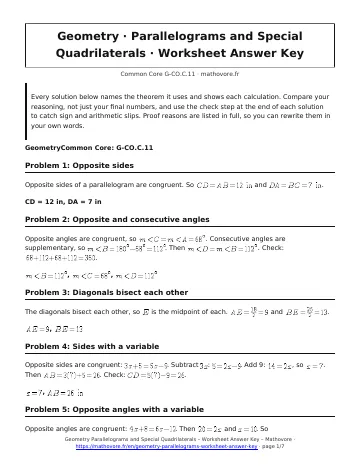
See every chapter on the Geometry math page.