Key takeaway: This geometry dilations similarity worksheet answer key shows the scale factor, the coordinate rule or the angle sum behind each of the 23 answers. Test your own work by dividing one image length by its original. The quotient should equal k.
Every solution below shows the scale factor, the coordinate rule or the angle sum that gives the answer, and the final result is bold. Check your own work by testing one image length against the scale factor.
Geometry Dilations Similarity Worksheet Answer Key: problems 1–5
1. Scale factor from distances
The scale factor is the ratio of the distances from the center: \(k=\frac{OP^{\prime}}{OP}=\frac{15}{6}=\frac{5}{2}\).
Since \(k>1\), the dilation is an enlargement with k = 5/2 (2.5).
2. Find the image length
Every length is multiplied by \(k\): \(A^{\prime}B^{\prime}=\frac{3}{4}\cdot 12=9\).
The image is 9 inches long.
3. Find the original length
Image length \(=k\cdot\) original length, so original \(=\frac{20}{2.5}=8\).
The original segment was 8 centimeters long. Check: \(2.5\cdot 8=20\).
4. Enlargement or reduction
Compare each factor with 1.
- \(\frac{7}{4}=1.75>1\): enlargement
- \(0.6< 1\): reduction
- \(1\): no change (same size)
- \(1.2>1\): enlargement
- \(\frac{5}{9}< 1\): reduction
5. Dilate points about the origin
Use \((x,y)\to(kx,ky)\).
- \((3\cdot 3,\ 3\cdot(-2))\) gives \(P^{\prime}(9,-6)\)
- \((\frac{1}{2}\cdot(-4),\ \frac{1}{2}\cdot 6)\) gives \(Q^{\prime}(-2,3)\)
- \((4\cdot 5,\ 4\cdot 0)\) gives \(R^{\prime}(20,0)\)
- \((\frac{3}{7}\cdot 0,\ \frac{3}{7}\cdot(-7))\) gives \(S^{\prime}(0,-3)\)
Geometry Dilations Similarity Worksheet Answer Key: problems 6–10
6. Scale factor from coordinates
Divide an image coordinate by the matching original coordinate, then confirm with the other coordinate.
- \(\frac{5}{2}=2.5\) and \(\frac{10}{4}=2.5\): \(k=\frac{5}{2}\)
- \(\frac{2}{6}=\frac{1}{3}\) and \(\frac{-3}{-9}=\frac{1}{3}\): \(k=\frac{1}{3}\)
7. Dilate a triangle
The vertices are \(P(1,2),\ Q(3,1),\ R(3,3)\). Multiply each coordinate by 2.
\(P^{\prime}(2,4),\ Q^{\prime}(6,2),\ R^{\prime}(6,6)\)
Check one side: \(PQ=\sqrt{5}\) and \(P^{\prime}Q^{\prime}=\sqrt{20}=2\sqrt{5}\), which is twice as long. Image: P'(2, 4), Q'(6, 2), R'(6, 6).
8. Shrink a rectangle
The vertices are \(A(4,4),\ B(8,4),\ C(8,6),\ D(4,6)\). Multiply each coordinate by \(\frac{1}{2}\).
\(A^{\prime}(2,2),\ B^{\prime}(4,2),\ C^{\prime}(4,3),\ D^{\prime}(2,3)\)
The original rectangle is 4 by 2, so the image is \(\frac{1}{2}\cdot 4=2\) by \(\frac{1}{2}\cdot 2=1\). The new rectangle is 2 units by 1 unit.
9. Center not at the origin
From C to P: 2 right and 1 up. Multiply by 3: 6 right and 3 up from C, so \(P^{\prime}=(1+6,\ 1+3)=(7,4)\).
From C to Q: 1 right and 2 up. Multiply by 3: 3 right and 6 up, so \(Q^{\prime}=(1+3,\ 1+6)=(4,7)\).
\(PQ=\sqrt{1^{2}+1^{2}}=\sqrt{2}\) and \(P^{\prime}Q^{\prime}=\sqrt{3^{2}+3^{2}}=3\sqrt{2}\). P'(7, 4), Q'(4, 7); the image segment is 3 times as long.
10. Dilate a line
Pick two points on the line: \((0,-2)\) and \((1,1)\). Their images are \((0,-4)\) and \((2,2)\).
Slope: \(\frac{2-(-4)}{2-0}=3\), and the \(y\)-intercept is \(-4\).
\(y=3x-4\) The image line is parallel to the original and has \(2\cdot(-2)=-4\) as its intercept.
Geometry Dilations Similarity Worksheet Answer Key: problems 11–15
11. Which lines stay put
A line through the origin maps to itself. Any other line maps to a parallel line whose intercept is multiplied by 3.
- It passes through the origin: same line, \(y=-3x\)
- Intercept \(6\cdot 3=18\): \(y=-3x+18\)
- It passes through the origin: same line, \(y=\frac{1}{2}x\)
- Intercept \(-1\cdot 3=-3\): \(y=\frac{1}{2}x-3\)
12. Perimeter after a dilation
Multiply each side by 2.5: \(7\cdot 2.5=17.5\), \(9\cdot 2.5=22.5\), \(12\cdot 2.5=30\).
Image perimeter: \(17.5+22.5+30=70\) in. The original perimeter is \(7+9+12=28\) in., and \(2.5\cdot 28=70\).
Sides 17.5 in., 22.5 in., 30 in.; perimeter 70 in., which is 2.5 times the original.
13. Angles after a dilation
- \(m\angle C=180^{\circ}-48^{\circ}-67^{\circ}=65^{\circ}\)
- A dilation preserves angle measure, so \(48^{\circ},\ 67^{\circ},\ 65^{\circ}\) for \(A^{\prime},\ B^{\prime},\ C^{\prime}\) respectively.
14. Dilation then translation
Step 1, dilate: \(A^{\prime}(2,2),\ B^{\prime}(6,2),\ C^{\prime}(2,4)\).
Step 2, translate \((x,y)\to(x+3,\ y-1)\): \(A^{\prime}^{\prime}(5,1),\ B^{\prime}^{\prime}(9,1),\ C^{\prime}^{\prime}(5,3)\).
Check: \(AB=2\) and \(A^{\prime}^{\prime}B^{\prime}^{\prime}=4\). Final vertices: (5, 1), (9, 1), (5, 3). The triangles are similar with ratio 2.
15. Two dilations in a row
First dilation: \((2\cdot 4,\ 2\cdot 6)=(8,12)\).
Second dilation: \((\frac{3}{4}\cdot 8,\ \frac{3}{4}\cdot 12)=(6,9)\).
The factors multiply: \(2\cdot\frac{3}{4}=\frac{3}{2}\), and \(\frac{3}{2}\cdot(4,6)=(6,9)\). Final image (6, 9); single scale factor 3/2.
Geometry Dilations Similarity Worksheet Answer Key: problems 16–20
16. Third angles and similarity
\(m\angle R=180^{\circ}-52^{\circ}-71^{\circ}=57^{\circ}\) and \(m\angle Z=180^{\circ}-71^{\circ}-57^{\circ}=52^{\circ}\).
Matching angles: \(P=52^{\circ}=Z\), \(Q=71^{\circ}=X\), \(R=57^{\circ}=Y\). Two pairs already match, so AA applies.
The triangles are similar: PQR ~ ZXY (P matches Z, Q matches X, R matches Y).
17. Similar or not
- Third angles: \(180^{\circ}-35^{\circ}-80^{\circ}=65^{\circ}\) and \(180^{\circ}-80^{\circ}-65^{\circ}=35^{\circ}\). Both triangles have \(35^{\circ},\ 65^{\circ},\ 80^{\circ}\). Similar (AA).
- Triangle 3 has a third angle of \(90^{\circ}\), with angles \(30^{\circ},\ 60^{\circ},\ 90^{\circ}\). Triangle 4 has angles \(45^{\circ},\ 45^{\circ},\ 90^{\circ}\). Only the right angle matches. Not similar.
- Triangle 5 has base angles \(\frac{180^{\circ}-40^{\circ}}{2}=70^{\circ}\). Triangle 6 has base angles \(70^{\circ}\) and a vertex angle \(180^{\circ}-2\cdot 70^{\circ}=40^{\circ}\). Similar (AA).
18. Slope and length after dilation
\(P^{\prime}(4,2)\) and \(Q^{\prime}(10,6)\).
Slopes: \(\frac{3-1}{5-2}=\frac{2}{3}\) and \(\frac{6-2}{10-4}=\frac{4}{6}=\frac{2}{3}\). They are equal, so the segments are parallel.
Lengths: \(PQ=\sqrt{3^{2}+2^{2}}=\sqrt{13}\) and \(P^{\prime}Q^{\prime}=\sqrt{6^{2}+4^{2}}=\sqrt{52}=2\sqrt{13}\). Same slope \(\frac{2}{3}\); the image is twice as long.
19. Photo enlargement
Dimensions: \(4\cdot 2.5=10\) in. and \(6\cdot 2.5=15\) in.
Perimeters: \(2(4+6)=20\) in. and \(2(10+15)=50\) in., and \(2.5\cdot 20=50\).
The enlargement is 10 in. by 15 in.; its perimeter, 50 in., is 2.5 times the original 20 in.
20. Projector screen
Convert to one unit: 6 ft \(=72\) in. Scale factor \(k=\frac{72}{8}=9\).
Height: \(6\cdot 9=54\) in. \(=\frac{54}{12}=4.5\) ft.
Scale factor 9; the projected image is 4.5 feet tall.
Geometry Dilations Similarity Worksheet Answer Key: problems 21–23
21. Copier reduction
Scale factor \(60\%=0.6\). Dimensions: \(11\cdot 0.6=6.6\) in. and \(8.5\cdot 0.6=5.1\) in.
To undo a dilation of 0.6 use the reciprocal: \(\frac{1}{0.6}=\frac{5}{3}\) ≈ \(1.667\), about 167%.
The copy is 6.6 in. by 5.1 in.; a setting of about 167% restores the original size.
22. Dilation about a vertex
Multiply each side by 1.5: \(AB^{\prime}=1.5\cdot 8=12\), \(AC^{\prime}=1.5\cdot 6=9\), \(B^{\prime}C^{\prime}=1.5\cdot 7=10.5\).
Perimeters: \(8+6+7=21\) and \(12+9+10.5=31.5\), and \(1.5\cdot 21=31.5\).
AB’ = 12, AC’ = 9, B’C’ = 10.5; perimeters 21 and 31.5.
23. Find the center
If the center is C, then \(P^{\prime}=C+2(P-C)=2P-C\), so \(C=2P-P^{\prime}\).
\(C=(2\cdot 3-5,\ 2\cdot 2-4)=(1,0)\).
For Q: \((1+2(4-1),\ 0+2(5-0))=(7,10)\).
Center (1, 0); \(Q^{\prime}=(7,10)\).
How do you read the dilation answer key?
Scan the lengths first. Problem 2 gives 9 inches, and problem 3 gives 8 centimeters, because \(20: 2.5=8\). Problem 9 gives \(P'(7,4)\), not \((9,6)\). If you got the second, you forgot to subtract the center before scaling.
Which answers need extra attention?
Problem 13 gives \(m\angle C=65^{\circ}\), since \(180-48-67=65\) and dilations keep angles. Next, number 22 has sides 12, 9 and 10.5. Finally, 23 finds the center \((1,0)\), by solving \(P’=C+2(P-C)\), which gives \(C=2P-P’\).
What should you notice in applied answers?
The copier answer is 6.6 by 5.1 inches. Area shrinks to 36%, not 60%. The projector answer converts feet to inches first, so units match before you divide.
What if your ratio is off?
Check whether you scaled from the center or from the origin. Then confirm that you divided image by original, not the reverse. Redo the first changed coordinate and compare.

Printable PDF · Worksheet Answer Key
Geometry Dilations and Similarity Transformations worksheet answer key
Download the PDF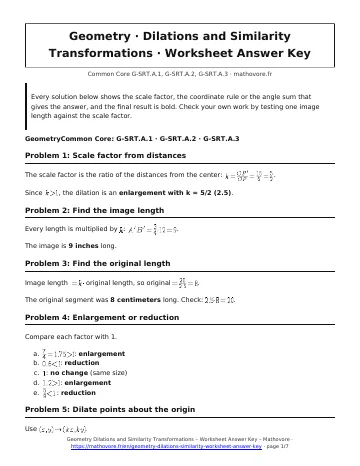
See every chapter on the Geometry math page.