

Key takeaway: This AP calculus integration worksheet answer key lists every step for all 26 problems, with each result in bold. Antiderivative solutions end with a derivative check, and definite integrals show the subtraction. The key supports AB Unit 6. Solve a problem first. Then compare the substitution you chose, because a different but valid \(u\) can still produce the same result.
Full worked solutions for all 26 integration problems. Each answer shows the antiderivative or substitution, the evaluation of the limits where they apply, and the final result in bold. Compare each step with your own work, not only the final result.
AP Calculus Integration Worksheet Answer Key: problems 1–5
1. Power rule antiderivative
Apply the power rule term by term: \(\int 6x^{2}\,dx=2x^{3}\), \(\int -4x\,dx=-2x^{2}\), \(\int 5\,dx=5x\).
Answer: \(2x^{3}-2x^{2}+5x+C\). Check: the derivative is \(6x^{2}-4x+5\).
2. Fractional and negative powers
Rewrite as \(\int (3x^{1/2}-2x^{-2})\,dx\). Then \(\int 3x^{1/2}\,dx=3\cdot\frac{x^{3/2}}{3/2}=2x^{3/2}\) and \(\int -2x^{-2}\,dx=-2\cdot\frac{x^{-1}}{-1}=\frac{2}{x}\).
Answer: \(2x^{3/2}+\frac{2}{x}+C\).
3. Trigonometric and exponential
\(\int 4\cos x\,dx=4\sin x\), \(\int -3e^{x}\,dx=-3e^{x}\), and \(\int \frac{1}{x}\,dx=\ln|x|\).
Answer: \(4\sin x-3e^{x}+\ln|x|+C\).
4. Initial value problem
Integrate: \(f(x)=2x^{3}-x^{2}+C\). Use \(f(1)=4\): \(2-1+C=4\), so \(C=3\).
Answer: \(f(x)=2x^{3}-x^{2}+3\).
5. Four Riemann sums
\(\Delta x=1\). Left endpoints \(0,1,2,3\): \(L=0+1+4+9=14\). Right endpoints \(1,2,3,4\): \(R=1+4+9+16=30\). Midpoints \(0.5,1.5,2.5,3.5\): \(M=0.25+2.25+6.25+12.25=21\). Trapezoidal: \(T=\frac{14+30}{2}=22\).
Answer: \(L=14\), \(R=30\), \(M=21\), \(T=22\). The exact value is \(\frac{64}{3}\approx 21.33\).
AP Calculus Integration Worksheet Answer Key: problems 6–10
6. Sums from a table
The subinterval widths are \(2,3,4,1\).
- Left: \(3(2)+5(3)+8(4)+6(1)=6+15+32+6=59\) ft.
- Right: \(5(2)+8(3)+6(4)+4(1)=10+24+24+4=62\) ft.
- Trapezoidal: \(\frac{3+5}{2}(2)+\frac{5+8}{2}(3)+\frac{8+6}{2}(4)+\frac{6+4}{2}(1)=8+19.5+28+5=60.5\) ft.
Answer: 59 ft, 62 ft and 60.5 ft.
7. Overestimate or underestimate
Since \(f\) is decreasing, the left endpoints give the tallest rectangles and the right endpoints the shortest. Since \(f\) is concave up, chords lie above the curve and tangent lines lie below it.
- Left sum: overestimate.
- Right sum: underestimate.
- Midpoint sum: underestimate (concave up).
- Trapezoidal sum: overestimate (chords above the curve).
Left sum with \(\Delta x=1\): \(1+\frac{1}{2}+\frac{1}{3}+\frac{1}{4}=\frac{25}{12}\approx 2.083\), which exceeds the exact value \(\ln 5\approx 1.609\), as expected.
8. Properties of definite integrals
- \(\int_{3}^{5} f=\int_{1}^{5} f-\int_{1}^{3} f=7-2=5\).
- \(2(7)-3(-3)=14+9=23\).
- Reversing the limits: \(-7\).
- \(\int_{1}^{5} f\,dx+\int_{1}^{5}4\,dx=7+4(4)=23\).
Answer: 5, 23, \(-7\), 23.
9. Integrals from geometry
- The area of a semicircle with \(r=3\): \(\frac{1}{2}\pi(3)^{2}=\frac{9\pi}{2}\).
- A quarter circle: \(\frac{9\pi}{4}\).
- Add the rectangle of height 2 and width 6: \(\frac{9\pi}{2}+12\).
Answer: \(\frac{9\pi}{2}\), \(\frac{9\pi}{4}\), \(\frac{9\pi}{2}+12\).
10. Evaluate with the Fundamental Theorem
An antiderivative is \(x^{4}-3x^{2}\). Then \([x^{4}-3x^{2}]_{1}^{3}=(81-27)-(1-3)=54+2=56\).
Answer: 56.
AP Calculus Integration Worksheet Answer Key: problems 11–15
11. Trigonometric definite integral
An antiderivative is \(-3\cos x+2\sin x\). At \(\frac{\pi}{2}\): \(0+2=2\). At \(0\): \(-3+0=-3\). The difference is \(2-(-3)=5\).
Answer: 5.
12. Logarithmic and exponential limits
- \([3\ln x]_{1}^{e^{2}}=3(2)-3(0)=6\).
- \([4e^{x}]_{0}^{\ln 3}=4(3)-4(1)=8\).
Answer: 6 and 8.
13. Derivatives of accumulation functions
- By FTC Part 1: \(\sqrt{x^{3}+1}\).
- Substitute the upper limit and multiply by its derivative: \(\sin(x^{2})\cdot 2x\).
- Swap the limits to introduce a negative sign: \(-\ln(x^{2}+1)\).
Answer: \(\sqrt{x^{3}+1}\); \(2x\sin(x^{2})\); \(-\ln(x^{2}+1)\).
14. Accumulation from a graph
Use triangle areas (signed).
- \(g(2)=\frac{1}{2}(2)(4)=4\); \(g(4)=\frac{1}{2}(4)(4)=8\); \(g(6)=8-\frac{1}{2}(2)(3)=5\); \(g(8)=5-\frac{1}{2}(2)(3)=2\).
- \(g^{\prime}(6)=f(6)=-3\).
- \(g^{\prime}=f\) changes from positive to negative at \(x=4\), and \(g(0)=0\), \(g(8)=2\) are smaller, so the maximum is \(g(4)=8\).
- \(g^{\prime\prime}=f^{\prime}\), and \(f\) is decreasing on \((2,6)\), so \(g\) is concave down on \((2,6)\).
Answer: 4, 8, 5, 2; \(-3\); maximum 8 at \(x=4\); concave down on \((2,6)\).
15. Substitution with a power
Let \(u=3x^{2}+1\), so \(du=6x\,dx\). Then \(\int u^{4}\,du=\frac{u^{5}}{5}+C\).
Answer: \(\frac{(3x^{2}+1)^{5}}{5}+C\).
AP Calculus Integration Worksheet Answer Key: problems 16–20
16. Substitution with cosine
Let \(u=x^{3}\), so \(du=3x^{2}\,dx\) and \(x^{2}\,dx=\frac{1}{3}du\). Then \(\frac{1}{3}\int\cos u\,du=\frac{1}{3}\sin u+C\).
Answer: \(\frac{1}{3}\sin(x^{3})+C\).
17. Substitution giving a logarithm
Let \(u=x^{2}+4\), so \(du=2x\,dx\) and \(x\,dx=\frac{1}{2}du\). Then \(\frac{1}{2}\int\frac{1}{u}\,du=\frac{1}{2}\ln|u|+C\), and \(x^{2}+4 > 0\).
Answer: \(\frac{1}{2}\ln(x^{2}+4)+C\).
18. Definite substitution
Let \(u=x^{3}+1\), so \(du=3x^{2}\,dx\). When \(x=0\), \(u=1\); when \(x=2\), \(u=9\).
\(\int_{1}^{9}u^{1/2}\,du=[\frac{2}{3}u^{3/2}]_{1}^{9}=\frac{2}{3}(27-1)=\frac{52}{3}\).
Answer: \(\frac{52}{3}\).
19. Substitution with changed limits
Let \(u=\cos x\), so \(du=-\sin x\,dx\). When \(x=0\), \(u=1\); when \(x=\frac{\pi}{2}\), \(u=0\).
\(\int_{1}^{0}-u^{2}\,du=\int_{0}^{1}u^{2}\,du=[\frac{u^{3}}{3}]_{0}^{1}=\frac{1}{3}\).
Answer: \(\frac{1}{3}\).
20. Long division first
Divide: \(x^{2}+3x+5=(x+1)(x+2)+3\), so \(\frac{x^{2}+3x+5}{x+1}=x+2+\frac{3}{x+1}\).
Integrate: \(\frac{x^{2}}{2}+2x+3\ln|x+1|+C\).
Answer: \(\frac{x^{2}}{2}+2x+3\ln|x+1|+C\).
AP Calculus Integration Worksheet Answer Key: problems 21–25
21. Completing the square
Complete the square: \(x^{2}-6x+25=(x-3)^{2}+16\). Let \(w=\frac{x-3}{4}\), so \(dx=4\,dw\) and \((x-3)^{2}+16=16(w^{2}+1)\).
\(\int\frac{4\,dw}{16(w^{2}+1)}=\frac{1}{4}\tan^{-1}w+C\).
Answer: \(\frac{1}{4}\tan^{-1}(\frac{x-3}{4})+C\).
22. Water in a tank
Amount at \(t=8\) = initial amount + net change: \(40+\int_{0}^{8}(20-2t)\,dt=40+[20t-t^{2}]_{0}^{8}=40+(160-64)=136\).
Answer: 136 gallons.
23. Customers entering a store
The total is \(\int_{0}^{12}100\sin(\frac{\pi t}{12})dt\). Let \(u=\frac{\pi t}{12}\), so \(dt=\frac{12}{\pi}du\), and the limits become \(0\) to \(\pi\).
\(\frac{1200}{\pi}\int_{0}^{\pi}\sin u\,du=\frac{1200}{\pi}[-\cos u]_{0}^{\pi}=\frac{1200}{\pi}(1+1)=\frac{2400}{\pi}\approx 763.9\).
Answer: about 764 customers.
24. Leaking water
\(\int_{0}^{4}6e^{-0.5t}\,dt=[-12e^{-0.5t}]_{0}^{4}=-12e^{-2}+12=12-12e^{-2}\).
Since \(e^{-2}\approx 0.1353\), the amount is about \(12-1.624=10.38\).
Answer: \(12-12e^{-2}\approx 10.38\) gallons.
25. Saving for a bike
Net change: \(\int_{0}^{10}(40+6t)\,dt=[40t+3t^{2}]_{0}^{10}=400+300=700\).
Total: \(200+700=900\). Answer: $900.
AP Calculus Integration Worksheet Answer Key: problems 26–26
26. Analyzing an accumulation function
- By FTC Part 1: \(F^{\prime}(x)=x^{2}-2x\).
- \(F(x)=[\frac{t^{3}}{3}-t^{2}]_{0}^{x}=\frac{x^{3}}{3}-x^{2}\), so \(F(3)=9-9=0\).
- \(F^{\prime}(x)=x(x-2)=0\) gives \(x=0\) and \(x=2\). \(F^{\prime\prime}(x)=2x-2\): \(F^{\prime\prime}(0)=-2 < 0\), a local maximum with \(F(0)=0\); \(F^{\prime\prime}(2)=2 > 0\), a local minimum with \(F(2)=\frac{8}{3}-4=-\frac{4}{3}\).
Answer: \(x^{2}-2x\); \(F(3)=0\); local maximum at \(x=0\), local minimum at \(x=2\).
Which first answers can you verify quickly?
Problem 1 gives \(2x^3-2x^2+5x+C\), and problem 4 gives \(2x^3-x^2+3\). In problem 5, the left, right, midpoint and trapezoid sums are 14, 30, 21 and 22. Compare them with the exact area \(\frac{64}{3}\approx21.33\), and notice the midpoint is closest.
What do the definite integral answers show?
Problem 10 gives 56, problem 11 gives 5, and problem 12 gives 6 and 8. Each uses \(F(b)-F(a)\) with the antiderivative written out. For problem 12, \(3\ln(e^2)=6\), because \(\ln(e^2)=2\).
How do the substitution answers read?
The answers are \(\frac{(3x^2+1)^5}{5}+C\), \(\frac{\sin(x^3)}{3}+C\) and \(\frac{1}{2}\ln(x^2+4)+C\) for problems 15 to 17. Problem 18 gives \(\frac{52}{3}\), and problem 19 gives \(\frac{1}{3}\). Problem 20 divides first to get \(\frac{x^2}{2}+2x+3\ln|x+1|+C\).
What are the context answers?
Ethan in problem 25 has 900 dollars after 10 weeks. The accumulation function in problem 26 has \(F'(x)=x^2-2x\) and \(F(x)=\frac{x^3}{3}-x^2\).
How can you repair a wrong antiderivative?
Differentiate your answer. If you do not recover the original integrand, find the missing factor, often an inner derivative. Then redo the problem with that factor included and test again. After that, create a similar integral with a new exponent to confirm the habit.

Printable PDF · Worksheet Answer Key
AP Calculus AB Integration and Accumulation of Change worksheet answer key
Download the PDF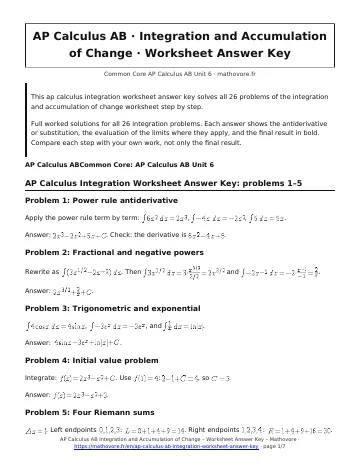
See every chapter on the AP Calculus AB math page.