Key takeaway: This AP calculus contextual test answer key offers justified solutions and scoring notes for each of the 20 marks. Points go to the model or equation, the calculus step, the numerical value and the units or interpretation. Equivalent forms earn full credit. The key follows AB Unit 4 and flags the units that are missing most often.
Worked solutions and a scoring guide for the Unit 4 test. Points are awarded for each correct step, so partial credit applies. The total is 20 points.
AP Calculus Contextual Test Answer Key: questions 1–5
1. Particle motion (3 points)
- \(v(t)=3t^{2}-18t+24\), \(a(t)=6t-18\)
- \(v=3(t-2)(t-4)=0\): t = 2 and t = 4.
- \(v(5)=75-90+24=9>0\) and \(a(5)=12>0\). Same sign: speed is increasing.
Scoring: (a) 1 point for both functions. (b) 1 point for both times . (c) 1 point for evaluating both signs and the correct conclusion.
2. Interpreting a derivative (2 points)
- At 10 minutes the soup is cooling at about 1.8 °F per minute.
- \(H(12)\approx 140+(-1.8)(2)=136.4\). About 136.4 °F.
Scoring: (a) 1 point for °F per minute and the meaning of the sign. (b) 1 point for the linearization value.
3. Local linearization (3 points)
- \(f^{\prime}(x)=\frac{1}{3}x^{-2/3}\), \(f^{\prime}(27)=\frac{1}{27}\): \(L(x)=3+\frac{1}{27}(x-27)\).
- \(L(28)=3+\frac{1}{27}\approx 3.037\). \(\sqrt[3]{28}\approx 3.037\)
- \(f^{\prime\prime}(x)=-\frac{2}{9}x^{-5/3}< 0\) so \(f\) is concave down and the tangent line lies above the graph: overestimate.
Scoring: 1 point per part. In (c) the reason must refer to concavity or the sign of the second derivative.
4. Melting ice cube (2 points)
\(\frac{dV}{dt}=3s^{2}\frac{ds}{dt}=3(25)(-0.2)=-15\).
\(-15\text{ in}^{3}/\text{min}\)
Scoring: 1 point for differentiating with the chain rule factor. 1 point for the value with the negative sign and units.
5. Plane and radar station (3 points)
- \(s^{2}=x^{2}+9\)
- \(2s\frac{ds}{dt}=2x\frac{dx}{dt}\). At \(x=4\), \(s=\sqrt{25}=5\). \(\frac{ds}{dt}=\frac{4}{5}(400)=320\). 320 mph
Scoring: (a) 1 point. (b) 1 point for the differentiated equation, 1 point for s = 5 and the final value.
AP Calculus Contextual Test Answer Key: questions 6–8
6. Limits with L’Hôpital (3 points)
- Form \(\frac{0}{0}\): \(\frac{4\sin(4x)}{2x}\), still \(\frac{0}{0}\); then \(\frac{16\cos(4x)}{2}\to 8\). 8
- Form \(\frac{\infty}{\infty}\): \(\frac{1/x}{1/(2\sqrt{x})}=\frac{2}{\sqrt{x}}\to 0\). 0
Scoring: (a) 1 point for naming the form and applying the rule once, 1 point for the value. (b) 1 point.
7. Marginal revenue (2 points)
- \(R^{\prime}(x)=50-0.2x\), so \(R^{\prime}(100)=30\).
- Selling the 101st scarf adds about $30 in revenue.
Scoring: 1 point for each part; the interpretation must include dollars per scarf.
8. Speeding up and slowing down (2 points)
\(v=(t-2)(t-4)\) and \(a(t)=2t-6\). Signs: \((0,2)\): \(v>0,a<0\); \((2,3)\): \(v<0,a<0\); \((3,4)\): \(v<0,a>0\); \((4,\infty)\): \(v>0,a>0\).
Speed increases on (2, 3) and (4, ∞).
Scoring: 1 point for the sign analysis of v and a, 1 point for both intervals.
Scoring summary
20 points: add the points of every question of this ap calculus contextual test answer key.
Which answers open the key?
Question 1 gives a total distance of 44 feet, with rest at \(t=2\) and \(t=4\). Question 6 gives limits of 8 and 0. In question 7, \(R'(100)=30\) dollars per scarf, which means the next scarf adds about 30 dollars.
How do you grade the interpretation question?
A full answer states that at 10 minutes the soup is 140 degrees and changing at the stated rate in degrees per minute. Omitting the time or the units loses a point. For example, writing only that the temperature is falling is incomplete.
What does an AP calculus contextual test key accept for linearization?
Accept \(y=3+\frac{1}{27}(x-27)\) for the cube root at 27, or an equivalent form. Then check the estimate, and award a point for the correct over or under statement. Since this cube-root graph bends downward, the line runs over the curve and the estimate is high.
Which related rates responses earn partial credit?
A correct linking equation earns the first point, and the differentiated equation earns the second. Substituting the instant values earns the last. However, plugging in numbers before differentiating loses the second point, because constants would be treated as variables.
How can the rubric support a quick retest?
Find the rubric line with the most losses and design a three-item retest on it. For instance, use unit-writing for interpretation errors. After that, compare the retest average with the original test result.

Printable PDF · Test Answer Key
AP Calculus AB Derivatives in Context: Motion and Related Rates test answer key
Download the PDF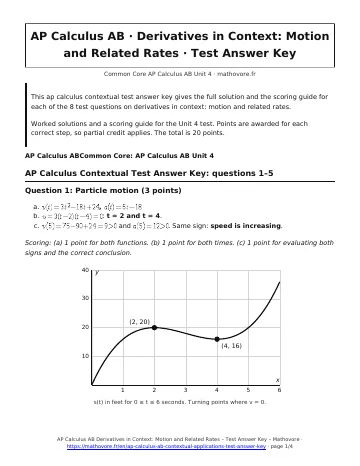
See every chapter on the AP Calculus AB math page.