Key takeaway: This algebra 1 building worksheet answer key solves all 23 function problems and shows each rule in full. Every solution names the input, the output and the check, so you can see why the formula works.
Write your own rule before you look.
Every solution shows the setup, the arithmetic and a check, with the final answer in bold. Compare your steps with these, especially the order of operations when you write a function and the minus sign when you subtract a cost function.
Algebra 1 Building Worksheet Answer Key: problems 1–5
1. Steps to a function
Multiplying by 4 gives \(4x\) and subtracting 7 gives \(f(x)=4x-7\).
\(f(5)=4(5)-7=20-7=13\). \(f(x)=4x-7\), \(f(5)=13\)
2. Recursive growth
Start: \(h(0)=6\). Each week adds 2: \(h(n)=h(n-1)+2\).
\(h(3)=10+2=12\) and \(h(4)=12+2=14\). \(h(4)=14\) inches
3. Recursive to explicit
The value starts at 5 and 3 is added \(n\) times , so \(f(n)=3n+5\).
\(f(10)=3(10)+5=35\). \(f(n)=3n+5\), \(f(10)=35\)
4. Order of the steps
Add 6 first, so the sum must be in parentheses: \(g(x)=3(x+6)\).
\(g(4)=3(4+6)=3(10)=30\). \(g(x)=3(x+6)\), \(g(4)=30\)
5. Taxi fare function
Cost is the flat fee plus the rate times the miles: \(c(m)=2.25m+3\).
\(c(8)=2.25(8)+3=18+3=21\). \(c(m)=2.25m+3\); the ride costs $21.00
Algebra 1 Building Worksheet Answer Key: problems 6–10
6. Sum of two functions
\((f+g)(x)=(3x+2)+(x-5)=4x-3\).
\((f+g)(2)=4(2)-3=5\). Check: \(f(2)=8\) and \(g(2)=-3\), and \(8+(-3)=5\). \(4x-3\); \(5\)
7. Difference of two functions
\((f-g)(x)=(5x-1)-(2x+8)=5x-1-2x-8=3x-9\).
\((f-g)(6)=3(6)-9=9\). Check: \(f(6)=29\), \(g(6)=20\), and \(29-20=9\). \(3x-9\); \(9\)
8. Product of two functions
\((f\cdot g)(x)=(x+3)(2x)=2x^{2}+6x\).
\((f\cdot g)(4)=2(16)+6(4)=32+24=56\). Check: \(f(4)\cdot g(4)=7\cdot 8=56\). \(2x^{2}+6x\); \(56\)
9. Profit function
\(P(x)=R(x)-C(x)=6x-(2x+40)=4x-40\).
\(P(25)=4(25)-40=60\). Check: \(R(25)=150\), \(C(25)=90\), \(150-90=60\). \(P(x)=4x-40\); profit \(\$60\)
10. Break-even from a graph
Break even when revenue equals cost: \(7x=3.5x+84\), so \(3.5x=84\) and \(x=24\).
\(R(24)=168\) and \(C(24)=3.5(24)+84=84+84=168\). 24 hats, revenue \(\$168\)
Algebra 1 Building Worksheet Answer Key: problems 11–15
11. Solve f(x) = c
\(3x-4=20\), so \(3x=24\) and \(x=8\). Check: \(f(8)=24-4=20\). \(x=8\)
12. Inverse of a linear function
\(y=5x+10\), so \(y-10=5x\) and \(x=\frac{y-10}{5}=\frac{y}{5}-2\).
Check: \(f(3)=25\) and \(\frac{25-10}{5}=3\). \(x=\frac{y-10}{5}\)
13. Inverse with a fraction
\(y=\frac{x}{4}+6\), so \(y-6=\frac{x}{4}\) and \(x=4(y-6)=4y-24\). The inverse undoes “add 6” first, then “divide by 4”.
For \(y=9\): \(x=4(9-6)=12\). Check: \(f(12)=3+6=9\). \(x=4y-24\); input \(12\)
14. Check an inverse
\(f(5)=8\) and \(g(8)=\frac{15}{3}=5\). Also \(g(5)=\frac{12}{3}=4\) and \(f(4)=12-7=5\).
Each function returns the original input, so \(g\) is the inverse of \(f\).
15. Is the rate constant?
\(x\) rises by 2 each step and \(y\) rises by 6 each step (\(11-5=6\), \(17-11=6\), \(23-17=6\)), so the rate is constant: \(\frac{6}{2}=3\) per 1 unit.
The start value at \(x=0\) is 5, so \(f(x)=3x+5\). Check: \(f(6)=23\). constant rate 3; \(f(x)=3x+5\)
Algebra 1 Building Worksheet Answer Key: problems 16–20
16. Compare two tables
Table A: \(12-7=5\), \(17-12=5\), \(22-17=5\), always +5 for each 1 step in \(x\).
Table B: \(6-3=3\), \(12-6=6\), \(24-12=12\), the changes keep doubling. Only Table A has a constant rate (5 per unit)
17. Temperature conversion
(a) \(1.8c+32=68\), so \(1.8c=36\) and \(c=20\).
(b) \(c=\frac{F-32}{1.8}\). Check with 95°F: \(\frac{95-32}{1.8}=\frac{63}{1.8}=35\) and \(1.8(35)+32=95\). 20°C; \(c=\frac{F-32}{1.8}\)
18. Play ticket profit
\(R(x)=8x\), \(C(x)=1.25x+150\), \(P(x)=8x-(1.25x+150)=6.75x-150\).
A profit needs \(6.75x>150\), so \(x\) is greater than 22.2. Test the whole numbers 22 and 23: \(P(22)=148.5-150=-1.5\) (a loss) and \(P(23)=155.25-150=5.25\). 23 tickets
19. Taxi fare inverse
\(c-3=2.25m\), so \(m=\frac{c-3}{2.25}\).
\(m=\frac{25.5-3}{2.25}=\frac{22.5}{2.25}=10\). Check: \(2.25(10)+3=25.5\). 10 miles
20. Savings recursion
Recursive: \(S(0)=45\), \(S(n)=S(n-1)+12\). Explicit: \(S(n)=12n+45\).
\(12n+45=165\), so \(12n=120\) and \(n=10\). Check: \(12(10)+45=165\). 10 weeks
Algebra 1 Building Worksheet Answer Key: problems 21–23
21. Hot dog stand profit
\(P(x)=3.5x-(1.1x+48)=2.4x-48\).
Break even: \(2.4x=48\), so \(x=20\). Profit for 50: \(P(50)=2.4(50)-48=120-48=72\). 20 hot dogs; profit \(\$72\)
22. Gas tank inverse
\(0.04m=14-g\), so \(m=\frac{14-g}{0.04}=350-25g\).
For \(g=6\): \(m=350-150=200\). For \(g=0\): \(m=350\). Check: \(14-0.04(200)=6\). 200 miles; 350 miles
23. Two classes combined
(a) \(T(x)=(4x-20)+(6x-35)=10x-55\).
(b) \(10x-55=145\), so \(10x=200\) and \(x=20\). Check: \(L(20)=60\), \(C(20)=85\), \(60+85=145\).
(c) \(x=\frac{T+55}{10}\). \(10x-55\); 20 hours; \(x=\frac{T+55}{10}\)
How do you verify a function rule?
First, test the rule on a point from the story. Next, test a second point. For example, the rule multiply by 4 and subtract 7 gives \(f(x)=4x-7\), so \(f(5)=13\). Likewise, the recursive sequence starting at 5 and adding 3 gives \(f(n)=3n+5\), so \(f(10)=35\).
What are the combined function answers?
The sum \((f+g)(x)=4x-3\) equals 5 at x equal to 2. The difference of \(5x-1\) and \(2x+8\) is \(3x-9\), which equals 9 at 6. The product \((x+3)(2x)\) is \(2x^{2}+6x\), which equals 56 at 4. The scarf profit is \(4x-40\), and the hat graph breaks even at 24 hats.
- Solving \(3x-4=20\) gives \(x=8\).
- The inverse of \(5x+10\) is \(x=\frac{y-10}{5}\).
- The inverse of \(\frac{x}{4}+6\) is \(x=4(y-6)\).
What do the checks and applications show?
In problem 14, \(g(f(5))=5\) and \(f(g(5))=5\), so the functions undo each other. Noah’s savings follow \(S(n)=45+12n\). Therefore a recursive start of 45 plus 12 each week gives the same totals as the explicit rule.
How do you turn wrong function rules into right ones?
Label each miss as an order error, a sign error or a setup error. Then retry two items of the most common kind and verify with a second input. In addition, speak the story aloud before you write the rule.

Printable PDF · Worksheet Answer Key
Algebra 1 Building Functions and Inverses worksheet answer key
Download the PDF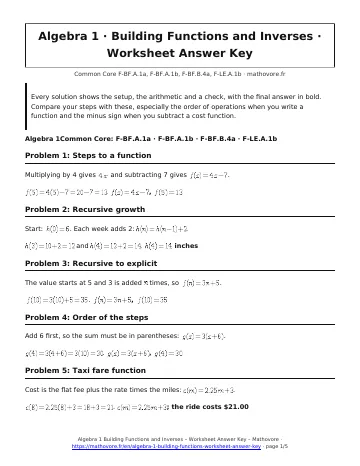
See every chapter on the Algebra 1 math page.