Key takeaway: Here is an algebra 1 linear equations worksheet with 22 printable problems. You will solve multi-step equations with fractions, decimals and variables on both sides, justify steps, recognize special cases and rearrange formulas.
The set follows the A-REI and A-CED standards, and the last six problems are stories about taxis, gyms, gardens and savings. Give each step a separate line, because neat work makes errors easy to find. Answers are posted on another page.
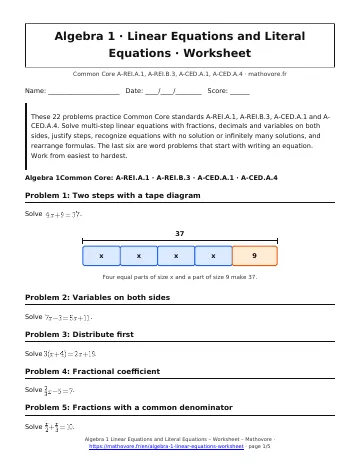
These 22 problems practice Common Core standards A-REI.A.1, A-REI.B.3, A-CED.A.1 and A-CED.A.4. Solve multi-step linear equations with fractions, decimals and variables on both sides, justify steps, recognize equations with no solution or infinitely many solutions, and rearrange formulas. The last six are word problems that start with writing an equation. Work from easiest to hardest.
Algebra 1 Linear Equations Worksheet: problems 1–5
1. Two steps with a tape diagram
Solve \(4x+9=37\).
2. Variables on both sides
Solve \(7x-3=5x+11\).
3. Distribute first
Solve \(3(x+4)=2x+19\).
4. Fractional coefficient
Solve \(\frac{2}{3}x-5=7\).
5. Fractions with a common denominator
Solve \(\frac{x}{2}+\frac{x}{3}=10\).
Algebra 1 Linear Equations Worksheet: problems 6–10
6. Fractions on both sides
Solve \(\frac{x+3}{4}=\frac{2x-1}{3}\).
7. Decimals on both sides
Solve \(0.4x+1.2=0.7x-0.3\).
8. Give the reasons
Maya solved \(2(x-3)+5=x+7\) in the five steps shown. Write the reason for each step after the first.
- \(2(x-3)+5=x+7\)
- \(2x-6+5=x+7\)
- \(2x-1=x+7\)
- \(x-1=7\)
- \(x=8\)
9. Find the error
Jamal solved \(3(x-2)=12\) like this: \(3x-2=12\), \(3x=14\), \(x=\frac{14}{3}\). Find his mistake and solve correctly.
10. No solution or not?
Solve \(2(x+3)=2x+5\). Explain the result.
Algebra 1 Linear Equations Worksheet: problems 11–15
11. Infinitely many solutions?
Solve \(4(x-2)+3=4x-5\). Explain the result.
12. Solve by graphing
The graph shows \(y=2x-1\) and \(y=-x+5\). Use it to estimate the solution of \(2x-1=-x+5\), then solve algebraically.
13. Solve for the height
The area of a triangle is \(A=\frac{1}{2}bh\). Solve for \(h\), then find \(h\) when \(A=36\) and \(b=9\).
14. Solve for width
The perimeter of a rectangle is \(P=2l+2w\). Solve for \(w\), then find \(w\) when \(P=50\) and \(l=15\).
15. Standard form to y
Solve \(2x+3y=12\) for \(y\). Then find \(y\) when \(x=3\).
Algebra 1 Linear Equations Worksheet: problems 16–20
16. Temperature formula
Solve \(C=\frac{5}{9}(F-32)\) for \(F\). Then convert \(35^{\circ}\text{C}\) to degrees Fahrenheit.
17. Taxi fare
Priya’s taxi ride costs \(\$3.50\) plus \(\$2.25\) per mile. The total was \(\$17.00\). Write and solve an equation for the number of miles.
18. Gym plans
Gym A charges a \(\$60\) sign-up fee and \(\$25\) per month. Gym B charges no fee and \(\$40\) per month. After how many months do both cost the same, and what is that cost?
19. Garden fence
The length of a rectangular garden is 3 feet more than twice its width. The perimeter is 54 feet. Find the dimensions.
20. Consecutive odd integers
The sum of three consecutive odd integers is 87. Find the integers.
Algebra 1 Linear Equations Worksheet: problems 21–22
21. Trapezoid base
The area of a trapezoid is \(A=\frac{1}{2}(b_1+b_2)h\). Solve for \(b_1\). Then find \(b_1\) when \(A=84\), \(b_2=9\) and \(h=8\).
22. Shopping with fractions
Ethan spent one third of his savings on a game and one fourth on a jacket. He has \(\$35\) left. How much did he save?

What is on this algebra 1 linear equations worksheet?
Problems 1 to 3 solve two-step and distributive equations, such as \(7x-3=5x+11\). Next, problems 4 to 7 add fractions and decimals. Then problems 8 and 9 ask you to give reasons and to find Jamal’s error in \(3(x-2)=12\).
After that, problems 10 to 12 explore no solution, infinitely many solutions and graphs. Finally, problems 13 to 22 rearrange formulas and solve word problems.
Which problems need extra care?
Problem 6 has a fraction on each side, so clear both denominators at once. In problem 9, Jamal multiplied only the first term by 3, a common slip. Meanwhile, problems 10 and 11 look alike, yet one has no solution and the other has infinitely many.
Also, problem 22 asks about one third and one fourth of savings, so use the common denominator 12.
How do the story problems use equations?
Priya’s taxi ride in problem 17 costs $3.50 plus $2.25 per mile, with a total of $17. Meanwhile, a gym with a $60 fee meets a gym with none in problem 18. A garden in problem 19 has a length that equals twice the width plus 3 feet.
Therefore, define the variable first. Then write the equation in words before you use symbols.
What step-by-step routine prevents slips?
Begin by clearing parentheses. Next, clear fractions or decimals. Then combine like terms on each side. After that, move the variable terms to one side. Also, move the constants to the other side. Finally, divide and check by substituting.
How can you check an answer without the key?
First, substitute your value into the original equation, not into a later line. Next, simplify the left side. Then simplify the right side. When the two sides agree, the answer is right. Otherwise, hunt for the slip. Because a correct check takes only seconds, make it a habit. Besides, a check catches sign errors that a second reading would miss.
For a special case, the check works differently. First, notice that the variable cancels. Then look at what remains. If the remaining statement is false, there is no solution. However, if it is true, every number works. Therefore, test a random value, such as 10, to confirm.
Similarly, check a formula by plugging in numbers. For example, solve \(P=2l+2w\) for w, and then test with \(l=15\) and \(P=50\). If you get 10, the rearrangement is sound. Finally, label the units in the story problems, so your sentence says dollars, miles or feet.
How should you read a word problem before writing an equation?
First, underline the unknown. Next, circle the numbers. Then decide which words mean add, subtract or multiply. For instance, the phrase per mile signals multiplication. Also, the word total signals an equals sign. After that, write the equation in one line. Because a diagram often helps, sketch the rectangle for the garden. Meanwhile, list the three consecutive odd integers as n, n + 2 and n + 4. As a result, the equation almost writes itself. Finally, answer in a full sentence with units.
What is a good follow-up?
Check your answers against the key and fix the first wrong line in each miss. Next, write your own no-solution equation and your own identity. Finally, try the quiz to see whether your solving routine holds up under time.

See every chapter on the Algebra 1 math page.